Disagreement Used to Cost You Something
They watched the same moment and saw completely different things. Here's what we lost when that stopped mattering.
Read the full essayThe data behind this essay. Every figure traces to a source the essay cites. Hover any card to share it.
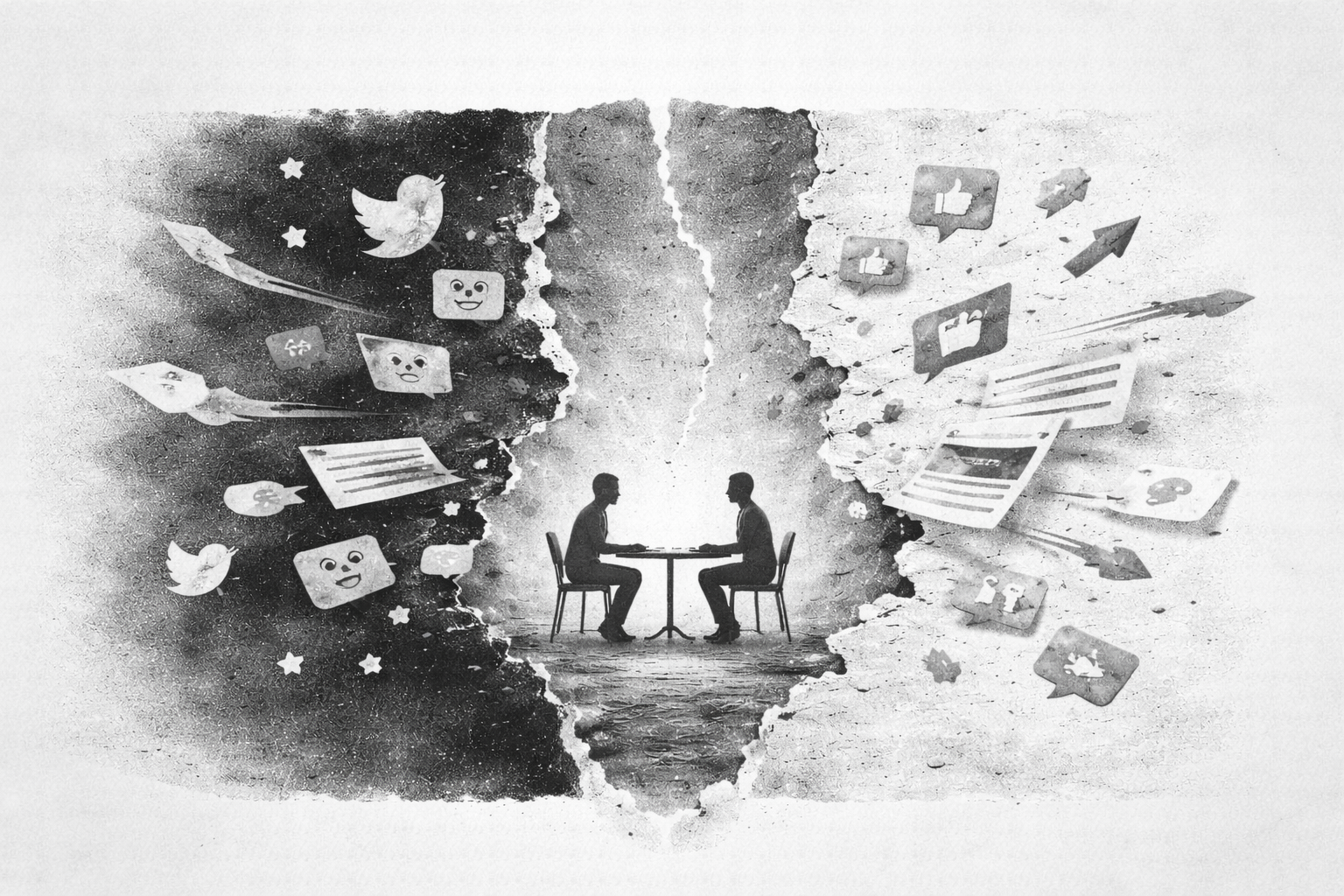
There was a time when disagreement required something of you. You had to look someone in the eye and finish the conversation.
On August 22, 1961, Ida Siekmann climbed into her window on Bernauer Strasse trying to get from East to West Berlin and died from the fall, often cited as the first casualty associated with the Berlin Wall. Days earlier it had been an ordinary street where you waved to a neighbor. Ryan's point is that the wall did not only divide, it eliminated the middle: the shared space where people could interpret the same world, be wrong, revise, apologize, and keep eating dinner together.
The middle did not vanish so much as thin out. Gallup found 43 percent of Americans identified as politically moderate in 1992, the largest ideological cohort at the time, falling to 34 percent by 2024. Pew found that between 1994 and 2014 the share of Americans with consistently liberal or conservative views doubled from 10 percent to 21 percent while those holding mixed views fell from 49 percent to 39 percent (Pew Research Center, 2014).
Ryan reaches for Simons and Chabris's 1999 inattentional blindness study, where viewers counting basketball passes miss a person in a gorilla suit walking through the scene. You do not miss the gorilla because you are unobservant. You miss it because you are focused. Scale that up and millions of people are each counting passes from their own side, scanning for different threats and villains, then walking away convinced the other person is delusional.
What changed is cost. You used to have to disagree in the barber's chair, in the grocery store, on the sideline of a Saturday soccer game, and finish the conversation. Now you can fire off a zinger, tag a few people to stoke it, and walk away, and the algorithm rewards you for it. Ryan closes on his grandmother, a member of the Silent Generation, who said you must be able to dine with prince and pauper. That is the middle: not a spineless middle, but one where your convictions are strong enough that you do not need to destroy someone else's to feel secure in your own.
The Berlin Wall did not just divide, it eliminated the middle, the shared space where disagreement did not end the relationship.
Americans identifying as politically moderate fell from 43 percent in 1992, the largest cohort at the time, to 34 percent in 2024 (Gallup, 2025).
Between 1994 and 2014, the share of Americans with consistently liberal or conservative views doubled from 10 percent to 21 percent, while those with mixed views fell from 49 percent to 39 percent (Pew Research Center, 2014).
You do not miss the gorilla because you are unobservant. You miss it because you are focused (Simons and Chabris, 1999). Two people can watch the same moment and each conclude the other is delusional.
140 people died trying to cross the Berlin Wall. They were not dying for an ideology, they were dying to get back to the people on the other side of a line someone else drew.
Plain-language definitions for the ideas in this episode. Structured for search and AI answers.
The failure to perceive an unexpected object in plain sight because attention is committed elsewhere, documented by Simons and Chabris in 1999. We perceive and remember only the aspects of a scene that receive focused attention.
In this episode: The gorilla experiment Ryan adapts for keynotes, used here as a model for political fracture.
Not moderate politics or the absence of conviction, but the shared space where people holding different views can stay in the room, finish the conversation, and remain in relationship.
In this episode: The gray bar Ryan puts across the bottom of the slide, labeled what actually happened.
The friction that used to attach to conflict, requiring you to face the person, stay present, and finish it. That cost is what kept people tethered, and it is what anonymity and distance were designed to eliminate.
In this episode: The title argument.
Lines worth keeping, verbatim from the episode.
You miss it because you're focused.
The middle is still there. It's waiting for someone to sit down in it first.
There was a time when disagreement required something of you.
Straight answers to the questions this essay raises. Open by default, structured for search and AI.
What does "the middle" mean in this essay? +
In this essay, the middle is not moderate politics. It is the shared space where people can disagree, stay in the room, and finish the conversation without ending the relationship. It is having convictions strong enough that you don't need to destroy someone else's to feel secure in your own.
What does Gallup's data show about political moderates? +
Gallup found that 43% of Americans identified as politically moderate in 1992, making moderates the largest ideological cohort at the time. By 2024, that share had fallen to 34%. The essay uses this to show the center thinning over three decades.
What is the "Invisible Gorilla" experiment and why does it matter here? +
In a 1999 study by Daniel Simons and Christopher Chabris, viewers asked to count basketball passes often failed to notice a person in a gorilla suit walking through the scene. The point is that attention is selective, so we perceive only what we focus on. Ryan applies this to culture: when millions of people count passes from their own side, they miss what the other side sees.
How did algorithms change the cost of disagreement? +
The essay argues that disagreement once required physical presence and accountability, since you had to look someone in the eye and finish the conversation. Algorithms removed that friction by letting people fire off a comment and walk away. Because these systems reward outrage with likes, shares, and reach, they amplify division rather than dialogue.
How do Millennials and Gen Z fit into this fracture? +
The essay describes an information arc where Millennials were the first generation with information available at scale, which created an expectation of instant access and transparency. Gen Z inherited a version of that promise already corrupted by filtered feeds and "fake news," so they became highly skeptical and verification-oriented. What they want underneath it is authenticity, a person willing to sit in the gray.
Full show notes
Disagreement used to cost you something. Today, it costs nothing — and that’s the problem.
The Berlin Wall is remembered for what it built. But what it really destroyed was the middle: the shared space where people could disagree, stay in the room, and finish the conversation. Today, an invisible wall made of algorithms, labels, and distrust has done the same thing. In this episode, generational futurist Ryan Vet explores what happened to the middle ground in American culture, why the “Invisible Gorilla” experiment reveals how we’re all missing what’s right in front of us, and what leaders must do to reclaim the space where real dialogue lives.
From Gallup’s data on the collapse of political moderates to the inattentional blindness research of Simons and Chabris, Ryan connects the dots between generational information arcs, algorithmic fracture, and the leadership mandate to stay in the room.
The middle didn’t vanish overnight. Gallup found moderates fell from 43% of Americans in 1992 to 34% in 2024 — a slow erosion with compounding consequences.The “Invisible Gorilla” problem: when you’re preconditioned to count passes from your own side, you miss the gorilla walking through the room. Millions of people are doing this simultaneously.Disagreement used to require physical presence and accountability. Algorithms eliminated that friction — and we lost something irreplaceable when it went.Millennials got information at scale. Gen Z inherited a version of that promise already corrupted by filtered feeds, “fake news,” and earned institutional distrust.The middle isn’t a spineless, uncommitted position. It’s having convictions strong enough that you don’t need to destroy someone else’s to feel secure in your own.For leaders: the goal isn’t agreement. It’s staying in the room long enough to finish the conversation.Research and Sources Cited
Gallup (2025). U.S. Political Parties Historically Polarized Ideologically. https://news.gallup.com/poll/655190/u-s-political-parties-historically-polarized-ideologically.aspxPew Research Center (2014). Political Polarization in the American Public. https://www.pewresearch.org/politics/2014/06/12/political-polarization-in-the-american-public/DiMaggio, P., Evans, J., & Bryson, B. (1996). Have Americans’ social attitudes become more polarized? American Journal of Sociology, 102(3), 690–755.Simons, D. J., & Chabris, C. F. (1999). Gorillas in our midst: Sustained inattentional blindness for dynamic events. Perception, 28(9), 1059–1074.Berlin.de / Chronik der Mauer. Victims of the Wall. https://www.berlin.de/mauer/en/history/victims-of-the-wall/Connect with Ryan Vet
Newsletter (COLLIDE): https://www.RyanVet.com/collideWebsite: https://www.ryanvet.comYouTube: https://www.youtube.com/@RyanVetLinkedIn: https://www.linkedin.com/in/ryanvet/Read the full essay: https://collide.ryanvet.com/p/disagreement-used-to-cost-you-somethingAbout Ryan Vet
Ryan Vet is a USA TODAY bestselling author, generational futurist, and international keynote speaker whose research on generations, culture, and the future of work has been featured in Forbes, Financial Times, ABC, NBC, and CBS. With over 1,000 live presentations to his credit and a seat in the National Speakers Association Million Dollar Speakers Group, Ryan helps organizational leaders understand the generational forces reshaping teams, families, and society — before those forces fully unfold. His weekly newsletter, COLLIDE, reaches tens of thousands of subscribers at www.RyanVet.com/collide.
Send us Fan Mail
About Ryan VetRyan Vet is a USA TODAY bestselling author, futurist, and international keynote speaker whose insights on generations, culture, and the future of work have been featured in Forbes, Financial Times, ABC, NBC, and CBS. His research helps leaders understand emerging generational patterns and anticipate societal shifts before they fully unfold.
Join 20,000+ Leaders for Weekly InsightsIf you want deeper research and behind-the-scenes insights on generations and the future of culture and society, join Ryan’s weekly newsletter: 👉 https://ryanvet.com/collide