That gap between the label and the reason is the whole story. It matters more than the label itself, and how we use the label matters more than most people realize. So before we talk about who Millennials are, we have to talk about how to think about them at all.
Labels are output, not input: the Generational Prism
I push back on generational labels often, and no cohort has been labeled harder than this one. Millennials became a punchline before most of them finished school. Entitled. Lazy. Coddled. The trophy generation. But labels are shorthand, and shorthand is easily misused. Start with the label, and you end with a caricature. Start with the moment, and you get a generation.
That is why I rely on a framework I call the Generational Prism: Age, Moment, Label. The label is the output, not the input. It is what happens when a person's life stage collides with the conditions of the world around them.
Run the Millennial labels through the Prism and they invert. Entitled becomes a generation asking what it takes to succeed while carrying real financial weight. Lazy becomes efficient, finishing the work faster and stopping there. Disloyal becomes a search for a clear path when the old one disappeared. Every one of those stereotypes has a kernel of truth and a much larger why underneath it. The Millennial story is the clearest case I know for reading the moment before you reach for the label.
When does the Millennial generation start and end?
Millennials cover those born between 1981 and 1996, the range used by Pew Research Center, and the one I use. As of 2026 that makes them roughly 30 to 45 years old. The youngest turn thirty this year. The oldest are in their mid-forties, well into the family-bearing years and increasingly the people running the meeting rather than sitting quietly in it.
Ranges vary, and I have used wider ones in older work. What matters is the moment they share, not the exact year the window closes. And the defining fact of that moment is timing: Millennials landed on the seam between two worlds, which is why almost everything about them reads as half of one thing and half of another.
Who they are: one foot in each world
Millennials were the bridge. They had one foot in the real world, grounded in reality, and the other trying to find its footing on a screen. They remember playing outside with friends. They remember the family desktop. They remember the dial-up screech. And then they watched the line blur.
That in-between formation produced a generation of contradictions, and I mean that as a description, not a criticism. They are equally self-confident and utterly insecure. They grew up too fast, exposed by technology to the realities of the adult world earlier than any cohort before them, and not fast enough, held in a longer adolescence by a slower, more sheltered path to independence. They are one of the most educated and skilled generations in history, and one of the most doubted.
They were also sold a specific dream. Every generation is sold one by the dominant medium of its era. For the Boomers it was the American Dream itself, the house and the title and the climb. For Millennials, the dream came through the early internet, and it went like this: if you are remarkable, put it online, you will be found, and your life will change. For a while the internet delivered on that promise. Then the platform that could discover a kid singing in a church became the platform that monetized attention, sold data, and rewired how people felt about their own faces. Many Millennials are now quietly auditing the promises they were sold as teenagers. Asset rich, cash poor. Followings without foundations.
I am a case study in this myself. By birth year I am a Millennial, but my parents, a late Boomer and an early Gen Xer just three years apart, raised me on a long leash with minimal coddling and a firm foot planted in the technological world. Generational identity is never only birth year. It is birth order, family dynamics, geography, and wiring. I call that the Generational Blur, and it is why every one of these portraits has fuzzy edges. The label is a starting point for a conversation, not the end of one.
Reading past the labels: the myths beneath the behavior
No generation has been managed through a thicker fog of stereotypes, so it is worth naming a few directly and looking at what sits underneath each one.
They were called disloyal. The job-hopping was real. But it was not an absence of commitment. Every adult in a Millennial's life had been a friend, a coach, or a mentor, and almost never a boss, so they tend to treat a title as something earned rather than obeyed. Titles are fake news, as far as they are concerned. What looked like restlessness was usually a search for a clear path, and the fastest way to lose a Millennial is to promise them the moon and then fail to deliver it.
They were called lazy. In practice, they were efficient. A Millennial will find the fastest route to the finish line and stop there, which reads as slacking only if you were counting hours instead of output. Measure the work rather than the time in the chair, and the picture flips.
They were called anti-social. They grew up making friends, dating, and building relationships online, so their social life simply lived somewhere their elders could not see it. They are not anti-social. They are differently social, and frequently lonely inside it, because comparing your real life to everyone else's curated one is a quiet tax that compounds.
And they were called glued to their screens, which cut both ways. Growing up with technology made Millennials comfortable with it, not automatically expert at it. That is a mistake I have flagged for years. Do not confuse an affinity for technology with mastery of it.
None of these labels is entirely wrong. Each is simply shallow. The behavior is real. The reason underneath it is the part worth leading with, and it is the part almost everyone skips.
What shaped them
When I trace what forms a generation, I use seven cultural levers, with a helpful acronym of R.E.S.P.E.C.T.: Religion, Education, Sex and Gender, Politics, Economics, Communication, and Technology. For Millennials, technology and economics did the heaviest lifting, so start there.
Technology. Millennials are the bridge cohort. The internet entered their lives first as a tool, not a toy: email, research, early chatrooms, a chore to get online while someone was still on the home phone. Then, in their teens and twenties, it turned social, and the culture shifted underneath them. They are digital natives who still remember the analog world, which is exactly why they feel the loss of it. One caution I have made for years still holds: do not mistake an affinity for technology with mastery of it. Growing up with screens made Millennials comfortable, not automatically expert.
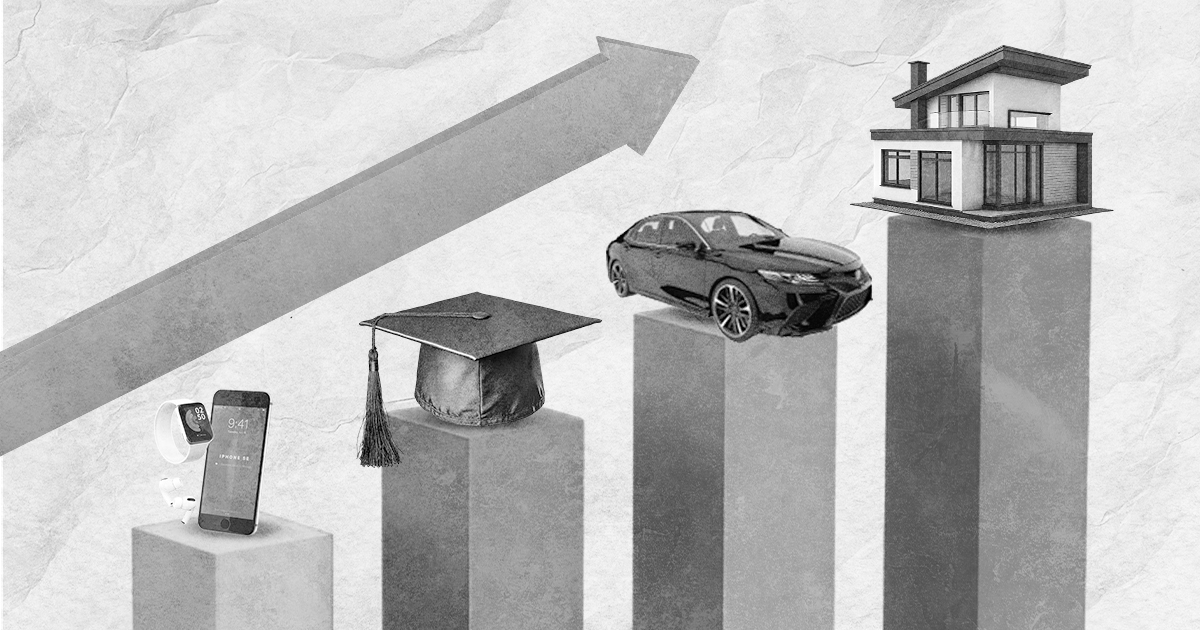
Economics. This is where Millennials were quietly reshaped, and where the "entitled" label falls apart fastest. They did not decide to redefine personal finance. They inherited a baseline so inflated that they built their budgets from the bottom up, accounting for fixed "essential" costs before they even knew what they could afford. I call that bottom-up budgeting. The new essentials were real. Internet and a phone stopped being luxuries and became prerequisites for friends, work, and school, and the typical American now carries about 8.4 subscriptions running $118 to $237 a month (Savanta, 2024; Whop, 2024). The same pattern had shown up earlier with mobility. A large share of Millennials were handed their first car, often with insurance quietly folded into a parent's budget, so freedom arrived prepackaged and free right up until adulthood turned every piece of it into a bill. Then came the debt. Millennials were, in a real sense, raised into student loans by well-meaning parents who urged college at all costs, and they still carried average balances around $40,438 as of 2024, years or even decades after graduating (Experian, 2024). So when Millennials kept asking for raises in the mid-2010s, it was not indulgence. It was math. And the parents and leaders most frustrated by the asking were often the very ones who had set the baseline, handing down a lifestyle without the instructions for affording it. Understanding that does not require handing out raises. It requires trading frustration for curiosity, and asking what assumptions shaped the person doing the asking.
Entrepreneurship and work. By the old yardstick, self-employment, Millennials looked like the least entrepreneurial generation in modern history. Fewer than 4% were self-employed at age 30, against 5.5% of Gen X and 6.7% of Boomers at the same age (NWBC, 2017). But that number read in isolation paints the wrong picture. It was not that they lacked ideas. They lacked the freedom to try, coming of age in the Great Recession with record debt and thinner safety nets. Entrepreneurship did not die for them. It evolved. Boomers started businesses to make a living. Millennials, and Gen Z after them, more often start them to make a statement and a second income, layering freelancing, reselling, content, and passion-based gigs on top of a paycheck. 44% of Millennials freelanced in 2023, against 30% of Gen X and 26% of Boomers (Upwork, 2023). I have some skin in this one. My own first company launched when I was fourteen, filed from a courthouse bench with cash I had saved from lemonade stands, and it grew to more than 200 clients across 25 countries. By the data, I was never supposed to be an entrepreneur. Plenty of my generation quietly proved the data incomplete.
Communication. Millennials mostly grew up online, and that includes how they make friends and how they date. That made them fluent in digital connection and, often, lonely inside it, comparing their real lives to everyone else's curated ones. The label was anti-social. The truth is they are differently social, and they long for face-to-face connection more than the myth admits.
Education. Millennials were told, more than any generation before them, that college was not a gift but a given, an expected step rather than an earned one. They were, in a real sense, raised into debt by well-meaning parents who urged college at all costs. They also learned inside a school system newly built around rubrics, group projects, and teamwork, which shaped how they approach work: they want the criteria spelled out, and they collaborate by default.
Sex and gender. Millennials came of age as the norms of their parents' era opened up. Conversations about sexuality that were taboo for Boomers and even Gen X became part of ordinary coming of age, and the culture moved, within their lifetimes, from hiding identity to accepting and often celebrating it. Millennials were also, to that point, the most racially and ethnically diverse generation the country had raised, and they carried that expectation of diversity into how they think about workplaces and leadership.
Politics, media, and a culture of fear. Millennials came of age inside a brand-new information environment, and it shaped their worldview long before it shaped their politics. They were the first children raised under the 24-hour news cycle. Lenore Skenazy put the origin plainly when I spoke with her on The Ryan Vet Show. In the 1980s, she said, "we got cable television, which gave us the 24-hour news cycle. When you have 24 hours of bad news in the background of your life, it seems like bad things are happening all the time." Add the milk-carton kids and the rise of stranger-danger television, and you get a generation raised by parents marinating in fear, even as crime was actually falling.
That fear took strange and specific shapes. Millennials grew up in the shadow of the AIDS era, and while the disease itself was not something most children understood, the panic around it was everywhere. Parents warned their kids about public toilet seats and mosquito bites. The lesson underneath was not really about a virus. It was that the world was dangerous in ways you could not see, and that caution was a form of love.
Then came the events they would carry for life. Columbine changed what school itself felt like, and it began a long reframing of bullying, safety, and who counts as a victim that we are arguably still untangling, a shift I dig into with anti-bullying expert Izzy Kalman on The Ryan Vet Show. And above all, there was September 11th. Nearly every Millennial can tell you exactly where they were. The youngest were barely five, in pre-kindergarten. The oldest were in college. It became this generation's Pearl Harbor, a single tragic morning that split time into before and after, the way their grandparents remembered December 7th. What was different was the exposure. The 24-hour news cycle, the early digital cameras, and the first camera phones meant the images arrived faster, closer, and more relentlessly than any generation had ever absorbed a national tragedy. They did not read about it the next morning. They watched it, live, on repeat.
Out of all of that, a political instinct formed that runs more toward issues than institutions. A cause, for this generation, functions almost like a friend. They are quicker to rally around a problem they believe in than a party they are told to trust, which is exactly what you would expect from a cohort taught early that the institutions narrating the world could not always be trusted to narrate it honestly.
Religion. Millennials are the hinge. When Boomers were around 21, in the mid-to-late 1970s, claiming no religion at all was an edge case, under 5% of Americans, while church membership held above 70% (Gallup, 2023). When Gen X was around 21, only about 9% of 18-to-24-year-olds claimed no affiliation. By the time Millennials reached that age in the early-to-mid 2000s, something had clearly broken. The "no religion" share among young adults had jumped to roughly one in three (NORC, 2014). In a single generational span, "none" went from the margins to the mainstream. Millennials did not invent the drift away from institutions, but they are the cohort in which it became normal. The deeper story of the "nones," and of a spiritual hunger fed almost entirely outside the walls of the church, belongs to the youngest Millennials and to Gen Z, who carried it further.
How to lead and work with them
Here is what has changed since I first wrote about managing Millennials: they are no longer the new kids. Millennials are now the largest bloc of the workforce, a growing share of its managers, and the parents of Gen Alpha. So this is less about handling a young generation and more about understanding your peers, your leaders, and often yourself.
The core still holds. Millennials want structured freedom, clear boundaries and a clear definition of winning, with real autonomy inside them. Give them the rubric and the outcome, then get out of the way. Measure output, not hours, because a generation that works to live will finish efficiently and go home, and that is a feature, not a flaw. Motivate with goals tied to human impact rather than dollars, because they prioritize purpose over paycheck and will find the door if the work does not mean anything.
Feedback is oxygen. Annual reviews are a thing of the past; they want to know how they are doing while they can still act on it, and a specific thank-you that tells the story of why their work mattered lands far better than a generic "good job." And do not confuse perks with culture. Ping-pong tables do not retain anyone. Culture is the people, and Millennials will walk away from a workplace of benefits long before they walk away from one where they feel instrumental and connected.
A few specifics consistently work. Between the carrot and the stick, Millennials run toward the carrot and shut down at the stick, so lead with what winning looks like rather than what losing costs. Tie the goal to human impact instead of the balance sheet, because "our goal is to reach this many customers and change this many lives" moves them in a way "we need to hit $1.2 million this year" never will. Hand them the rubric, since they grew up being graded on one and they want the criteria for success made explicit. Invest in mentorship, because they genuinely want to learn from the people around them and often just do not know where to start. And take the first day seriously, because a generation that forms impressions almost instantly decides fast whether a place is worth their loyalty. The payoff is real. Even amid all the job-hopping, the vast majority of Millennials say they would rather grow their career inside their current company than leave it. Most of them want to stay. They just need a reason.
One last shift worth naming. Many Millennials are now raising Gen Alpha, and they are deliberately trading the "give them everything" model they were raised on for experiences over gadgets, teaching their kids to value what they have rather than simply have more. Millennials learned the hard way how much it costs to give too much too soon, and they are parenting from that lesson.
Frequently asked questions about Millennials
What years is the Millennial generation?
Millennials cover those born between 1981 and 1996, the range used by Pew Research Center. As of 2026 that makes them roughly 30 to 45 years old, with the youngest turning thirty this year and the oldest in their mid-forties.
How old are Millennials in 2026?
As of 2026, Millennials are roughly 30 to 45 years old. The youngest, born in 1996, turn thirty this year, and the oldest, born in 1981, are in their mid-forties. They are well into middle age, they make up the largest share of the workforce, and many are now managers and the parents raising Gen Alpha.
Are Millennials the same as Generation Y?
Yes. Generation Y is an older name for the same cohort born between 1981 and 1996, the "Y" simply marking them as the generation following Gen X. The name Millennials, a nod to the group coming of age around the turn of the millennium, won out and is now the standard label.
Are Millennials still young?
No, and this is the most common misread. The oldest Millennials are in their mid-forties and the youngest turn thirty in 2026. They are well into middle age, they make up the largest share of the workforce, many are now managers and leaders, and they are the parents raising Gen Alpha.
What are Millennials' defining characteristics?
They are the bridge generation, the last to remember life before the internet and the first remade by it. That produced a cohort of contradictions: highly educated yet doubted, equally self-confident and insecure, purpose-driven, and quick to organize around causes over institutions. They grew up too fast, and somehow not fast enough.
Why do people call Millennials entitled or lazy?
Because the surface behavior invites it and the reasons underneath get ignored. What looked like entitlement, asking about raises and paths early, was often a request to know what success requires, layered on genuine financial pressure. What looked like laziness was usually efficiency: they finish faster and stop, rather than perform long hours for their own sake.
How are Millennials different from Gen X?
Gen X were the self-reliant latchkey kids who wanted to be left alone to do good work and go home. Millennials want the opposite of alone: mentorship, frequent feedback, and a clear path, plus purpose in the work itself. Gen X trusts institutions least and asks for autonomy. Millennials ask for structured freedom.
What is the difference between Millennials and Gen Z?
Millennials, born 1981 to 1996, watched the internet arrive and adopted it as teenagers and young adults, so they still remember the analog world. Gen Z, born after 1996, never knew an offline one. Millennials optimized life into curated experiences; Gen Z is recalibrating toward presence and what feels real. Millennials are the bridge between the two worlds. Gen Z is the first fully native to the screen.
What do Millennials want at work?
Structured freedom above all: clear goals and a clear definition of winning, with real autonomy inside those boundaries. They want purpose over paycheck, frequent and specific feedback rather than a once-a-year review, mentorship, and a culture that feels like a second family. Perks like ping-pong tables do not retain them. Feeling instrumental and connected does.
What is "bottom-up budgeting"?
It is my term for how Millennials were forced to handle money. Instead of income first and spending second, they account for fixed "essential" costs, connectivity, subscriptions, insurance, loan payments, before they know what they can actually afford. It is why so many kept asking for raises. It was not indulgence. It was math.