In a recent NPR interview, Bill Gates reaffirmed his commitment to philanthropy: nearly all his wealth will be given away. He’s already donated over $59 billion—a sum surpassing the GDP of countries like Croatia and equivalent to the combined annual earnings of nearly 1 million average American workers (U.S. Bureau of Labor Statistics [BLS], 2025). Gates plans to leave “just a few million” to each of his three children—enough to live comfortably but not extravagantly. Granted, a “few million” would be a nice inheritance for the vast majority of people.
❝
“I want them to have the freedom to do anything, but not the pressure to do nothing.”
Bill Gates (NPR, 2025)
This philosophy isn’t just personal, it’s emblematic of a generational shift.
One Billionaire Reflecting a Generation
Born in 1955, Gates epitomizes the Baby Boomer archetype: a college dropout turned tech magnate. But his desire to give away his fortune mirrors a broader trend among Boomers, a generation that amassed unprecedented wealth and is now contemplating its legacy.
Boomers hold over 50% of all U.S. household wealth (Cerulli Associates, 2023). They were the first to benefit from 401(k) retirement plans, introduced in the early 1980s (Guideline, n.d.), and witnessed the rise of mutual funds as accessible investment vehicles (Investopedia, n.d.). With expanding credit markets, they leveraged financial tools previously unavailable to many of their predecessors—owning homes, buying stocks, and using consumer credit not as emergencies but as strategies.
The Echo: From Dream to Disbursement
Raised amidst post-war prosperity, Boomers cultivated the American Dream, prioritizing quantity over quality and valuing long work hours as a ladder to success. Now, as they approach retirement, many are shifting focus from accumulation to allocation. Plus, a big part of that American Dream was that perfect vision for the “2.2 kids.” This means that birth rates went down, and any inheritance will be heavily concentrated on fewer descendants.
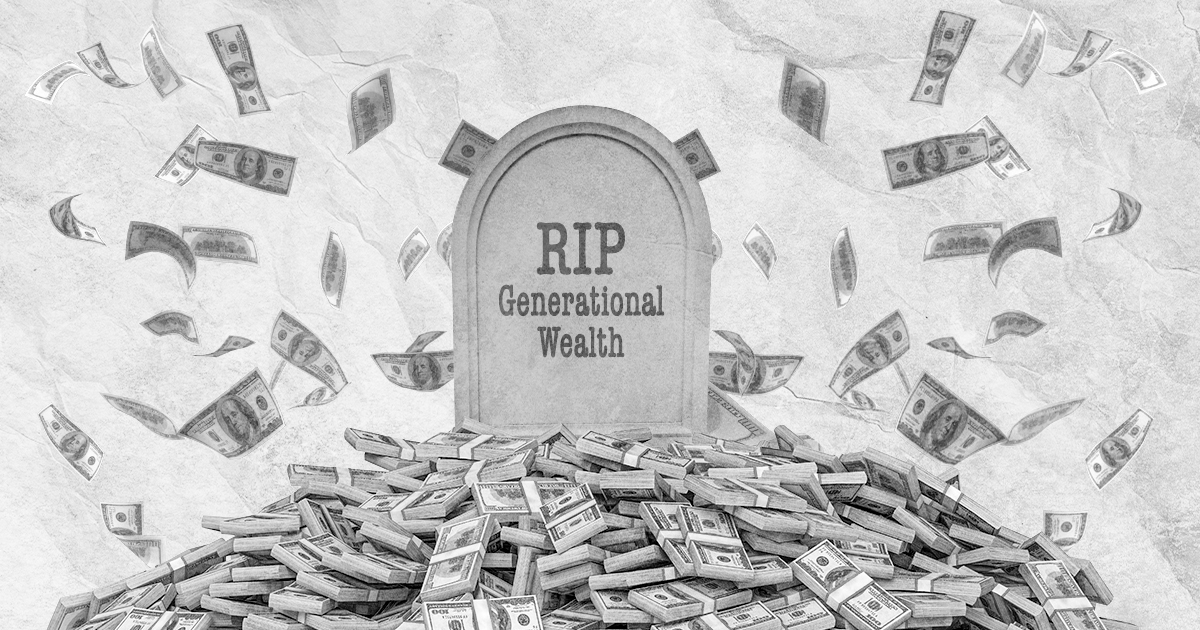
The Great Wealth Transfer is underway.
An estimated $84.4 trillion will pass from Boomers and the Silent Generation to their heirs by 2045, with Boomers alone transferring about $53 trillion (Cerulli Associates, 2023). This isn’t merely a financial transaction; it’s a cultural moment.
The Tension: Wealth Without Wisdom?
As Millennials and Gen Z inherit this wealth, questions arise: Will they uphold the values of their predecessors? Or will they redefine success? Will they retire early? Will they squander their inheritance?
The silver lining is that many younger recipients are turning to financial coaches, philanthropic endeavors, and value-driven investments, seeking purpose over profit (NPR, 2025). We know the younger generations to love information. They often try to seek insight and knowledge, albeit from their two digital friends Google and ChatGPT.
However, are these generations that were once stereotyped as lazy going to receive a golden parachute and an early exit from the workforce? Or will they continue to move forward in their careers?
From Ladder to Legacy
Something interesting happens as we age—our attitudes towards money progress from success (accumulation) to significance (impact). Boomers climbed the ladder of success, each rung representing hard work and perseverance. They were the first ones to clock into the office, last to clock out, often sacrificing time at home. Now, as they approach retirement, they are compelled to reflect on their journey to the top. They’re handing down not just wealth, but the responsibility to use it wisely.
Gates isn’t an outlier, he’s a reflection of a generation. His actions encapsulate a generational journey from building empires to building legacies.
Generational Snapshot
Opportunity for Fundraisers and Families
This transition offers a unique opportunity for nonprofits, financial advisors, and families to engage in meaningful conversations:
-
Legacy Planning: How can wealth align with personal values?
-
Philanthropic Engagement: What causes resonate across generations?
-
Educational Initiatives: How can we prepare heirs for responsible stewardship?
Addressing these questions can ensure that the Great Wealth Transfer becomes not just a shift in assets but becomes a redemptive moment between parents and kids. A true legacy isn’t forged with a certain number of zeroes in a bank account, it is etched behind with purpose and significance.
Thanks for reading!
Generations…In The Wild
Check out recent articles on The Great Wealth Transfer.
[
Ultra wealthy Gen Zers are giving away the millions of dollars they’ve inherited—Meet the money coaches helping them
Guilt-wracked Gen Z and millennial millionaires are giving their money to charitable causes: “A lot of them are just like, ‘Get it off, get it away.’”
fortune.com/2025/05/10/rich-gen-z-millennails-money-coaches-wealth-redistribution-philanthropy-bill-gates
[
Why Bill Gates is giving away his money faster : Consider This from NPR
Last week, the Gates Foundation announced it would spend more than $200 billion over the next 20 years — including nearly all the personal wealth of chair Bill Gates — and sunset operations in 2045.
www.npr.org/2025/05/12/1250811325/bill-gates-foundation-interview-giving-away-wealth
](https://www.npr.org/2025/05/12/1250811325/bill-gates-foundation-interview-giving-away-wealth)
Works Cited
Cerulli Associates. (2023). Generational wealth in the United States: A comprehensive analysis.
Guideline. (n.d.). Evolution and history of the 401(k). https://www.guideline.com/education/articles/evolution-of-401k
Investopedia. (n.d.). A brief history of the mutual fund. https://www.investopedia.com/articles/mutualfund/05/mfhistory.asp
NPR. (2025, May 12). Bill Gates on giving away his wealth. https://www.npr.org/2025/05/12/1250811325/bill-gates-foundation-interview-giving-away-wealth
U.S. Bureau of Labor Statistics. (2025, April 16). Usual weekly earnings of wage and salary workers, first quarter 2025[PDF]. https://www.bls.gov/news.release/pdf/wkyeng.pdf