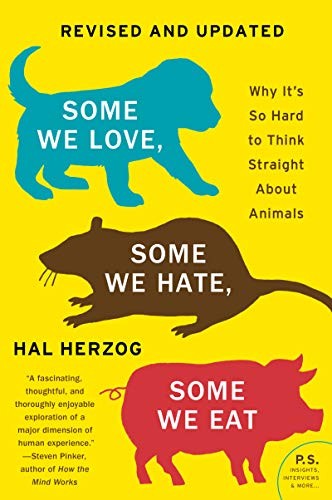
Some We Love, Some We Hate, Some We Eat
Why It's So Hard to Think Straight About Animals
Some We Love, Some We Hate, Some We Eat by Hal Herzog (2021) — Hal Herzog's account of why human attitudes toward animals are so inconsistent, driven by intuition, culture, and cuteness rather than by any rule we could state out loud.
What is Some We Love, Some We Hate, Some We Eat about?
Psychologist Hal Herzog draws on three decades of research in anthrozoology, the study of human-animal interaction, to explain why our attitudes toward other species are so rarely consistent. Across chapters on pet keeping, meat eating, animal research, cockfighting, and the cultural fashions that decide which breeds and species we adore, he argues that these judgments run on intuition, category, and appearance far more than on ethical reasoning. This second edition, published in 2021, is revised and updated throughout to reflect newer findings and shifting public attitudes toward animals.
Frequently asked questions about Some We Love, Some We Hate, Some We Eat
What is anthrozoology?
The scientific study of human-animal interaction, pulling from psychology, anthropology, sociology, and ethology. Herzog is one of the researchers who helped establish it as a field, and the book is essentially a tour of what that discipline has found, written for readers who have never heard the word.
What is the troubled middle?
Herzog's term for where nearly everyone actually lives. Not animal-rights absolutists, and not people who think animals do not matter at all. The troubled middle eats meat and loves its dog, objects to some kinds of animal use and accepts others, and settles each case on instinct rather than on principle. He puts himself in it, which is what keeps the book from reading as a lecture.
Is this an animal-rights book or an argument for going vegan?
Neither. Herzog is describing how people think, not prescribing what they should eat. He gives activists real space and takes their reasoning seriously, but he is just as interested in why moral consistency about animals is so hard to sustain, including for the activists themselves.
Why do we love some animals and eat others?
Herzog's answer is that it is mostly not about the animals. Facial proportions, the category your culture files a species into, and what the people around you do are doing most of the work. The reasons we give afterward tend to be justifications rather than causes, which is the uncomfortable finding at the center of the book.
Does the book say pets make you healthier?
It says the evidence is far weaker than the headlines. Herzog has spent years arguing that the pet effect is oversold. Studies point in every direction, including some that find pet owners worse off on particular measures, and the strongest public claims outrun the data behind them. It is one of the book's most useful correctives.
What is new in the second edition?
The publisher describes it as revised and updated throughout to reflect newer research and evolving attitudes toward animals, not a rewrite. The structure and argument of the 2010 original are intact while the studies, statistics, and cultural examples are refreshed. If you read the first edition, treat this as an update rather than a new book.
Who is Hal Herzog?
A psychology professor at Western Carolina University and one of the founding figures of anthrozoology. His fieldwork ranges from cockfighters in Appalachia to animal-rights activists to laboratory researchers, and he writes the long-running Animals and Us column for Psychology Today.
Books like Some We Love, Some We Hate, Some We Eat


Publication details
- Publisher
- Harper Perennial
- Published
- 2021
- Pages
- 384
- Format
- Paperback
- ISBN-13
- 9780063119284