How I’m Thinking About 2026
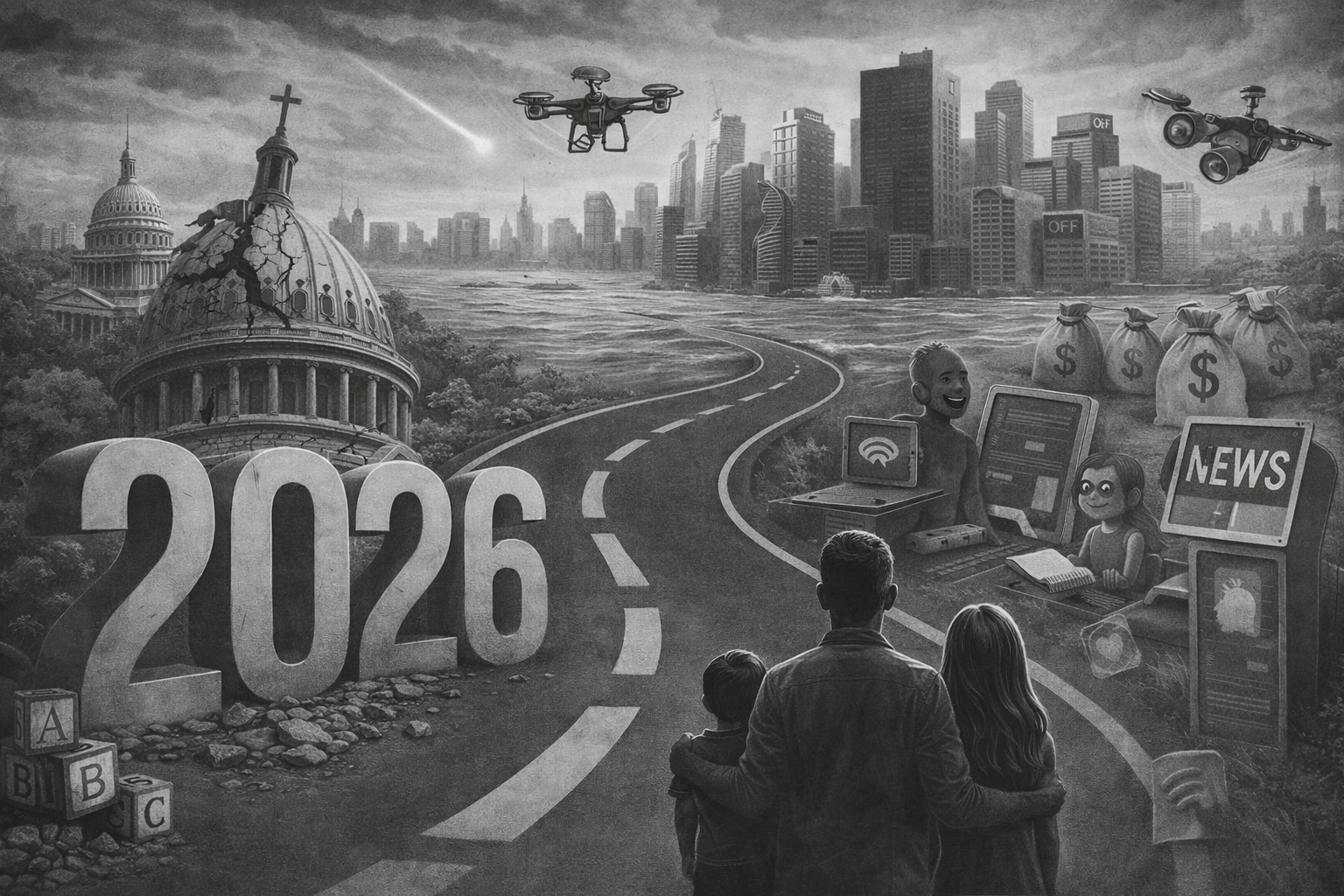
AI acceleration, cultural polarization, trust erosion, and the signals already shaping the next generation before 2026 even arrives.
Read the full essayThe future is not something that happens to us. It is something we are actively shaping, whether we are paying attention or not.
America turns 250 in 2026, and Gen Beta arrives as the first cohort to grow up from day one with generative AI as an assumed layer of reality rather than a tool. Ryan's first prediction is deeper polarity across every pillar. Religion fractures into all in and all out. Parenting diverges from gentle to authoritarian. Education splits between public, private, homeschool, hybrid, and alternative. Politics is only the most visible expression, and neutrality itself now reads as a stance.
The second prediction is cognitive erosion, arriving faster and more quietly than we are prepared for. Broadband took 7 years to cross 50 percent adoption and smartphones about 5. Generative AI reached 100 million users in 2 months, and by mid-2025, 58 percent of adults under 30 and 38 percent of all adults were using it. Ryan is explicit that AI replacing jobs is not his main concern. The concern is offloading. GPS did not just help us navigate, it eroded our ability to get from A to B unassisted. He tells on himself with chess: learning alongside his kindergartener, he turned to an AI tutor that corrected every move and removed the exact friction where learning happens.
Third, trust keeps eroding and has stopped being generational. Was this real and was this AI-generated have become ordinary questions. Legacy outlets that drew credibility from centralized authority are losing influence to individual commentators, so trust has not vanished, it has splintered into thousands of personalized ecosystems filtered by ideology, algorithm, and incentive.
Fourth, credibility markers are changing. Boomers built credibility through titles, degrees, and zip codes. Younger generations ask whether they control their time and can work how, when, and where they want. And fifth, the contradiction sharpens: phone bans in roughly three dozen states and nationwide in Australia, while AI moves the opposite direction into classrooms, toys, and learning platforms. We are trying to slow technology with one hand while accelerating it with the other.
Generative AI reached 100 million users in 2 months. Broadband took about 7 years to cross 50 percent adoption and smartphones about 5.
By mid-2025, 58 percent of adults under 30 and 38 percent of all adults reported using generative AI. The question is no longer whether it reshapes culture but how deeply.
Ryan's stated concern is not AI replacing jobs. It is cognitive erosion, the gradual dependency formed when planning, writing, reasoning, and synthesis get offloaded too early or too often.
Trust has not vanished, it has splintered. People increasingly trust a person rather than an institution, filtered through thousands of personalized ecosystems.
The defining contradiction of 2026: phone restrictions across roughly three dozen states while AI moves into classrooms, toys, and daily workflows, more powerful and more invisible than the screens we are removing.
Plain-language definitions for the ideas in this episode. Structured for search and AI answers.
The gradual weakening of mental capacity that follows from repeatedly offloading thinking to tools. Each individual offload feels insignificant, and together they rewire how a person thinks.
In this episode: Ryan's chess tutor, and the GPS that erased knowing the route.
Religion, education, sex and gender, politics, economics, communication, and technology. Ryan tracks generational movement by watching for friction across these seven at once.
In this episode: The structure of the entire forecast.
The condition in which taking no position is itself read as taking one, so institutions, brands, and leaders are pushed to declare allegiance on issues once outside their lane.
In this episode: Ryan's first prediction, and the thread connecting polarity across every pillar.
Lines worth keeping, verbatim from the episode.
What is sad is that neutrality itself is interpreted as a stance.
The future isn't something that happens to us. It's something we're actively shaping, whether we're paying attention or not.
Each individual cognitive offload feels insignificant and innocent. Together, they have already rewired how we think.
Straight answers to the questions this essay raises. Open by default, structured for search and AI.
What is Ryan Vet's biggest concern about AI heading into 2026? +
Ryan argues the most significant risk is not job loss but cognitive erosion, the quiet way AI increases our dependency on technology and weakens our thinking. He compares it to how GPS eroded our sense of direction and voice assistants replaced mental math and basic recall. His worry is that when planning, writing, reasoning, and synthesis are offloaded too early or too often, the mental muscle weakens gradually rather than collapsing all at once.
Why does Ryan say AI has already crossed the tipping point? +
He points to how quickly AI reached mass adoption compared with earlier technologies, noting that once a technology hits mass adoption the question stops being if it will reshape culture and becomes how deeply. He likens this moment to social media around 2012, when smartphones stopped being a cool gadget and became baseline. Because that threshold has already been crossed, he says the cultural question now is what is happening to our minds, not whether AI will change how we live.
What is Gen Beta, and why does the essay say it matters? +
Gen Beta is the new generation arriving in 2026, shaped primarily by Millennial parents and earlier-born Gen Z. Ryan describes them as the first generation from day one to grow up fully immersed in a world where generative AI is an assumed layer of reality, much as social media was for Gen Z and the Internet was for Millennials. He argues this matters because it signals that early formation itself is changing, not just behavior later in life.
How does the essay describe the erosion of trust? +
Ryan predicts trust will continue to erode across all generations, becoming harder to establish and easier to lose. He describes a shift from filters distorting reality to fake news and now AI-generated content and deepfakes, which make it harder for people to agree on what is authentic. As legacy media loses influence, he says people increasingly place trust in a person rather than an institution, splintering trust into thousands of personalized ecosystems.
What does the essay predict for education and credentials in 2026? +
Ryan predicts traditional markers of credibility will keep losing dominance and that education will be less about credentials and more about proof. He describes learning models fragmenting across public, private, homeschool, hybrid, and alternative paths, with a clearer fork toward professional graduate degrees or trade school. He argues demonstrated capability, what you can actually build and do, increasingly matters more than the name on a diploma.
What is the contradiction Ryan says will define the next generation? +
He describes a tension between restricting technology with one hand while accelerating AI with the other. Parents and schools are delaying social media and banning phones because they have seen the damage, even as AI moves in the opposite direction into classrooms, toys, learning platforms, and daily workflows. Ryan frames managing technology as a cultural skill that will determine whether we shape these tools intentionally or simply react to their consequences after the fact.
Full show notes
What will actually shape society by 2026—and which signals are already visible right now?
In this episode, generational futurist Ryan Vet explores how 2026 will arrive faster than we expect, why the pace of change is no longer linear but compounding, and why 2026 won’t be remembered as a year of answers but as a year of signals.
Rather than offering hype-driven futurist predictions, Ryan breaks down the deeper forces already reshaping society beneath the surface. Drawing on generational patterns, cultural history, and current data, he explains why artificial intelligence, trust erosion, education shifts, and widening cultural divides are not isolated trends but interconnected expressions of a larger recalibration already underway.
This conversation looks at what’s quietly changing now—and what that means for leaders, parents, educators, and institutions heading into 2026.
In this episode, you’ll explore:
AI in 2026 Why we’ve already crossed the AI tipping point, how adoption has accelerated faster than any prior technology, and why the most significant risk isn’t job loss—but how AI changes thinking, learning, reasoning, and problem-solving long before the effects are obvious.
Cognitive offloading and dependency How everyday tools like GPS, voice assistants, and AI tutors slowly reduce cognitive effort, why each tradeoff feels harmless in isolation, and why friction is where learning actually happens. Ryan explains when assistance quietly becomes erosion—and why this matters more than automation.
Technology management, not technology debate Why 2026 marks a shift from arguing whether technology is good or bad to learning how to manage dependency intentionally.
Education in 2026 Why credentials are losing influence, proof is replacing prestige, and learning models are fragmenting across public, private, hybrid, and alternative paths—and why demonstrated capability increasingly matters more than titles or degrees.
The contradiction shaping the next generation Why parents and schools are restricting screens while AI adoption accelerates into classrooms, toys, learning platforms, and daily workflows—and the tension this creates for early development.
Trust, credibility, and leadership How trust is eroding across generations, why credibility is becoming provisional, and why people increasingly place trust in individuals rather than institutions.
Cultural polarization beyond politics Why polarization now extends far beyond political affiliation into workplaces, brands, leadership expectations, and everyday life.
The arrival of Gen Beta What it means for a generation to grow up from day one in a world where AI is an assumed layer of reality—and how early formation is changing in ways we’re only beginning to understand.
This episode ultimately asks the harder questions:
What happens when assistance quietly becomes erosion? When does convenience weaken capability? How do you lead, teach, and parent intentionally in a world moving faster than reflection?
Send us Fan Mail
About Ryan VetRyan Vet is a USA TODAY bestselling author, futurist, and international keynote speaker whose insights on generations, culture, and the future of work have been featured in Forbes, Financial Times, ABC, NBC, and CBS. His research helps leaders understand emerging generational patterns and anticipate societal shifts before they fully unfold.
Join 20,000+ Leaders for Weekly InsightsIf you want deeper research and behind-the-scenes insights on generations and the future of culture and society, join Ryan’s weekly newsletter: 👉 https://ryanvet.com/collide