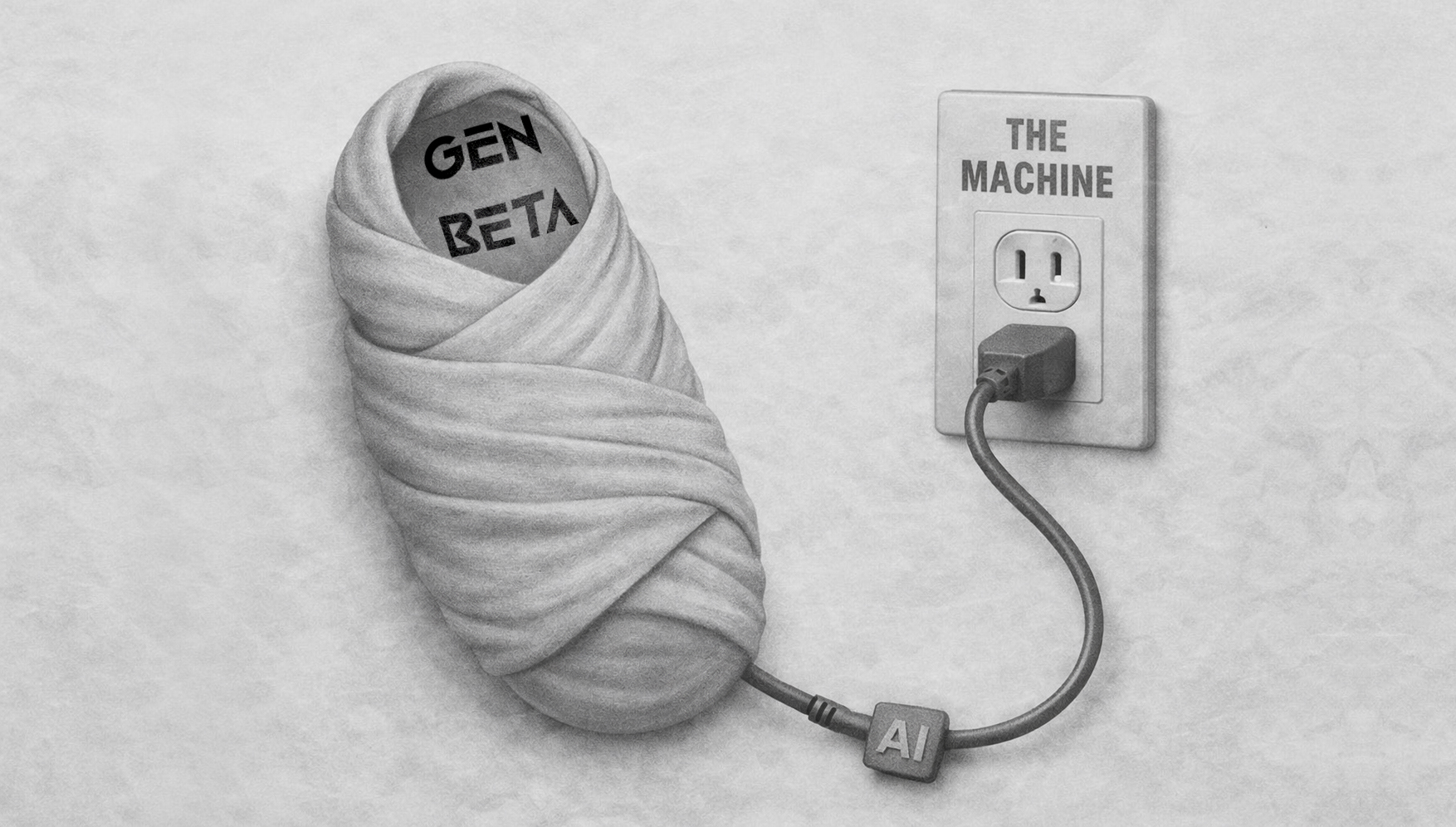
That definition matters more than the label, and how we use the label matters more than most people realize. So before we talk about who Gen Beta is, we have to talk about how to think about them at all.
Labels are output, not input: the Generational Prism
I push back on generational labels often. Not because they are useless, but because they are treated like settled science when they are really shorthand, and shorthand that is grossly misused. Even as major research institutions like Pew have stepped back from naming generations, culture pulls us right back into the labeling game. So the posture I take is simple. If we are going to use labels, we should use them intelligently.
That is why I rely on a framework I call the Generational Prism: Age, Moment, Label.
The label, whether Baby Boomer or Gen Beta, is not the starting point. It is the output. It is what happens when a person's life stage collides with the conditions of the world around them. When we start with the label, we end with stereotypes. We saw it with the decade-old claim that the Millennial generation was uniquely prone to job-hopping. Longitudinal data tells a different story. By age 30, Millennials had held only about 0.3 more jobs than late Boomers or Gen X. A rounding error became entire books.
Start with the label, and you get a caricature. Start with the moment, and you get a generation.
So when does Gen Beta actually begin?
Some outlets rushed to crown January 1, 2025 as the starting line. Others argue Gen Beta will not arrive for years. I land on 2026, and the reason is not the calendar. It is the culture.
Generational shifts follow cultural tipping points, not calendar pages. From the late 1990s to the early 2000s, home internet climbed from roughly 1% of U.S. households to over 50% in about seven years, with the tipping point around 1998. The smartphone followed the same curve, reaching nearly half of U.S. adults by 2012. Generative AI did not arrive gradually. It arrived all at once. ChatGPT reached 100 million users in roughly two months after its November 2022 launch. By mid-2025, Pew found 58% of U.S. adults under 30 had tried ChatGPT, and 38% of all U.S. adults reported using generative AI for work.
AI utilization is well past novelty. And childhood is shaped by what the adult world normalizes.
Here is the hinge. The parents, educators, and decision-makers shaping early Gen Beta are disproportionately Millennials, and Millennials currently use AI tools at higher rates than any other adult cohort. They are not just trying AI. They are integrating it. Meanwhile, Gen Z makes up a growing share of new parents. That is a new moment, and a new moment is what makes a new generation.
Reasonable people draw the line elsewhere. Jean Twenge has suggested Gen Alpha may extend to 2029. Mark McCrindle argued Gen Beta started in 2025. Both are defensible, because normalization never happens on a single day. It happens unevenly, across families and institutions. I call that overlap the Generational Blur. Saying Gen Beta begins in 2026 is not about being right. It is about shared language, so we can talk meaningfully about what is changing even when the edges are fuzzy. If you want the sources side by side, I walk through the full 2025 vs 2026 breakdown separately.
What makes Gen Beta different: three forces
A label does not alter a child's trajectory. Henry Schamp, born at midnight on New Year's Day in a Philadelphia hospital, did not inherit a different future than a child born at 11:59 the night before. Birth order matters. Parent age matters. Faith, community, and lived experience all matter. But sometimes the world crosses a tipping point, and three forces are converging on this one.
1. AI-native, not by choice. Gen Beta will not adopt AI the way we did. They will form identity and agency in a world where intelligence is ambient and struggle can be bypassed. I learned graphic design in the 1990s by erasing pixels one at a time. It was inefficient, and it taught me how things worked because there was no shortcut. Today that happens in seconds by voice command. Convenience has quietly replaced competence in places we once took for granted, and Gen Beta will grow up inside that trade before they are old enough to notice it was a trade.
2. The Romeo & Juliet inheritance. Shakespeare's tragedy is remembered as a love story and forgotten as an indictment: labels overpowering humanity, loyalty expected long before understanding is possible. Gen Beta will not just inherit polarization. They will inherit a world where unity is treated like betrayal. Trust in the federal government has fallen from 77% of Americans in the 1960s to roughly 16% today (Pew Research Center, 2023). Interpersonal trust has slid from nearly half of Americans in the early 1970s to roughly 30 to 34% (Pew Research Center, 2019). Only about 8 to 9% of Democrats and Republicans report a spouse or partner from the other party. This is the core of the Generational Pendulum: every generation overcorrects for the pain of the one before it, and when distrust becomes a parenting value, children inherit not just beliefs but boundaries.
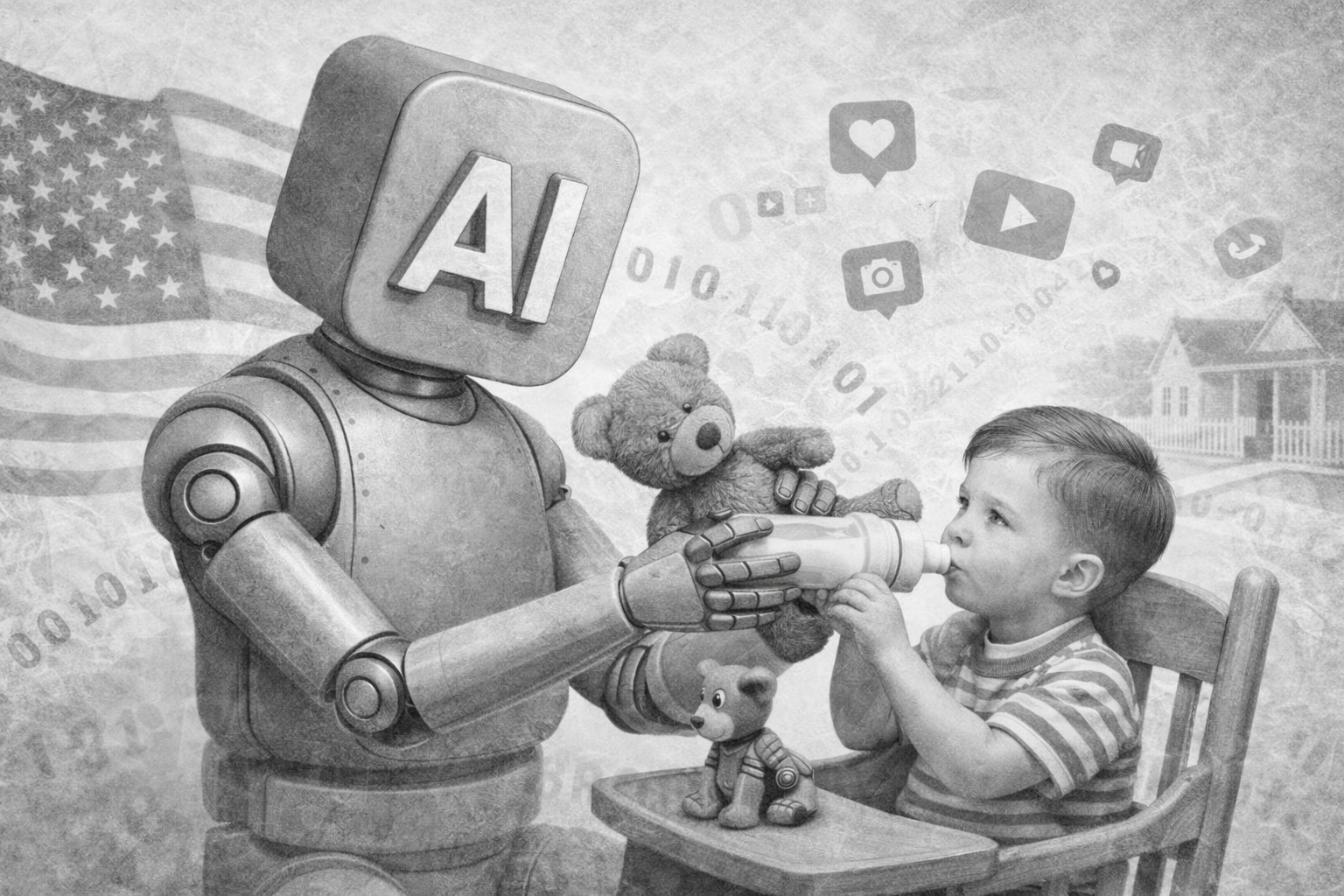
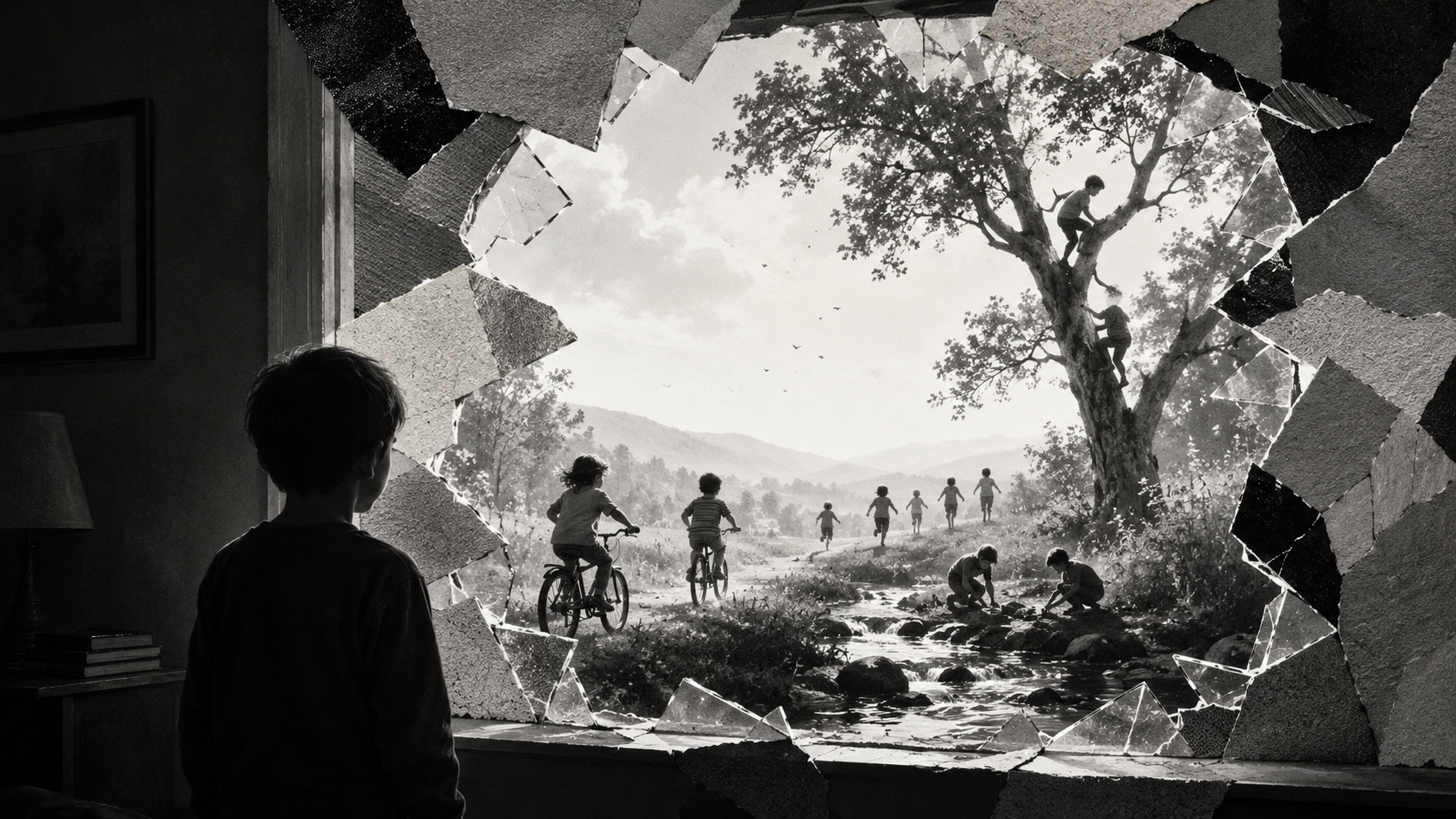
3. Parented by AI. Not absent parents, and not helicopter parents, but present parents increasingly tempted to outsource discernment to machines that cannot know a child's soul. The paradox is that even as parents tell kids to unplug, they are more plugged in than any parents in history. We tell children to go play outside while watching them from inside an app. "Did you hit your brother?" "No." "Hold on, I'm going to check the camera." That exchange rewires something fundamental. The issue is no longer honesty. Technology becomes the ultimate truth. Freedom without trust is not freedom. It is probation.
This isn't only my read. The people studying it see the same pattern.
I have hosted the researchers and practitioners closest to this on The Ryan Vet Show, and they keep arriving at the same conclusion from different doors.
Lenore Skenazy founded Let Grow with Jonathan Haidt and Peter Gray, and has spent nearly two decades on childhood independence. On the surveillance point, she named the trap exactly:
"We're replacing faith with certainty. And certainty is a lot more tenuous, because you have to keep checking it, than faith."
Lenore Skenazy, on The Ryan Vet Show
She points out that roughly 86% of children are now tracked, and that a live location dot does not deliver peace of mind. It accommodates anxiety, the way checking a locked door ten times does. Meanwhile Peter Gray's work in the Journal of Pediatrics shows that as children's independence declined across decades, their anxiety and depression rose. Not a coincidence, she argues. A cause. Thirteen states have now passed reasonable-childhood-independence laws in response.
Michaeleen Doucleff, NPR correspondent and author of Hunt, Gather, Parent (over a million copies, 30-plus languages), studied parenting on nearly every continent and found the same missing ingredient:
"What kids need is involvement in the adult world. And when they have it, they start to behave better."
Michaeleen Doucleff, on The Ryan Vet Show
Her second book reframes the very thing we blame for the crisis. Dopamine, she explains, is not the chemistry of pleasure. It is the chemistry of wanting and craving. The products in our children's lives are "designed to crank up our dopamine, but not our pleasure." The good news, she argues, is that the dopamine system is flexible, and parents have far more power to reshape it than they are told.
Put their evidence next to the pattern and it is hard to miss: independence is being engineered out of childhood, discernment is being outsourced to systems, and the generation raised inside that trade is the one being born right now. That is the conversation I am continuing with voices like Kevin Stinehart and Nicki Petrossi, and it is the reason Gen Beta is worth getting right early.
What leaders and parents do about it
Discernment is formed through friction. Wisdom comes from trial and error. Children are shaped not by optimized responses, but by being known. That is the Friction Doctrine, and it is the throughline for both parenting and leadership here.
For leaders, the mandate is not to abandon conviction. It is to model a different relationship to it. Three shifts matter most. Model conviction without cancellation: hold clear beliefs while still making room for dissent, so the next generation learns that disagreement does not have to end a relationship. Preserve spaces that are not optimized for agreement: algorithms sort people by sameness, and only institutions can protect the cross-cutting spaces human development requires. Make disagreement survivable: remove contempt from conflict, and unity becomes possible without uniformity.
For parents, the line is simpler. AI can offer perspective. It cannot offer presence. It has no lived experience, only aggregated ones, and it delivers confident answers that are often just someone else's worldview presented as truth. AI can be an incredible tool. It cannot be a parent.
The most countercultural act in the decade ahead may not be what we believe. It may be whether we can still sit at the same table as those who believe differently, and whether we can let a child struggle long enough to become someone.
Frequently asked questions about Gen Beta
When does Gen Beta start?
Gen Beta begins in 2026. The boundary is debated. Some place it at 2025, others later. But generational lines follow cultural tipping points, and 2026 is when AI crossed from something people occasionally use to invisible infrastructure children are raised inside of.
What years are Gen Beta?
Gen Beta covers children born from roughly 2026 through the late 2030s. The edges are intentionally fuzzy, an overlap I call the Generational Blur, because normalization happens unevenly across families and institutions.
Who comes after Gen Alpha?
Gen Beta. The naming follows the Greek alphabet after Gen Alpha, a convention introduced by social researcher Mark McCrindle.
Who are Gen Beta's parents?
Predominantly Millennials, with a growing share of older Gen Z. This matters because Millennials use AI tools at higher rates than any other adult cohort, so Gen Beta's earliest environment is shaped by the most AI-integrated parents in history.
How is Gen Beta different from Gen Alpha?
Gen Alpha grew up as technology accelerated. Gen Beta is the first cohort for whom AI is ambient from birth, not a tool they adopt but a condition they are formed inside. The difference is the tipping point: adopted technology versus invisible infrastructure.
Why does Gen Beta matter for leaders and parents now?
Because childhood is shaped by what the adult world normalizes today, and the decisions leaders and parents make now, about friction, trust, and independence, are already writing the operating system this generation will inherit.