Follow the show in your app. Apple leads on iPhone, Spotify on Android.
Summary
Chris Ruden says what did the real damage was not what other people said about him. It was that he believed them.
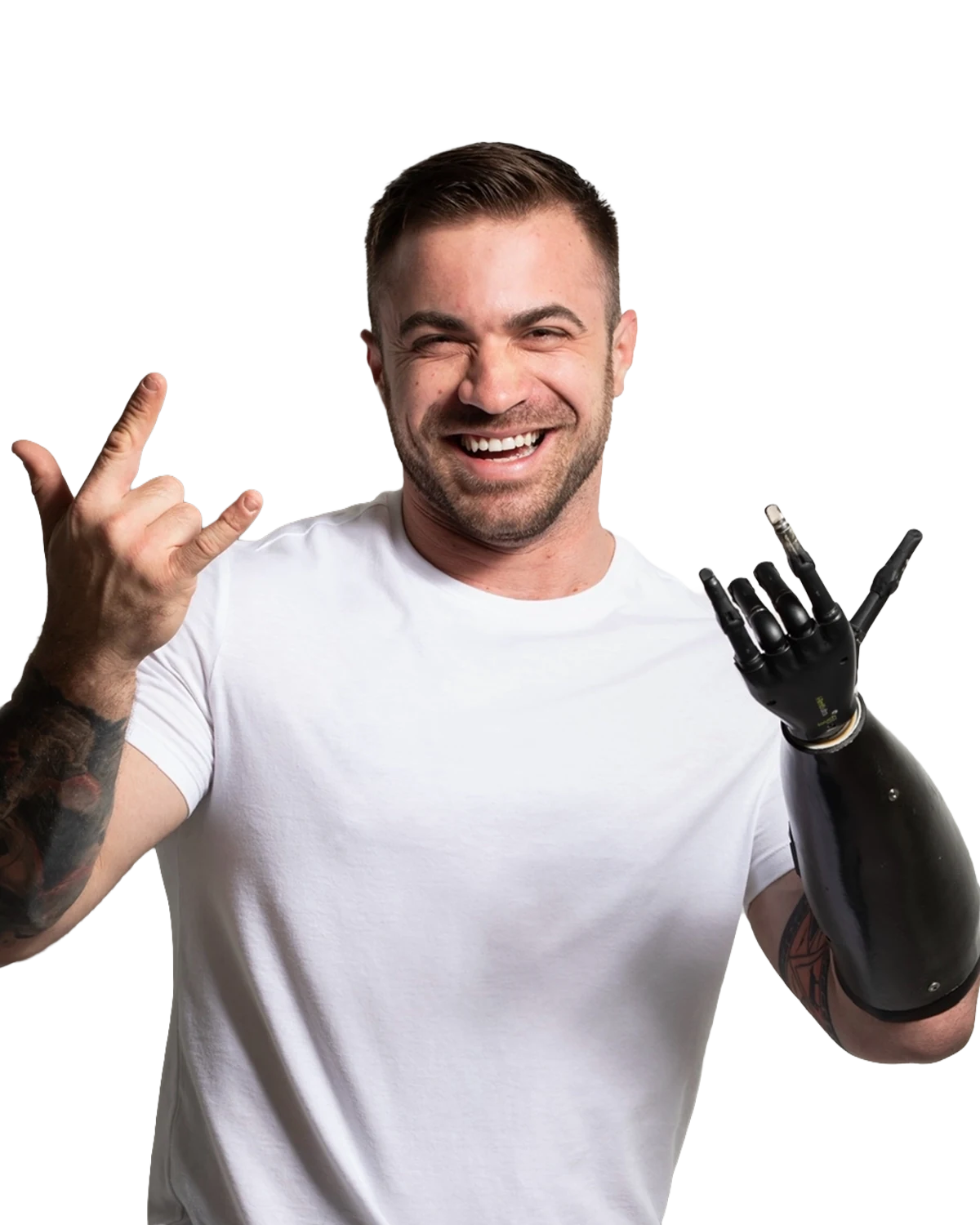
Chris Ruden is an amputee, a world record holding powerlifter and a professional speaker on culture and change. He was born with two fingers on his left hand and a shorter left arm, and he says he hid it for more than 17 years, until he was 27. When he stopped, he says, a video of him taking his glove off reached 7 million views and brought a call from Dwayne "The Rock" Johnson's Titan Games. Today he keynotes around the world on building cultures people brag about.
The first half is the story of a label he accepted as fact. Chris walks through how a difference gets collapsed into a defect, and how a person then spends years confirming it. The second half is what he teaches now, radical curiosity. Certainty gets mistaken for competence, especially the higher up an organization you go, and teams run on legacy narratives because they always have. His test is not "does it work?" but "is it optimal?"
Ryan Vet brings the generational lens, since the same labeling mistake gets made about Gen Z, Gen Alpha and older workers. Chris offers a way out: ask how, not whether, and strip a judgment down to facts. They also get practical about AI, parenting and the 10-minute weekly meeting habit Chris says will do more for a team than most consulting engagements.
Key takeaways
1
Chris Ruden says the label you accept does more damage than the insult. In his words: "It wasn't necessarily the insults that hurt me. It was the fact that I believed them."
2
He says stories get mislabeled as facts. "Not all feelings are facts," he says, and being certain does not make you right.
3
Radical curiosity, Chris says, starts with a better question rather than a better answer. His own is "how might we?", and he says the word "might" gives people the psychological safety to say something without needing to be right.
4
He argues the right test is not "does it work?" but "is it optimal?", because the old philosophy of "don't fix what's not broken" leaves no room for growth and innovation.
5
Chris says certainty is not competency, and that the higher up an organization you go, the less curious people get, because leaders fear that not having the answer looks weak.
6
He asks teams whether they have 30 years of experience or one year of experience repeated 30 times. "We're not really stacking experience, we're stacking time."
7
Chris calls curiosity a muscle that atrophies when it is not used, and says over-relying on AI is one way that happens. "The quality of output is based on the quality of input."
8
His practical habit: start one meeting a week with 10 minutes on what the team might have missed, and ask "if I was fired today and re-hired as a consultant, what's the first thing I would fix?"
9
On Gen Z at work, Chris suggests managers ask how, not whether: "How could I make our working relationship work, even though we're different?"
Terms defined
Plain-language definitions for the ideas in this episode. Structured for search and AI answers.
radical curiositynoun phrase · leadership
Chris Ruden's name for getting more curious about the things you think you already know. In practice it means a better question rather than a better answer.
In this episode: Chris says it came from his wife's observation that the answers you give people are really the questions you ask. His working question is "how might we?"
collapsing probabilitynoun phrase · psychology
Treating one possibility as the only one. Different becomes weird, an older colleague becomes set in their ways, a younger one becomes lazy.
In this episode: A phrase Chris says he picked up and kept. He applies it to himself, to generational labels and to outcomes that have not happened yet.
legacy narrativenoun phrase · organizations
The story a person or an organization tells to justify how things have always been done.
In this episode: Chris says legacy narratives work until they don't, and that they keep people stuck just because it has always worked that way.
competing commitmentsnoun phrase · teams
Two goals pulling against each other, such as wanting to go to the gym while also buying a tub of ice cream.
In this episode: Chris says competing commitments quietly wreck people and teams until they are acknowledged out loud.
Notable quotes
Lines worth keeping, verbatim from the episode.
“
It wasn't necessarily the insults that hurt me. It was the fact that I believed them.
Chris Ruden07:00“
Do we have 30 years of experience? Or do we have one year of experience repeated 30 times?
Chris Ruden28:36“
We're not really stacking experience, we're stacking time.
Chris Ruden28:46“
Certainty does not equal competency.
Chris Ruden27:17“
The question is not, does it work? The question is, is it optimal?
Chris Ruden18:26“
You can't solve tomorrow's problems with yesterday's logic.
Chris Ruden23:48“
Not all feelings are facts.
Chris Ruden03:30“
Curiosity is like muscle and it atrophies over time if not used.
Chris Ruden25:09“
Too many of us are guided by the rules we've set for ourselves as if they were cages we can't escape.
Chris Ruden23:23“
The quality of output is based on the quality of input.
Chris Ruden20:11
Chapters
Jump to any moment. Timestamps deep-link the audio.
The guest
Chris Ruden
Professional Speaker on Culture and Change · World Record Powerlifter
Chris Ruden is an amputee, world record holding powerlifter and professional speaker on culture and change. He competed on Dwayne "The Rock" Johnson's Titan Games and has delivered hundreds of keynotes around the world helping organizations build cultures people brag about.
Straight answers to the questions this conversation raises. Open by default, structured for search and AI.
What is radical curiosity?+
It is Chris Ruden's name for getting more curious about the things you think you already know. He says it starts with a better question rather than a better answer, and his go-to question is "how might we?" The word "might" gives people the psychological safety to say something without needing to be the right answer.
Why is "does it work?" the wrong question?+
Because it keeps you stuck on what has always worked. Chris Ruden says the better question is "is it optimal?" and argues that the old philosophy of "don't fix what's not broken" leaves no room for growth and innovation. You cannot innovate, he says, without understanding there might be a better way.
What does "30 years of experience or one year repeated 30 times" mean?+
Chris Ruden uses it to test whether a team is still learning. When people say they have 30 years of experience, he asks whether they have 30 years of experience or one year of experience repeated 30 times, because a lot of the time people stopped learning and just kept doing. In his words, "we're not really stacking experience, we're stacking time."
How does a label become part of someone's identity?+
Chris Ruden says the damage was not the insults he heard growing up, it was that he believed them. He describes collapsing a difference into a defect and then doing everything possible to confirm it, which he says is how a story gets mislabeled as a fact. His point is that being certain does not make you right.
What should a parent do when their child meets someone who looks different?+
Chris Ruden says there is no perfect way. Some days a parent will want to invite the child's questions, and some days they will say they are not going to answer that today but thank you for asking, and both are fine. His first step is giving yourself permission to be a human, and he encourages parents to stop looking for the one perfect script.
How are AI and curiosity connected?+
Chris Ruden says the quality of AI output is based on the quality of input, so the ability to grow with AI will be measured by the ability to stay curious and ask better questions. He sees prompting as practiced curiosity, and warns that over-relying on AI makes people less curious and more certain that it will take care of them.
How can a team build curiosity into its routine?+
Chris Ruden suggests starting one meeting a week with 10 minutes on what the team might have missed. He also offers the question "if I was fired today and re-hired as a consultant, what's the first thing I would fix?" He measures a team's curiosity by how well it stays curious under pressure.
How should managers and new hires work across generational labels?+
Chris Ruden says to ask how, not whether. His suggested question for a manager is "how could I make our working relationship work, even though we're different?" He also suggests stripping a judgment such as "this person is lazy" down to facts, and asking what you actually know.
Chris Ruden ·It wasn't necessarily the insults that hurt me. It was the fact that I believed them. Crystal is making fun of my hand with my the stapler calling me claw boy. I shoved my hand in my pocket and I kept it there for almost 20 years. We had a house together. She never saw my hand until she edited the video of me taking my glove off. 675 pounds as a one-armed person. But I have everyone say silk five times fast. And I'm like, what do cows drink? And everyone's like milk. And I'm like, water.
Chris Ruden ·Certainty does not equal competency. So we're not really stacking experience, we're stacking time. Do we have 30 years of experience or do we have one year of experience repeated 30 times?
00:41Welcome, and who Chris Ruden is
Ryan Vet ·The Ryan Vet Show. Welcome to another episode of The Ryan Vet Show. Today I have with me Chris Ruden, who is a world record holder and power lifter. And he actually was on a TV show with uh Dwayne "The Rock" Johnson, I think. Is that right? That's true. That was true. That's awesome. We'll we'll have to talk about that a little bit more. But Chris has just such an incredible story, and one of the things that he's focused on right now is radical curiosity and what that means in the world today.
Ryan Vet ·But beyond that, he has an incredible personal story and a journey that I want him to share with all of us today. So, Chris, could you share a little bit about your story and your world record holding uh position is unique? And you brought something to the table that many others didn't. So do you mind sharing your story with us?
01:24Born with a limb difference, and hiding it for 17 years
Chris Ruden ·Yeah, so you know, I'm a professional speaker now and I've a few books out and all of that. But going back to where this all started, I was born with two fingers on my left hand and a shorter left arm. I usually have a super cool prosthetic arm, but it is laying around the house somewhere. Uh and uh I actually hid my disability for 17 plus years, up until I was 27. So that process of being labeled broken or useless or helpless or any of these other synonyms with disability, I just hid the majority of my life.
Chris Ruden ·So, in hiding for so long, I hid my disability. My entire identity became so certain that like I was broken, you know, and I was still competitive, but almost to prove to myself like I'm good enough. So I found ways to adapt naturally. Uh, but that laid the groundwork for what I do today. I didn't know it back then. But my constant desire to see a situation and say, like, how could I adapt? How what might I be missing in this case? I didn't realize I was doing it, but I constantly had to find ways to do things.
Chris Ruden ·I'm a one-handed guy living in a two-handed world, you know? So uh I had to find ways to adapt. And through that, I I found bodybuilding and powerlifting, and that's kind of where the journey started.
02:40Identity and the labels we carry
Ryan Vet ·That's a powerful story, and I appreciate you sharing that. And you you said a couple words that I think are really important. One is this identity, and and you had this identity that really shaped a lot of your earlier years. It took you a long time to come past an identity that you've you had been labeled as. Could you talk a little bit about the formative years there in your life and and wrestling with identity and labels? Because I think we all have some label uh that we struggle with.
Ryan Vet ·And I think you look at the world in which we live in now, it's easy to assign labels to generations, to political parties, to identities that that we take on, and it can really uh misshape the way someone grows up. Could you talk a little bit about your journey there?
03:20How a childhood label hardened into certainty
Chris Ruden ·Yeah, I think uh from a broad perspective, we usually take context or even trends and we turn it into stereotypes. We take information and turn it into certainty and fact, and like uh not all feelings are facts, you know, even if you feel very strongly, just because you're certain doesn't make you right. And I say that from experience because I was certain that I was broken. Now it didn't make me right, but I did everything possible to confirm that certainty. So um my mom was a nurse and uh she did what she could.
Chris Ruden ·She had a kid who has a physical disability. You know, they amputated most of the fingers in my left hand, and she did her best. We grew up in a really like hard neighborhood, and uh she put me in a small school. She did her best until I went to middle school, and that's when kind of like all hell broke loose. I was made fun of like every day. It was just brutal. I think middle school is the worst place to be in in general in life. Forged by fire. That phrase was designed for middle schoolers, I'm sure of it.
Chris Ruden ·Um, but every day, dude, I was just every day I was made fun of, and like one specific story I share a lot from stage is there was this girl named Crystal, and she was like a such a pretty girl to me, and I wanted to work her, like uh work up the courage to like ask her out. And I I'll never forget going up to her desk, and like my friends are like laughing at me, and I'm like telling them to stop. You know, I'm like, You're gonna mess this up.
Chris Ruden ·And I turn around and Crystal is making fun of my hand with my the stapler calling me Claw Boy. And at that time I wasn't hiding my hand, you know. I pretended like it didn't her and it it damn near killed me because she humiliated me, you know. And the girl I wanted to ask out was the one making fun of me in front of class. I shoved my hand in my pocket and I kept it there for almost 20 years. Like that moment, that moment made me decide that I'm broken and I need to hide parts of me for the rest of my life.
Chris Ruden ·Like I was so convinced, I was so sure. And uh that was the one day I always used to lie to my mom and tell her everything was fine when she'd ask, How was your day? And that day I didn't, you know. That day I lost it on her, and I was like, Why did you do this to me? Like, why did you make me like a monster? You're a nurse and you help everyone else, but you couldn't even help your own son. Like, how could you do that to me? You shouldn't have had me.
Chris Ruden ·And she broke down and she cried and like she hugged me and she she could barely say, I'm sorry to me. And I didn't know it then. Like, I was still years of hiding, but I knew somehow, someway, I didn't want to see my mom like that. Because I realized, like, okay, she can't do anything about it. I can't do anything about it, or can I? Like, what could I do if I had to do something?
Chris Ruden ·So, again, the the framework kind of came way later, but that started the whole like, okay, I'm gonna hide, but I'm also gonna try to be the best version so that hey, shiny object, look over here. Look how good I am at everything else. Just don't look at my hands.
06:19What to tell a parent whose kid is different
Ryan Vet ·So it that that those insults really fueled you to become who you are today. And it was a painful journey. It was a painful climb to to get there. And I think a lot of people today are assigned labels, and it might not always be physical. It might be uh emotional or situational, and I think that's happening uh in extreme ways with social media today and and with technology.
Ryan Vet ·What would you say to a parent with a kid today that it might be getting made fun of, bullied for anything that that makes them a little bit different, but makes them unique and special in their own way, what would you say to those parents in a digital age?
06:58"It was the fact that I believed them"
Chris Ruden ·I think it's important to separate it, it wasn't necessarily the insults that hurt me. It was the fact that I believed them. It was the fact that it's not the label was created, it's the fact that I chose it for myself. Because if like you walk by a crazy person on the street and they tell you you're a loser, you're gonna be like, oh, that guy's crazy, you know? But if your friend says that to you, you internalize that label far differently than if given somewhere else.
Chris Ruden ·So like I think the best thing I could say to even parents of kids who are different, which you go into Starbucks, if everyone looked just like you, you'd be freaked the hell out. Like we know that's terrifying if everyone looked like you. So like we accept differences in so many ways, but in so many ways we don't. So I think it's recognizing oh, differences are okay. We've just shrunken the idea of what normal is in society.
Chris Ruden ·And with that shrunken version of what society is okay with, we now tell ourselves stories mislabeled as facts. I think the worst label we've accepted is stories as facts. To tell ourselves we are not good because of something is not a fact, no matter how strong you believe it. So kids with disabilities or differences, it's reminding them that the differences are what make individuals individuals. And it trying to separate yourself from a difference is a Sisyphean battle, rolling the rock up a hill.
Chris Ruden ·It's only going to inevitably crush you over and over and over again until you lean into the idea that you're not what your difference is or isn't, you're who you are. That it's such a drastic separation, separating habit from identity. And it took me a long time to separate. Because at the end of the day, even you, Ryan, like you have the exact same story as me. And so do so do you, who's listening right now. You went over some stuff, you got over some stuff, and some more stuff's coming.
Chris Ruden ·We have the same story, different, you know, specifics, but in general, same story. So at a certain point I had to say, like, okay, given that that's my story, what can I do with where I'm at right now to make this suck a little bit less? You know, that's the not the motivational speaker who has you walk on hot fire. I'm more of the cynical realist that says, if the building's on fire, get the hell out. Like, don't chant positive affirmations. I need you to like take care of that situation.
Chris Ruden ·So for me, it was like, okay, I need to stop getting flat tires and setting the car on fire, and I have to start just dealing with the thing at hand.
09:25How a parent should handle a curious kid who meets someone different
Ryan Vet ·That's so powerful, Chris. And in just a minute, I want to get into the idea of this radical curiosity you talk about. And I want to get into what does this mean in the workplace? What does this mean out in the business world and for leaders? But before I do, I know a lot of parents listen to this show, and I have a question that I know parents have asked me, and I'm sure parents have asked you before.
Ryan Vet ·And the question is when their kids, especially younger kids, who are inquisitive and they're curious, we're gonna get to that in a minute, they come across someone who looks different than them and might have a difference or a disability. How should a parent work with that kid in that individual?
Chris Ruden ·So it the hardest part about this conversation is there's no perfect way. And I'm gonna preface this with my own experience. There are days where I love to educate people about my disability, or even I have type 1 diabetes as well, you know, an autoimmune disease that's invisible. There's days I want to talk about my prosthetic arm, and there's days that I don't want to. That's okay. I I think we are all looking for the answer when it's usually just an answer, and it will be different on different days.
Chris Ruden ·So there will be days as a parent, you want to help that curiosity and invite that kid to ask questions. There'll be days where you don't want to, and that's also okay. I think we have to stop looking for the perfect way. We're so scared of doing the wrong thing. You have to remember you're doing everything you think is best in that moment. And there will be times like, hey, we're not gonna answer that question today, but thank you for asking.
Chris Ruden ·And there's gonna be days like, oh, well, he's actually born differently, and that's completely okay. Just like you look different, he looks different. Both of those are okay. So I think giving yourself permission to be a human is step one.
11:12Frameworks versus being human
Ryan Vet ·I I think what you said is really fascinating. I was having a conversation earlier, and so much of modern parenting today and even modern leadership is framework-based. Not that there's anything wrong wrong with frameworks, but people take those as the letter of the law, not the spirit of the law. And it's like step one said this, so I don't have to go to step two. And it's just not helpful. And I think you just hit the nail on the head that we need to be humans, interacting with other human beings.
Ryan Vet ·And you said it at the beginning of our conversation, we all have stories, and we need to understand those stories are what form us and what shape us, and we all have similar story-narrative arcs, though they manifest themselves differently. They start in a different point and might end in a different point. But being curious is important, and also being situationally aware is important. I think that's really, really helpful.
11:55Collapsing probability: when different becomes weird
Chris Ruden ·So there's a concept that I was just learning about, and they they said a phrase that I've been like obsessed with, and it's collapsing probability. And I was like, oh, that has my interest. And we do that. We we collapse probability to, oh, that's weird. Is it weird? Or is it just different? Because we've collapsed different to weird. And we do this a lot of times. We label someone, oh, you're older, that means you are you're set in your way. Oh, you're younger, you're generation alpha, you're lazy.
Chris Ruden ·We've collapsed probability into context, possibility, must be this. So we've we've limited someone's ability. We've created a label, then we've created a behavior towards the label that's not even real. I did that with myself. We do it internally and externally. So learning to expand probability allows people to see more options. Because what happens if having a disability is not weird? What happens if a certain leadership style is not weird? It's different. Why does different have to be weird?
Chris Ruden ·Why does weird have to be bad? Just that learning where you've collapsed probability requires you to take a step back. And I love using an example of imagine you hate the color brown and you see a painting and it's brown, and you're like, this painting is awful. It's terrible, it's disgusting. You take a step back and you're like, oh my god, that's the Mona Lisa. That's the most amazing painting I've ever seen in my life.
Chris Ruden ·You were so close that all you could see is something you didn't like, and you didn't change your vantage point, which allowed you to see a greater picture. For me, I was so close to my disability that I knew I was broken. Didn't make me right, but I did everything I could to prove myself right. Call it confirmation bias, call it cognitive dissonance, whatever you want. It made my life suck. And that happens in and out of the workspace where we have we have decided outcomes that haven't even happened yet.
Chris Ruden ·We've collapsed future probability to negative outcomes and then experience the feeling from the negative outcome that never even happened. We're suffering twice.
Ryan Vet ·That's you just had so much gold layered in there. And I think you you nailed it when it comes to generations too. We take this label and we've applied an outcome before we've even gotten to know the person. That's my whole generational prism framework, going back to frameworks that we shouldn't be using. But the frameworks, it's this idea.
14:17Silk, silk, silk, milk: conditioned responses that pass for thinking
Chris Ruden ·Life is so dynamic that there are rules that are 90% of the time are going to help us. 10% of the time, that statistic we just created is complete BS. So it's okay to understand the humanness of like, I think everyone should have a framework. If the speed limit says 60 miles an hour, you should probably go the speed limit. But if you need to speed up to 80 miles an hour to avoid hitting a semi truck, there are cases outside of the framework that call to be used. We can't just perfectly like rinse and repeat.
Chris Ruden ·I do this exercise from stage and I absolutely love it. It's a fun, like makes everyone laugh in these corporate audiences that are sometimes difficult. But I have everyone say silk five times fast. You know, like silk, silk, silk, silk, silk. And I'm like, what do cows drink? And everyone's like, milk. And I'm like, water. It's water.
Chris Ruden ·And I'm like, if you can, if I can condition you to just have a response just because it rhymes, you know, how many times have you conditioned yourself to do things just because it's the next step, but it's not the next right step? It's just what you're familiar with. We've we've brainwashed ourselves to see certain situations and have certain responses. That's not human at all. Like kind of what you said, we're married to a framework without adding the humanness of like, oh, this case might not work.
Ryan Vet ·That's profound. And you actually got me. I I did think milk just then.
Chris Ruden ·We do it all we do it all the time. There's always the one guy who's like, well, technically, cows at one point do drink. I'm like, you're probably so much fun.
Ryan Vet ·You always have one of those in the crowd. Yeah, yeah. That's a oh, I have speaker stories. That's that's for another time. I'm sure we have some of the things.
Chris Ruden ·Oh, we'll have our we'll have our five to nine conversation after this, you know.
15:58From being interested to being curious
Ryan Vet ·Exactly. Exactly. Well, I I want to get into your what you're really focused on now, this idea of curiosity. And I'm curious about it because I think this is something that with the advance of AI, with the advance of technology, with the advance of how fast information is moving, we're becoming less curious as a society. Not that we're not interested, but I think there's a big difference between interested in information and actual curiosity. So I'd love to hear your perspective on what you're building, what you're working on, what you're thinking about.
16:26How might we: where radical curiosity comes from
Chris Ruden ·I'm gonna be super honest. So, like I'm at the I'm at the stage in my speaking career where like I've really I've broken into the space, I've gotten to where I want to be, and I'm just like growing, and I'm super happy with that. It's taken a really long time to do it. Uh, I feel like my my story was definitely the struggle of like be the last person in the race, but quit last. So you're inevitably in first place by default, you know?
Chris Ruden ·So uh I was talking to my wife actually, who does social media for a bunch of like major companies. I'm trying to come up with my brand hook. And I see everyone has some like action-based answer. Like, do it the right way, keep going, like some sort of action, start with why, you know? And I'm like, I know, I understand what it should be, shoulding all over myself, you know. I understand it should be action-based, it should do this. And I'm like, I just I struggled with it for years.
Chris Ruden ·And one day my wife's like, you realize the answers you give people are really the questions you ask. She's like, your best way of helping people is by asking questions, not giving them answers. And that like opened up everything for me. And I'm like, questions over exclamation point, kind of that idea. And I'm like, my best answer is how might we? That's you know, how might we? How giving you permission to figure out there is a way, how is it?
Chris Ruden ·Might gives you the psychological safety of saying something without needing to be the right answer. We a connected piece. And that kind of formed into this idea of radical curiosity. What happens if we got more curious with the things that we think we know? How many companies go into meetings, mergers, projects saying, well, this is how we do it, this is how we've always done it? Those legacy narratives that silk, silk, silk milk.
Chris Ruden ·Those legacy narratives that keep people stuck just because it's always worked that way. Imagine if I said, you know, Ryan, what kind of uh horse do you have? And you're like, Well, I drive a car, and I'm like, well, horse horses work. The question is not, does it work? The question is, is it optimal? And too many people are stuck using the old philosophy of don't fix what's not broken. There is no room for growth and innovation with that concept.
Chris Ruden ·You cannot innovate without understanding there might be a better way. I start one of my keynotes with a huge question, and I say, What is one thing that if you were wrong about would change everything? And the room is just like silent because people are like, damn. It makes you back up from that wall and go from the brown picture to the Mona Lisa, and it makes you like question and consider.
Chris Ruden ·I have found that education, which is good in its own way, there's almost always a rate of limiting return with everything, like a statistical L curve. ChatGPT starts out amazing, ends up you included the prompt in the email, and now you're like stupid. You know, I've found that people in education have learned A, B, C, or D. You have to have the right answer. And once you have the right answer, you're rewarded with entrance to other schools, to jobs, to GPAs, to all these things.
Chris Ruden ·But in real life, the best answers rarely come fully formed. This is not a school standardized test. So we are trained, if we don't have the immediate perfect answer, we don't we don't look competent. So now we would rather have fast, incorrect answers than slow, impartial, good answers. The lack of curiosity has made people rely on certainty, which is why AI has been such a big boom, because it's given people a false sense of confidence. I think AI is incredible, but like anything, it's a tool.
Chris Ruden ·The quality of output is based on the quality of input. Our ability to grow with AI is going to be measured in our ability to stay curious and ask better questions, both to LLMs and to just life in general. So I don't believe in just predicting the future. I believe in creating cultures and environments that invite curiosity when the future you planned didn't go as planned.
20:41Should kids learn AI early?
Ryan Vet ·That's that's really good. One of the big things I get a lot of questions right now is how young should I start my kid on AI? When should I teach them prompting?
Chris Ruden ·Should, should, should. Yeah, those shoulds kill me. But I'm sure that's a really hard question to answer. And I'd love to hear like, what do you say to that?
Ryan Vet ·Yeah, I mean, I I'm all for exactly what you've said. If the kid learns to be curious, you don't need to teach them AI. They'll be able to get the input. They'll be able to have the logic from learning how to interact with others, learning chess or learning playground dynamics, or learning how to play, pick up basketball. They'll learn what's necessary to be able to talk to a computer. And I think there's obviously some learning, there's some technique, but those skills can be added on to a foundation of curiosity.
Ryan Vet ·And I think that's what we're really in in some ways seeing positive trends in parenting right now. If you're looking at Gen Alpha and Gen Beta, we are seeing a return to the outdoors. We are seeing a return to play-based learning. We are seeing a return to less screen time, a lot of value in that. But some of that is still, I would say, supervised or structured, where the parents say, Hey, go play outside, but we've got the security camera and we're watching you just in case.
Ryan Vet ·Uh or you can go ride your bike one block away, but we've got the AirPod, or not the AirPod, uh, the air tag in your shoe and we're tracking you. There's some value to that, but there's The question is at what point does that limit or those tools limit curiosity?
22:07Trust but verify: prompting is practiced curiosity
Chris Ruden ·That's and that's a really good question. I think there is a military, I forgot what branch, and I could be misquoting this, but I know it's somewhere that says trust but verify. Trust but verify. I think that's completely okay. You know, um in reality, I feel like AI specifically, like LLMs, are teaching people the art of curiosity through prompting. If you learn better prompting, what you're really learning is how do I ask better questions to get better outcomes?
Chris Ruden ·So that art is great, but like anything, when that's done lazily, the outcome will be less good. I think teaching the concept of curiosity for teams and corporations, but also parents and people in general, like you said, it helps many more people do many more things than just teaching a hyper-specific thing. If you can learn to use a curiosity lens to view situations, you immediately go from can't to possible.
Chris Ruden ·And possible doesn't mean guarantee, but it means I would rather have something with a possible fix than a guaranteed no fix. So immediately just having that mindset gets people creative. I think too many of us are guided by the rules we've set for ourselves as if they were cages we can't escape. We've created a set of rules, like, no, we have to do it this way. That's just how we have to do it. Just because you have in the past doesn't mean you always have to.
Chris Ruden ·And of course, as a speaker, we always have to have some sort of like quippy thing to say. But one of my things is like, oh, you can't solve tomorrow's problems with yesterday's logic. Sometimes you can, but a lot of times it's going to require you to think differently. In new times come new ways of thinking. The good thing is, curiosity is an evergreen concept to apply to urgent happenings. I truly believe that. And I've seen teams who prioritize curiosity.
Chris Ruden ·We could talk about the benefits for days where teams feel more psychologically safe. Uh, a benefit that's a little contrarian is I think curiosity invites disagreements in a healthy way. Curiosity lowers the barrier to honest communication and it lowers the barrier to having disagreements that aren't blowouts. It invites that, like, kind of, and I think that could help parents too, to allow kids to have the curiosity to question things in a healthy, respectful way.
Chris Ruden ·We're not talking about the kid who just says why over and over and over and over again. That's not that's not the curiosity, that's that's uh avoidance and procrastination dressed up as curiosity. We're talking about like thoughtful questions on how we can move the needle forward in this specific situation, you know?
24:58Curiosity is a muscle
Ryan Vet ·Absolutely. Do you think curiosity is gained over time, lost over time, or just sort of steady?
Chris Ruden ·I think it's like muscle, especially coming from a bodybuilding powerlifting background. I think curiosity is like muscle and it atrophies over time if not used. I think the like anything, uh almost everything is a skill in my belief, you know. And if if that skill is not practiced, we rely on the opposite, which is like certainty or reliance. With the use of AI, we tend to over-rely on things. And when we over-rely on things, we get less curious and more certain that the my AI will take care of me.
Chris Ruden ·It worked here, so it might work there. Collapsing probability of problems, it works both ways. So I think we need to constantly stay curious, and it should be ingrained into a framework or a meeting style or a weekly, bi-weekly, or monthly process. I truly think one of the best ways, I'm gonna give out my biggest industry secrets. People pay so much money for, and I'm gonna ruin my whole career right now. Start one meeting a week with 10 minutes of like what might we have missed?
Chris Ruden ·What's one thing that we haven't really focused on this week? What could we be missing? Big question. If I was fired today and re-hired as a consultant, what's the first thing I would fix? That's the curiosity that allows you to have a competitive advantage over everyone else who is so sure that they are the futurist, that they are the person, they know what's coming. What happens when reality doesn't agree with your expectations? That's how I measure a team's ability to stay curious under pressure.
26:38Which teams are least curious? Certainty is not competency
Ryan Vet ·Those are some really provocative questions and ones that I think will get people thinking on teams. Now, when you go into a team, is there a certain type of team or an archetype of team that is just naturally less curious than others? And what causes that?
Chris Ruden ·Yes and no. It's I think it can be types of teams, it can be partial industries, but a lot of it comes to sometimes departments, but a lot of times the higher up we go, the less curious we get. And that is an education-based thing because we're relating certainty with competency. And that's the biggest problem. Certainty does not equal competency. I think there is a huge fear that if you are a leader and you don't have the right answer, um, you're going to be seen as a less capable leader.
Chris Ruden ·And that we need to change that narrative completely. Leaders who ask questions or even show that they don't have the full answer immediately get their team to believe in them more because they're like, oh, you're more human than we thought. There's always been this weird like disconnect between managers, team members, and like C-suite. And what I would love is to incorporate that psychological safety that comes from leading through curiosity.
Chris Ruden ·You know, I found that older companies that have been doing this for X amount of time tend to rest on their legacy narratives. And they have a competing commitment with what has always worked and what's currently not working. It's that struggle. And that competing commitment is like wanting to go to the gym, but also you just bought a really big tub of ice cream. Like I got two things that competing commitments like ruin people's lives. And until you can acknowledge them, you can't fix them.
Chris Ruden ·So I get a lot of people who will say, Well, we have 30 years of experience. And if I'm feeling petty enough, sometimes I ask very simply, do we have 30 years of experience? Or do we have one year of experience repeated 30 times? Because a lot of times we stopped learning and we just kept doing. So we're not really stacking experience, we're stacking time. I I want to invite people to think more deeply about the things they think they know.
Chris Ruden ·And that's that's tough because then it gets into like ego and uh allowing yourself to trust that just because you might not be right now doesn't mean you're bad or incapable.
29:08Gen Z at work: curiosity between managers and new hires
Ryan Vet ·Yeah, that goes to labeling, internal labeling and projecting a label on yourself. I think there's a lot of truth to that, and we we often do that. Now let's talk about new people entering the workforce, Gen Z primarily right now entering the workforce. They're technology native, they grew up, they're social media natives, um, and they've had AI for the better part of five years. So their their entire college career uh has been AI has been a part of that.
Ryan Vet ·There's a lot of stigma that managers and leaders, even if the manager and leader is young, has against those entering the workforce. How would you help those two different age groups communicate better and stay curious with one another? So, first let's talk to the the manager of the new employee and let's talk to the the new employee looking up the chain.
Chris Ruden ·Is the uh I love questions. So I would ask, is there a chance my belief about an entire generation doesn't apply to everyone? Yes. Is there a chance this person might be one of those people? Yes. If this person happens to be exactly what I think, how could I make our working relationship work, even though we're different? The how part of that allows people to say, it's possible, I just haven't found it yet, versus can I?
Chris Ruden ·I take away the yes or no and I make people focus on the how because it it stops you from going to know. The second we get to know, we shut off. We're like, nah, it's not possible. They're just lazy. Okay, how could I blend their knowledge, their experience, and their shortcomings with my knowledge, my experience, and guess what? I have shortcomings too. I think we magnify other people's shortcomings and we minimize our own.
Chris Ruden ·If we can acknowledge those things open and honest, that's why I like to go down to fact reducing things to just facts. Is this person lazy? I don't know. I think so. I'm not asking what you think. Let's talk about facts. Is this person lazy? Well, I don't know. So you can't say. Give people a chance by starting, strip things down to the facts and then build from there.
Chris Ruden ·We are so exhausted by the labels we've created and the feelings we've got from the labels we created, and then we create environments that reinforce those labels just to have us say, see, I was right. What did you win by being right?
Ryan Vet ·Nothing.
Chris Ruden ·Nothing. So I I want to invite people to ask like, how can we make this work? How can we bridge that divide? Is there a divide? Or have we come into this conversation with a divide? So I think we always see divides. We just don't question where they come from. And sometimes they come from us bringing them ourselves.
Ryan Vet ·That's profound. And I think we see a lot of that in polarity today. It's it's the system that keeps us on social media, it's the system that keeps us engaged, is creating polarity and creating these divides. But when you sit in a room with someone and you are curious to hear their story and have a conversation with them, you realize that that wall might be, you know, maybe a one-inch wall, not a you know, a hundred-foot barrier between you and and the reality that you think is there.
Ryan Vet ·So I think those are really good. What what would you say to the the new student graduating, uh, going to work for the first time? What would you want them to be curious about?
32:34What a new graduate should be curious about
Chris Ruden ·I want people to understand the even if you get a job with a company, you're getting a job with a department. And even if you get a job with a department, you're getting a job under a person. Asking how this person prefers to work, how they prefer to communicate, and what would be best in terms of like what they expect, expected outcomes and expected process, that lack of communication, you just need to be curious as to how that person works best.
Chris Ruden ·Because if you work great one way and they work great a different way, you both are constantly going to be frustrated. It's kind of like love languages, I guess, if you want to relate it to that. It's okay if you have your process, but if they prefer a slightly different process, do your process and then incorporate theirs. Taking that one extra step to be curious as to how you could be seen as the best employee to them specifically.
Chris Ruden ·You can't fight the idea that, well, I did it this way and I still got the same result. That's the job part, but jobs are made of people. And that's where I talk about culture a lot is how do we build a culture people brag about? Well, it's an environment that invites curiosity, an environment that invites feeling safe enough to do things differently, and to use consideration in who you're working with and for. At the end of the day, your manager and you as a team member are still people.
Chris Ruden ·We have to accommodate each other. No one is more or less important. It's important to use curiosity to say, how can I serve you and the client at the same time? Easier said than done. Of course, of course, but better done than said, anyways. You know, like you have to do it anyways, and it'll make your life so much easier.
34:23Titan Games and the video that went viral
Ryan Vet ·That's really helpful. Now I want to go and shift gears completely because I'm curious. This is to feed my own curiosity. Perfect. Tell me about the the TV show, The Titan Games. What was that experience like? Reality TV always has all sorts of stigmas. Plus, you know, the Dwayne "The Rock" Johnson was there. So tell me a little bit about uh that experience for you.
Chris Ruden ·Yeah, so I uh even while hiding my disability, I got into like powerlifting just because honestly, I was like told I couldn't, so I had to find a way to do it. And I built this like hook to lift weights, and I ended up competing in powerlifting because I wasn't big enough muscle-wise to do bodybuilding, which is what I originally wanted to do. I did that for six years. I ended up winning all these competitions, seven plus state competitions, broke state records and deadlift and powerlifting.
Chris Ruden ·Uh, and then I ended up breaking a world record doing 675 pounds as a one-armed person. Uh, so I got all these like accolades and powerlifting. Then I finally switched to bodybuilding, which took years and I struggled with body image for so long. Then I got judged based on my body against what we call normies or non-disabled people.
Chris Ruden ·Uh, I ended up winning my first bodybuilding competition, which was really cool to be judged compared to people who are not disabled and still be able to present something you know I was proud of. From there, I finally stopped hiding my hand. When I stopped hiding my hand, I made a video on YouTube. And uh at the time, the partner I was with, we were together for four years, and she had never seen my hand. We had a house together, she never saw my hand until she edited the video of me taking my glove off.
Chris Ruden ·So, like, that's how much I was hiding my disability. I I posted it on YouTube for me to be like this coming out moment, you know. I woke up to 7 million views on YouTube, front page of Reddit, and the internet was going crazy. Got a call from the TV show to invite me to be on this, to compete for a spot on the TV show. And uh ended up getting the spot with 15 other guys and 15 other girls, and I was on all the billboards and stuff, but it was really cool. I got to compete, and uh it was just a physical competition.
Chris Ruden ·I ended up uh losing one of my parts, and when I did, I got to share a message, which was super cool, and that message resonated with hundreds of thousands of people around the world. The rock came down and hugged me. It was a video of that, which is pretty cool. Um, but it was it was really cool to be able to be that person I wish I had growing up, you know, and it was it was an awesome thing to do. I'm not a reality star type person, you know.
Chris Ruden ·I love what I do in in my own life, but uh it was a cool opportunity to do.
Ryan Vet ·That's really cool. I appreciate you sharing that that story and the the history behind it. I would love to know, is there anything I didn't ask you that you feel I should have asked you, or anything you want to share with the audience here?
37:13What Chris wants leaders to take away
Chris Ruden ·I don't think so. I think it's I think it's important to recognize like whether it's lived experience or personal experience or education expertise, like what can you do with the position you're in right now to make it a little bit better or to make it suck a little bit less? That concept, that even that curiosity in itself has helped me help hundreds of organizations from different banks to retail to the dairy farmers' associations of America.
Chris Ruden ·You know, uh I've been all around the country, spoken in all kinds of different situations from Ghana and Uganda to cruise ships to I've realized people share one thing. They benefit from being more curious and not closing themselves off to what used to work yesterday. Those legacy narratives, uh, whether they're personal and internal or corporate and cross-functional, the legacy narratives work until they don't.
Chris Ruden ·So without systems of checks and balances or curiosity and consideration, I guess you could say, um, it's a dangerous place to be in. So it's my job to help people build places where people are happy to go to work and not miserable, you know, on Sunday for Monday morning. So that's that's what I do. It's what I love to do, and that helped me personally. So it's something I can't have imposter syndrome with because I've done it myself and I continue to do it on a daily basis.
38:38Where to find Chris Ruden
Ryan Vet ·I love that. Well, Chris, how can people find out more about you, find that video that went viral, or get in touch with you if they're looking for a speaker or even uh a consultant to bring into their organization?
Chris Ruden ·Yeah, absolutely. So just my name, Chris Ruden. You can go to my website, chrisruden.com, or on LinkedIn, feel free to reach out. I'd love to have a conversation with anyone about anything, whether we're talking philosophy or uh anything speaking, uh, I'm always here. So I'm on every social, just at my name, but feel free to reach out.
Ryan Vet ·Awesome. Thanks so much. And Chris, you had so many good one-liners in here on the show page. I always have quotes and one-liners. I think it's gonna be overflowing. I think we might have to expand that block uh on the uh page. So all of Chris's contact information will be in the show notes as always. And if you go over to the website, you can see the more detailed transcript and all the one-liners that we're gonna add from this episode. So, Chris, thanks so much for being on the Ryan Vet Show today.
Chris Ruden ·Thanks for having me, man.
Ryan Vet ·Until next time, inspire forward.
Full show notes
Chris Ruden was born with two fingers on his left hand and a shorter left arm, and he says he hid it for more than 17 years. He and Ryan Vet talk about what that did to his sense of who he was, and about the idea he built his speaking career on: radical curiosity.
Ideas worth keeping
The belief did the damage. Chris’s line on labels: it was not the insults that hurt, it was that he believed them.
Stories are not facts. A story told often enough starts to feel like a fact. Feeling certain is not the same as being right.
How might we? His working question. He says the word “might” gives people the psychological safety to speak without needing to be right.
Is it optimal? His replacement for “does it work?” Legacy narratives work until they don’t.
Certainty is not competency. He says leaders who admit they do not have the full answer get their teams to believe in them more.
Ten minutes a week. Start one meeting with what the team might have missed.
Numbers in this conversation, including the 675 lb lift, the 7 million views and the 17 years of hiding, are Chris’s own on-air statements.