Cognition had gone up every single generation since the late 1800s. Gen Z is the first to go down, and they spent more time in school than we did.
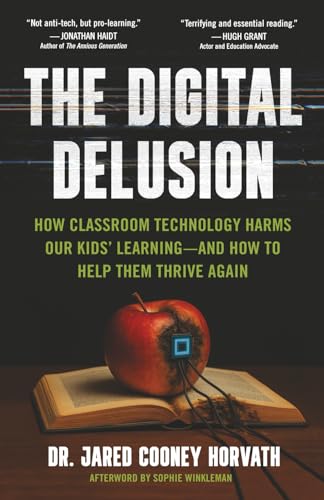
Dr. Jared Cooney Horvath is a teacher turned neuroscientist who studies how humans learn. In January 2026 he testified before the US Senate that pulling smartphones out of schools is only step one, because the laptops do not teach either. His book The Digital Delusion, re-released by Harmony on August 18, 2026, lays out the data showing that student outcomes fell as technology entered education, and then explains the mechanism underneath it.
The mechanism is transfer. Learning only moves in one direction, hard to easy. You learn to handwrite before you type, and to do arithmetic before you reach for a calculator. Technology exists to strip friction out, so a child who starts easy has nowhere harder to go. That produces the distinction at the center of this conversation: an expert who hands a task to a tool is offloading, because they can vet the output the second it appears. A novice doing the same thing is outsourcing, and learns nothing at all.
Host Ryan Vet, who does not allow screens in his own house, presses on where that leaves parents, schools, and AI. Horvath's answer on AI in K through 12 is unambiguous, and his answer on whether Gen Z can recover is two words: heck no, it is not too late.
Learning only transfers in one direction, hard to easy. A child who learns to handwrite can move to typing, but a child who starts on the easy tool cannot move that skill into anything harder.
An expert who hands a task to AI is offloading, because their expertise lets them vet the output immediately. A novice who hands over the same task is outsourcing, and learns no facts and no skills in the process.
Almost all of the measured benefit of an AI tutor shows up on the tutor itself. When researchers test whether students can apply the skill off the program, scores fall sharply, the same pattern that ended the brain training industry.
Learning from a human teacher produces physiological synchrony, with an effect size of 0.68. There is no biology in a screen for a child to resonate with, so an entire mechanism of human learning is simply removed.
Between 2013 and 2023 the share of kids worldwide meeting even minimum digital literacy dropped 13%, while the share explicitly taught to use computers at school rose by hundreds of percent.
PISA first measured creative thinking in 2022. Singapore ranked first at 41 out of 60 against an OECD average of 33. Most systems that scored well in creative thinking also scored well in math, reading and science, though several did not.
Seven months after the book first published, proposed state ed tech bills went from 3 to 31. Horvath calls the fix a reversion rather than a change, because the analog infrastructure still exists.
Plain-language definitions for the ideas in this episode. Structured for search and AI answers.
The movement of knowledge or a skill from the context where it was learned into a different context. It reliably runs hard to easy, from handwriting to typing or from arithmetic to a calculator, and it does not run in reverse.
In this episode: Horvath's answer for the single biggest reason classroom technology fails.
Handing a task to a tool that you already know how to do yourself. It works because your expertise lets you judge the output the moment it appears.
In this episode: What Horvath does when he asks AI to run statistics he could run by hand.
Handing a task to a tool with no knowledge of the process and no ability to judge whether the result is right. Same tool as offloading, opposite outcome.
In this episode: What happens when a novice is given an expert's productivity tool, illustrated by the rented e-bike that runs out of battery.
The way two people in genuine rapport begin to match physically, with heart rates, breathing, and blinking falling into step and brain activity converging. The formal term for the underlying process is affective empathy.
In this episode: Why a human teacher has a 0.68 effect size on learning and a screen has nothing to resonate with.
The gradual loss of a human capability as each new tool removes the friction that built it, from spell check flagging a word to Grammarly rewriting the sentence.
In this episode: Ryan's frame for the slow handoff of thinking to software, which Horvath grounds in the data on transfer.
Lines worth keeping, verbatim from the episode.
They won't learn facts, they won't learn skills, they'll just learn dependence on the tool.
It takes human beings a couple years to learn how to speak, but it takes them decades before they have anything meaningful to say.
Your generation uses technology. My generation invented technology, which means it represents our way of thinking way more than it represents yours.
No one asked to have a screen put in their face for six hours a day every day at school.
School is nothing other than a giant ban. It is a recognition that kids are not ready for the real world.
As long as you're alive and breathing, this whole system is still malleable. So keep pushing it.
If they can learn the human skills of negotiating the playground, of working with a classmate, or even interfacing with a teacher, then they'll be fine prompting a machine.
Jump to any moment. Timestamps deep-link the audio.

Jared Cooney Horvath
Educational neuroscientist · Director, LME Global
Jared Cooney Horvath is a teacher turned neuroscientist. He started in the classroom teaching grades 6 through 12, went to study the brain during what he calls the decade of the brain so he could bring the science back to his students, and has now spent about 16 years in academia. He earned a master's in mind, brain, and education from Harvard, did a research fellowship at Harvard Medical School under Alvaro Pascual-Leone, and completed a PhD in cognitive neuroscience at the University of Melbourne. He lectured at the Melbourne Graduate School of Education from 2013 to 2024 and remains an honorary researcher at Melbourne and at St Vincent's Hospital Melbourne. He is the director of LME Global and the creator of The Learning Blueprint.
He built his reputation debunking overclaims rather than making them. His most-cited work found no reliable cognitive benefit from transcranial brain stimulation, directly against the commercial hype of the mid 2010s, and he has spent years pushing back on pop neuroscience that outruns its evidence. He now applies the same standard to educational technology. His argument is not that screens are distracting. It is that student-facing, internet-connected devices conflict with the mechanics of learning itself, which he calls a category problem rather than a software problem. He describes himself as pro-rigor, not anti-tech, and draws a hard line between teacher-facing technology, which he considers largely fine, and one-to-one student devices, which he does not.
His book The Digital Delusion was self-published in December 2025 and is re-released by Harmony, an imprint of Penguin Random House, on August 18, 2026, with roughly 25% more material. In January 2026 he testified before the US Senate Commerce Committee on technology in schools, arguing that removing smartphones is only the first step. He writes the Substack The Digital Delusion and posts learning research to his YouTube channel.
Straight answers to the questions this essay raises. Open by default, structured for search and AI.
Why does Jared Cooney Horvath say classroom technology harms learning? +
Because of transfer. Learning only travels in one direction, hard to easy. You learn to handwrite before you type and to do arithmetic before you use a calculator. Technology is designed to remove friction and keep things easy, so a child who starts easy cannot move that skill into anything harder. They learn dependence on the tool instead of the skill.
What is the difference between offloading and outsourcing? +
Offloading is what an expert does: they hand a task to a tool because they already know how to do it and can immediately vet the output. Outsourcing is what a novice does: they use the tool with no knowledge of the process and no ability to judge whether the result is right. Same tool, opposite outcome. Horvath's example is a rented e-bike that runs out of battery. The fit rider pedals home. The unfit rider calls an Uber.
Do AI tutors actually work? +
Horvath argues they work only inside narrow, right-or-wrong domains, and that almost all of the measured benefit shows up on the tutor itself. When researchers test whether students can apply the skill away from the program, scores fall sharply. He compares it to brain training apps, where players got better at the game and not at anything else.
Does Jared Cooney Horvath think AI belongs in schools? +
No. He argues AI has no place in K-12 because it is not a learning tool, and that school is by design a set of bans that shields children from the adult world until they are ready for it. He does distinguish teacher-facing technology, which he considers largely fine, from student-facing internet-connected devices, which he says are where learning collapses.
Is it too late for Gen Z? +
No. Horvath's position is that the brain stays malleable, so the capability can be rebuilt with effort. His hope is that as Gen Z recognizes what was done to them, they push back and demand something different for their own children.
Full show notes
Cognition had gone up every single generation since the late 1800s. Literacy, numeracy, working memory, executive function, IQ. School was the engine, and each generation spent more time in it than the one before. Gen Z spends more time in school than we did and is the first generation on record to move backward. Dr. Jared Cooney Horvath’s argument is that something decoupled cognitive development from schooling, and that the something was the technology we put in front of every child.
Horvath is a teacher turned neuroscientist who directs LME Global and testified before the US Senate in January 2026 that pulling smartphones out of schools is only step one. His book The Digital Delusion, re-released by Harmony on August 18, 2026 with roughly 25% more material, lays out the data and then explains the mechanism: transfer. Learning only travels hard to easy. You learn to handwrite before you type and to do arithmetic before you reach for a calculator. Technology exists to remove friction, so a child who starts easy has nowhere harder to go.
That leads to the distinction at the center of the conversation. An expert who hands a task to a tool is offloading, because their expertise lets them vet the output the moment it appears. A novice doing the same thing is outsourcing, and learns no facts and no skills at all. His illustration is a rented e-bike that runs out of battery: the fit rider pedals home, the unfit rider calls an Uber.
Host Ryan Vet, who does not allow screens in his own house, presses on what that means for parents and schools. Horvath’s answer on AI in K through 12 is unambiguous. His answer on whether Gen Z can recover is two words.
In this episode:
- Why Gen Z is the first generation on record to score lower than its parents, and what decoupled cognition from school
- Transfer, and why learning only runs hard to easy
- The difference between offloading and outsourcing, and the e-bike that explains it
- Why AI tutors mostly make kids better at AI tutors
- Physiological synchrony, the 0.68 effect size, and what a screen has no way to replicate
- Why millennials are more digitally literate than Gen Z despite never being taught
- What PISA’s first creative thinking results say about knowledge and originality
- The line between teacher-facing technology and student-facing devices
- Why Horvath says AI belongs nowhere in K through 12
- Whether it is too late for Gen Z, and why the fix is a reversion rather than a revolution