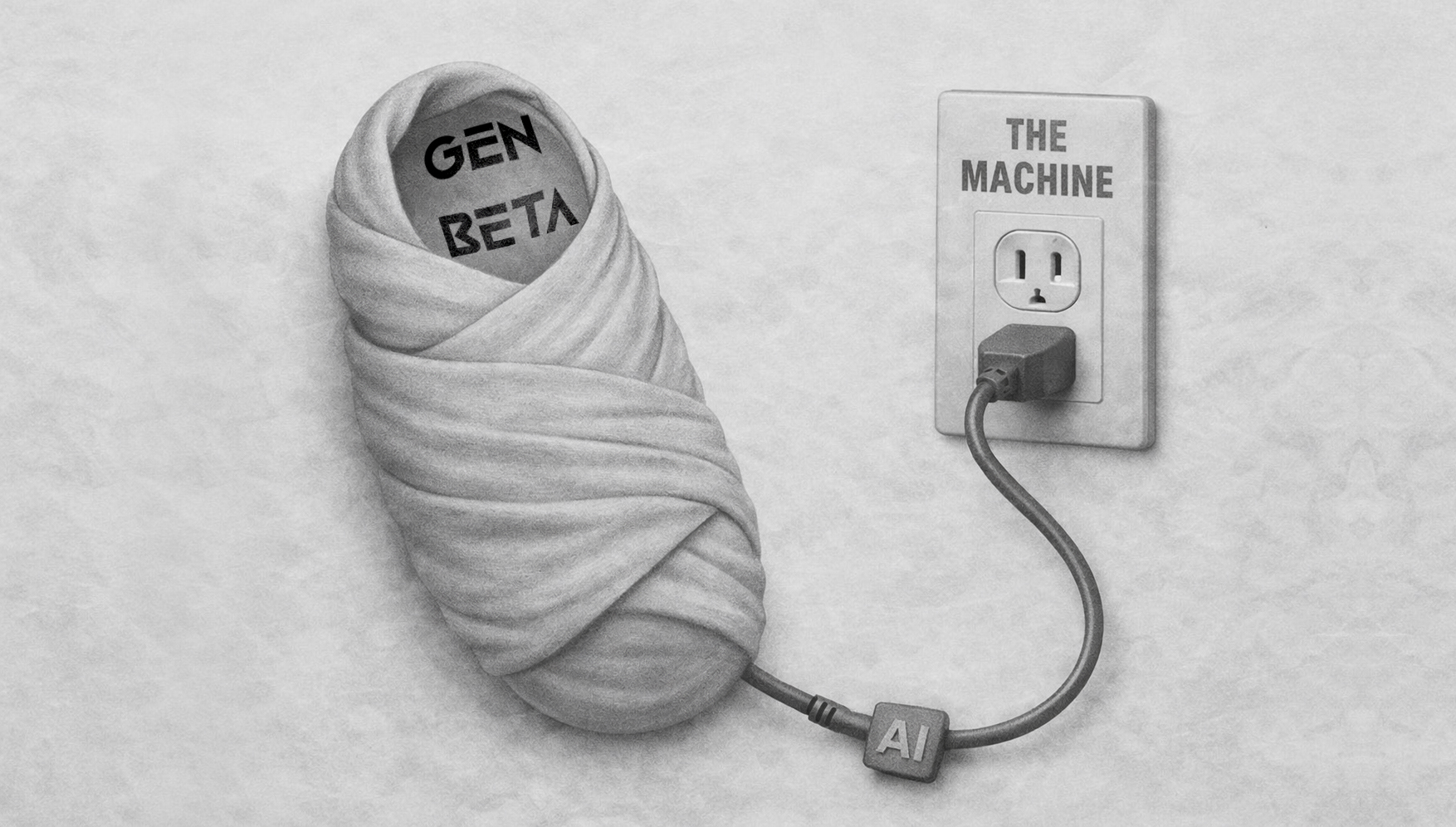
That is the short answer. The longer answer is more interesting, because the disagreement is not sloppiness. It is a window into how generations actually form, and why the tidy chart you saw shared on New Year's Day is more convention than finding.
The honest answer: nobody official decides this
There is no bureau of generations. No government office, no academic body, no single authority sets these lines. The U.S. Census Bureau formally defines exactly one generation, the Baby Boomers, and leaves the rest to researchers and writers. So when someone tells you Gen Beta "officially" started on January 1, 2025, the honest question is: official according to whom?
The name itself comes from Mark McCrindle, a social researcher in Australia who introduced the Greek-alphabet convention when Gen Alpha needed a label. His framework runs on clean fifteen-year cohorts: Gen Alpha from 2010 to 2024, Gen Beta from 2025 to 2039. That tidiness is a feature for a chart and a weakness for the truth. Human formation does not reset on a round number.
Look at how serious researchers actually disagree.
| Source | Gen Alpha ends | Gen Beta begins | Basis for the line |
|---|---|---|---|
| Mark McCrindle | 2024 | 2025 | Coined the Greek-letter naming; clean 15-year cohorts |
| Annie E. Casey Foundation | 2025 | 2026 | Child-and-family demographic data (KIDS COUNT) |
| Ryan Vet | 2025 | 2026 | Cultural tipping point: AI becomes ambient, not adopted |
| Jean Twenge | 2029 | 2030 | Technology-driven method (Generations, 2023) |
| Pew Research Center | Undefined | Undefined | Stepped back from fixed generational labels (2023) |
The spread runs from 2025 to 2030. That is a five-year gap between credible people looking at the same children. When the experts disagree by half a decade, the debate is not about who read the calendar correctly. It is about what a generation even is.
Labels are output, not input
This is the part most of the coverage skips. I work from a simple frame I call the Generational Prism: Age, Moment, Label. The label, Gen Beta or any other, is not the starting point. It is the output. It is what happens when a person's life stage collides with the conditions of the world around them. Start with the label and you get a caricature. Start with the moment and you get a generation.
So the question "when does Gen Beta start" is really "when did the world change enough that a child born into it is being formed by something new." That is not a January 1 event. It is a tipping point, and tipping points are visible mostly in hindsight.
Home internet went from roughly 1% of U.S. households to more than half in about seven years, with the hinge around 1998. The smartphone followed the same S-curve, reaching nearly half of U.S. adults by 2012. No one woke up on a specific morning and declared the shift. The shift declared itself, and the children raised after it were quietly different from the ones raised before.
Why 2026, and not 2025
Generative AI did not arrive gradually. ChatGPT reached 100 million users in roughly two months after its November 2022 launch, one of the fastest technology adoptions ever measured. By mid-2025, Pew found that 58% of U.S. adults under 30 had used ChatGPT, and that 38% of all U.S. adults were using generative AI at work. That is well past novelty and into normal.
Here is the hinge that decides the date. Childhood is shaped by what the adult world treats as ordinary. The parents, educators, and caregivers forming the earliest members of this cohort are disproportionately Millennials, who use AI tools at higher rates than any other adult generation, with a fast-growing share of Gen Z now entering parenthood behind them. A child born into that household is not adopting AI. They are being raised inside it, the way my generation was raised inside cable television without ever deciding to be.
By 2026, that condition is not coming. It is here. The tool became the environment. That is why I mark the line at 2026 and not at McCrindle's 2025: nothing culturally decisive happened on January 1, 2025 that had not already been building, and the fuller normalization, AI as ambient infrastructure in ordinary homes, reads more honestly as a 2026 reality.
Why 2026, and not 2029
Jean Twenge, whose data work I respect a great deal, extends Gen Alpha all the way to 2029 in her 2023 book Generations, which would push Gen Beta to 2030. Her method is technology-driven, and by that logic she waits for the next clearly distinct technological wave before closing the cohort.
I part ways with her gently here. If technology is the driver, the wave already broke. Waiting until 2030 to acknowledge it treats a shift that has already reordered how families search, learn, work, and answer their kids' questions as if it were still on the horizon. The tipping point is not five years away. It is behind us. A child born in 2026 is being formed inside it right now, which is exactly why getting the label right early actually matters.
The Generational Blur
None of this means the edges are sharp. They are not. I call the overlap the Generational Blur. Normalization never happens on a single day. It happens unevenly, across households and school districts and income levels and countries, some years ahead and some years behind. A child born in December 2025 and one born in January 2026 did not inherit different futures because a calendar flipped.
So when I say 2026, I am not drawing a fence. I am offering shared language, a place to stand so we can talk meaningfully about what is changing even when the boundary is soft. Pew's 2023 decision to step back from fixed generational labels was the intellectually honest move, and it points at the same truth: the value is not in the exact year. It is in naming the shift clearly enough to think about it.
What this actually changes
If you lead people or raise them, the date is not trivia. It is a prompt. The operating system the first AI-native generation will run on is being written right now, in the small decisions adults make about friction, trust, and attention. Whether a child is allowed to struggle before being handed the answer. Whether the first response to a hard question is a person or a prompt. Whether convenience is quietly allowed to replace competence before anyone notices the trade.
The year on the chart matters less than the recognition behind it. A new moment is here. A new generation is being formed inside it. And the most consequential choices about who they become are not being made in 2039, when the cohort closes. They are being made this year, at kitchen tables, by us.
Frequently asked questions
When does Gen Beta start?
Gen Beta starts in 2026. The boundary is contested: Mark McCrindle marks 2025, the Annie E. Casey Foundation ends Gen Alpha in 2025 which puts Gen Beta at 2026, and Jean Twenge extends Gen Alpha to 2029. I land on 2026 because generations follow cultural tipping points, and 2026 is when AI became ambient infrastructure children are raised inside of rather than a tool adults adopt.
Is Gen Beta 2025 or 2026?
Both dates are defended by credible sources, which is why you see them both. 2025 comes from Mark McCrindle’s clean fifteen-year naming convention. 2026 comes from the Annie E. Casey Foundation’s end of Gen Alpha in 2025, and from the view that a generation begins at a cultural tipping point. I use 2026, and I treat the edge as intentionally fuzzy, an overlap I call the Generational Blur.
What generation is my child if they’re born in 2026?
A child born in 2026 is Gen Beta by my read, and by the Annie E. Casey Foundation’s, which ends Gen Alpha in 2025. Mark McCrindle would place a 2026 birth in Gen Beta too, since he starts the cohort in 2025. Only Jean Twenge’s later boundary would still count 2026 as Gen Alpha. So across almost every framework, a child born in 2026 is Gen Beta.
Who decides when a generation starts?
No official body does. The U.S. Census Bureau formally defines only the Baby Boomers. Every other generational boundary is set by researchers and writers, which is why Mark McCrindle, the Annie E. Casey Foundation, and Jean Twenge can place the Gen Alpha to Gen Beta line anywhere from 2025 to 2030.
What years is Gen Beta?
Gen Beta covers children born from roughly 2026 through the late 2030s. The start is debated between 2025 and 2030, and the end is projected rather than settled. The edges are intentionally fuzzy because normalization happens unevenly across families and institutions.
Why do some sources say Gen Beta started in 2025?
Because Mark McCrindle, who introduced the Greek-alphabet naming, uses tidy fifteen-year cohorts that place Gen Beta at 2025. That is a naming convention, not a cultural finding. The date got repeated widely on New Year’s Day 2025, but serious researchers still disagree by as much as five years.
Who comes after Gen Alpha?
Gen Beta, following the Greek alphabet after Alpha, a convention introduced by social researcher Mark McCrindle. The generation after Gen Beta would, by that same convention, be Gen Gamma, though whether that name sticks is an open question.
Is Gen Beta the same as Gen Alpha?
No. Gen Alpha and Gen Beta are consecutive cohorts, not the same generation. Gen Alpha covers children born from roughly 2010 to 2025, and Gen Beta begins where Alpha ends. The clearest difference is the tipping point: Gen Alpha grew up as technology accelerated around them, while Gen Beta is the first cohort formed with AI as ambient infrastructure from birth rather than a tool they adopt.