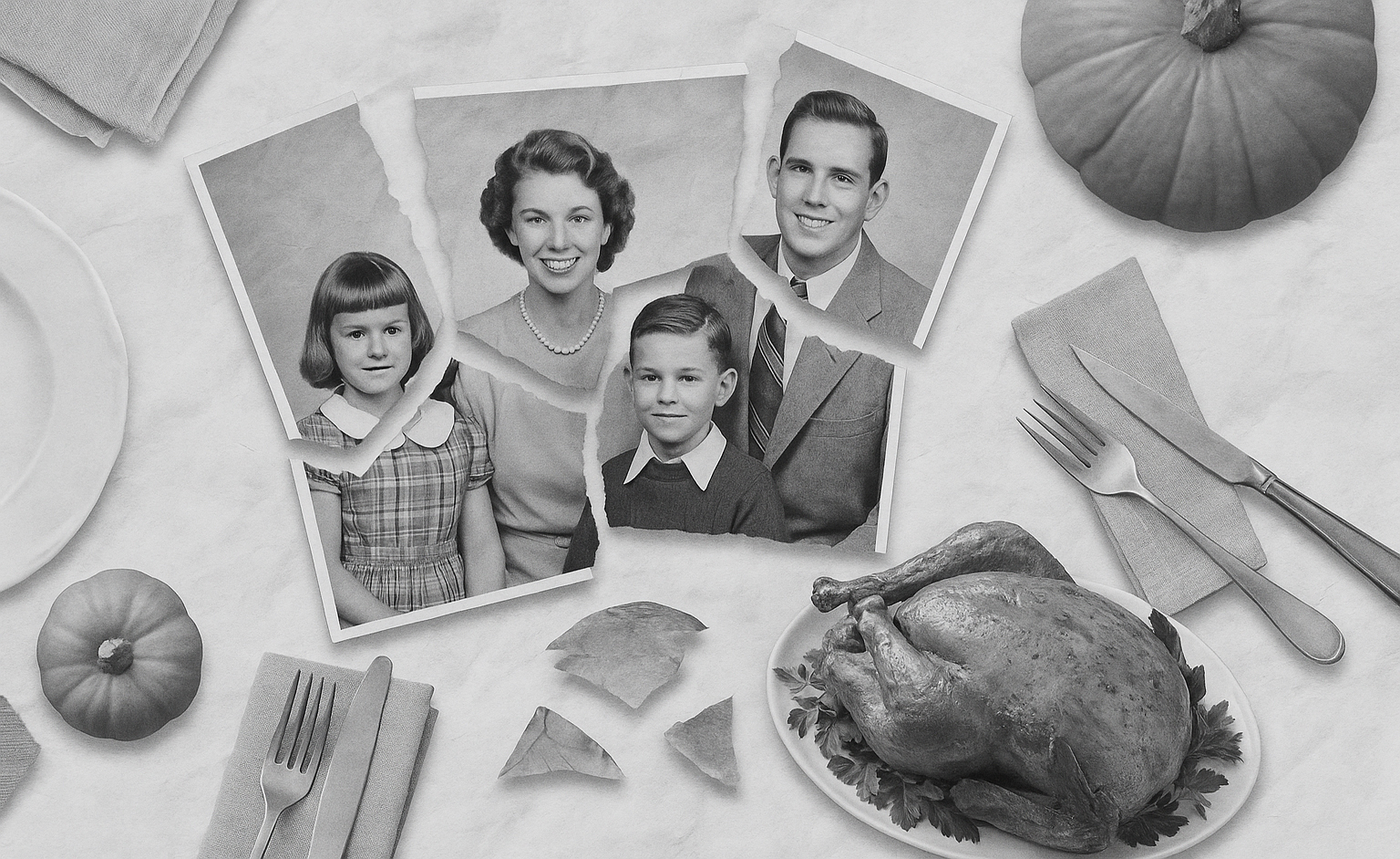
From Chandler Bing to Gen Z: The Thanksgiving Rebellion Reshaping the American Family
From 90s sitcom drama to real-time estrangement, the holiday table is revealing a quiet generational shift in how we show up and why some don’t.
Read the full essayThe data behind this essay. Every figure traces to a source the essay cites. Hover any card to share it.
Families have always been messy. What changed is that conflict used to be something we worked through, not something we walked away from.
89 percent of Americans report increased stress during the holidays, and it is not a generational problem. Seven of the top 10 contributors are relational or familial. Ryan notes the tension is not new either, pointing to the ninth episode of Friends, 31 years ago, where Chandler explains he loathes Thanksgiving because it is the day his parents announced their divorce.
What has changed is estrangement. Millions of Americans now identify as estranged from a parent, sibling, or child, citing toxic parents, boundary violations, and the need to protect their own mental health. Ryan notes the irony that the term toxic parenting was coined only a few years before Gen Z was born. He is careful not to make light of genuinely harmful family situations, while observing that a generation raised to prioritize psychological safety may read normal family conflict as harm.
The data backs a broader drift. 26 percent of U.S. adults have cut off communication with a parent. A Becoming You Labs whitepaper analyzing over 80,000 people found the family first mentality among Gen Z sits 54.7 percent below Boomers and Gen X, and 38 percent below Millennials. Meanwhile fertility has fallen from over 3.0 births per woman in the mid-20th century to roughly 1.62 today, and median age at first marriage has risen to about 30 for men and 28 for women, against 22 and 20 in the 1950s.
Ryan runs it through the Generational Prism. Age effects say young adults of every era are more exploratory and self-focused. Moment effects say estrangement can now be validated instantly and publicly in ways unthinkable 30 years ago. Label effects account for a cohort raised by helicopter parents and formed as global citizens rather than members of an immediate family. His close is not a scolding: belonging, however imperfect, still matters.
89 percent of Americans report increased stress during the holidays, and 7 of the top 10 contributors are relational or family-related rather than financial.
26 percent of U.S. adults have cut off communication with a parent, and Gen Z's family first mentality ranks 54.7 percent below Baby Boomers and Gen X, and 38 percent below Millennials.
U.S. fertility has fallen from over 3.0 births per woman in the mid-20th century to roughly 1.62 today, the lowest in modern U.S. history (CDC and NCHS, 2025).
Median age at first marriage has risen to about 30 for men and 28 for women, compared with 22 and 20 in the 1950s, while 9.1 percent of U.S. adults now cohabit, up from 3.7 percent in 1996.
The flavor of family discord has evolved. Thirty-one years ago it was divorce, parent against parent. Now the fracture runs at every level: brother against sister, mother against daughter.
Plain-language definitions for the ideas in this episode. Structured for search and AI answers.
The degree to which a person treats family as a defining feature of identity and purpose rather than one value among many. Research across 80,000 people finds a sharp downward tilt among Gen Z.
In this episode: The measurable drift underneath the estrangement trend.
Ryan Vet's Age, Moment, Label model, used to separate what is simply young adulthood from what is a genuine cultural shift likely to persist as a cohort matures.
In this episode: How Ryan tests whether the family drift is a life stage or a lasting change.
The imprint of the specific conditions a cohort lives through. Here it is a media environment where family estrangement can be posted, validated, and rewarded publicly within minutes.
In this episode: Why what Boomers might call a typical Sunday dinner now gets labeled toxic.
Lines worth keeping, verbatim from the episode.
Once conflict was something we worked through, not something we walked away from.
belonging, however imperfect, still matters
Straight answers to the questions this essay raises. Open by default, structured for search and AI.
Why is family estrangement becoming more common? +
The essay points to a Vogue article showing that millions of Americans now identify as estranged from a parent, sibling, or child. The most cited reasons are toxic parents, boundary violations, and unsafe relationships, along with a desire to protect one's own mental health. Ryan Vet frames this as a sign of the rising need for psychological safety among Gen Z, while noting that the term 'toxic parenting' only entered the culture in a 1989 book by Dr. Susan Forward.
What is the Generational Prism and how does it explain these family trends? +
The Generational Prism is a model Ryan Vet uses to separate age effects, moment effects, and label effects when reading a generation. Age effects note that younger adults of every era are more exploratory and self-focused. Moment effects capture how social media therapy and boundary culture now validate estrangement publicly, while label effects account for Gen Z growing up as digital natives shaped by helicopter parenting. Together they help distinguish a passing stage of youth from a lasting cultural trend.
How much has the importance of family declined for Gen Z? +
Citing a Becoming You Labs whitepaper, the essay reports that Gen Z's 'family first' mentality ranks 54.7% below Baby Boomers and Gen X, and 38% below Millennials. The whitepaper's author, Daniel B. Davis, PhD, analyzed a sample of more than 80,000 people. He concluded that younger adults treat family as one value among many rather than a defining feature of identity or purpose.
How have marriage, childbearing, and living arrangements shifted? +
The essay reports that U.S. fertility has fallen from over 3.0 births per woman in the mid-20th century to roughly 1.62 today, the lowest in modern U.S. history. The median age at first marriage has risen to about 30 for men and 28 for women, up from 22 and 20 in the 1950s. Cohabitation has also become common, with 9.1% of U.S. adults now living with a partner, up from 3.7% in 1996.
What does Ryan Vet mean by family being redefined? +
The essay argues that the nuclear-family version of the American Dream has given way to smaller families, later marriages, and normalized cohabitation. Blended families, multi-generational households, LGBTQ+ families, and chosen family networks have become mainstream. Like every swing of the Generational Pendulum, these changes bring their own unintended consequences.
Full show notes
Thanksgiving used to be about turkey, travel, and tradition. Today, it’s becoming a litmus test for where families stand and in many cases, why they’re falling apart.
In this episode, Ryan Vet breaks down the quiet generational rebellion happening around the holiday table. Drawing from his widely read COLLIDE article and insights shared at ThinQ, Ryan explores why family estrangement is rising, why Gen Z is more likely to skip family gatherings, and how psychological safety, boundaries, and “toxic family” language are redefining what it means to belong.
You’ll hear the stat from psychotherapist Matthias Barker that stunned the ThinQ audience:
26% of U.S. adults have cut off communication with a parent.
From Chandler Bing’s Thanksgiving dread to Gen Z’s emotional safety checklist, this episode explains the cultural forces reshaping family, identity, and holiday traditions. It’s not about blaming any generation; it’s about understanding why the family structure is shifting and what that means for all of us this holiday season.
If you’ve ever felt tension walking into a family gathering, wondered why someone stopped showing up, or sensed that Thanksgiving “doesn’t feel the same anymore,” this conversation will connect the dots.
🔥 What You’ll Learn
• Why family estrangement is becoming mainstream • The Generational Prism and how each generation interprets conflict • Why Gen Z prioritizes psychological safety over tradition • How social media therapy normalizes going “no contact” • Why Millennials often feel caught between duty and boundaries • The shift from “family first” to “identity first” • How the holiday table reveals the future of the American family
📰 Want more conversations like this?
Subscribe to COLLIDE, Ryan’s weekly newsletter on generational leadership, cultural change, and the future of how we live and work: 👉 https://collide.ryanvet.com/
It’s where the deeper insights live and where every episode starts.
Send us Fan Mail
About Ryan VetRyan Vet is a USA TODAY bestselling author, futurist, and international keynote speaker whose insights on generations, culture, and the future of work have been featured in Forbes, Financial Times, ABC, NBC, and CBS. His research helps leaders understand emerging generational patterns and anticipate societal shifts before they fully unfold.
Join 20,000+ Leaders for Weekly InsightsIf you want deeper research and behind-the-scenes insights on generations and the future of culture and society, join Ryan’s weekly newsletter: 👉 https://ryanvet.com/collide