That quiet steadiness is the whole story, and it is exactly why they get missed. It matters more than the label, and how we use the label matters more than most people realize. So before we talk about who Gen X is, we have to talk about how to think about them at all.
Labels are output, not input: the Generational Prism
I push back on generational labels often. Not because they are useless, but because they get treated like settled science when they are really shorthand, and shorthand that is easily misused. Start with the label, and you end with a caricature. Start with the moment, and you get a generation.
That is why I rely on a framework I call the Generational Prism: Age, Moment, Label. The label is the output, not the input. It is what happens when a person's life stage collides with the conditions of the world around them.
Gen X got handed the "slacker" label young, all flannel and grunge and apparent indifference. Run it through the Prism and it inverts. What looked like disengagement was self-reliance, learned early by kids who came home to empty houses and figured things out on their own. What looked like a lack of ambition was a deliberate refusal to sacrifice everything for a title, made by people who watched their parents do exactly that. The slacker turned out to be one of the hardest-working, most dependable generations in the workforce. The label was lazy. The reality was the opposite.
When does Gen X start and end?
Gen X covers those born between 1965 and 1980, the range used by Pew Research Center, and the one I use. As of 2026 that makes them roughly 46 to 61 years old, squarely in their peak earning and leadership years.
They are also notably smaller than the generations on either side, about 15% smaller in population than the Boomers before them or the Millennials after. That size gap matters more than it sounds. A smaller cohort simply had fewer people in line for the top jobs, and it is part of why Gen X has spent its whole life as the demographic middle child, quieter by numbers as much as by temperament.
Who they are: the latchkey generation
To understand Gen X, start with the empty house. They were the original latchkey kids, the ones who let themselves in after school, sometimes with a key on a shoelace around the neck, and were met by the glow of the television, often MTV, in an empty living room. No one was home, and that was normal. Their freedom was not curated the way it would later be curated out of Millennials and Gen Z. It was simply expected. They could do more or less whatever they wanted after school, as long as they were home by the time the streetlights came on. Entertainment was a place you went, not a screen you held: quarters in hand at the arcade, shoulder to shoulder with other kids, waiting your turn at Space Invaders. They figured things out because they had to, and that early, unsupervised self-reliance became the defining trait of the entire cohort. It is the single most useful lens for understanding everything that came after.
It shaped how they see institutions, too. Where later generations would look at institutions and say, "I do not trust you, but I do not know where else to go," Gen X looked at them and said, "I do not trust you, so I will take care of myself." That is not cynicism for its own sake. It is the natural conclusion of a generation that learned early that the adults and the systems around them were not always going to catch them.
And it shaped what they want out of work. Gen X was the first generation to genuinely want work-life balance, and to mean it. They watched the cost of relentless ambition play out in their parents' lives, the burnout, the missed dinners, the identity swallowed whole by a job title, and many of them quietly decided they wanted no part of it. To Gen X, work is work. They will do it well, and then they will go home. That is not a lack of drive. It is drive that has been calibrated differently, toward doing meaningful work rather than chasing a prestigious badge.
What shaped them
When I trace what forms a generation, I use seven cultural levers, with a helpful acronym of R.E.S.P.E.C.T.: Religion, Education, Sex and Gender, Politics, Economics, Communication, and Technology. For Gen X, the story lives mostly in work, technology, and a hard-won skepticism, so start there.
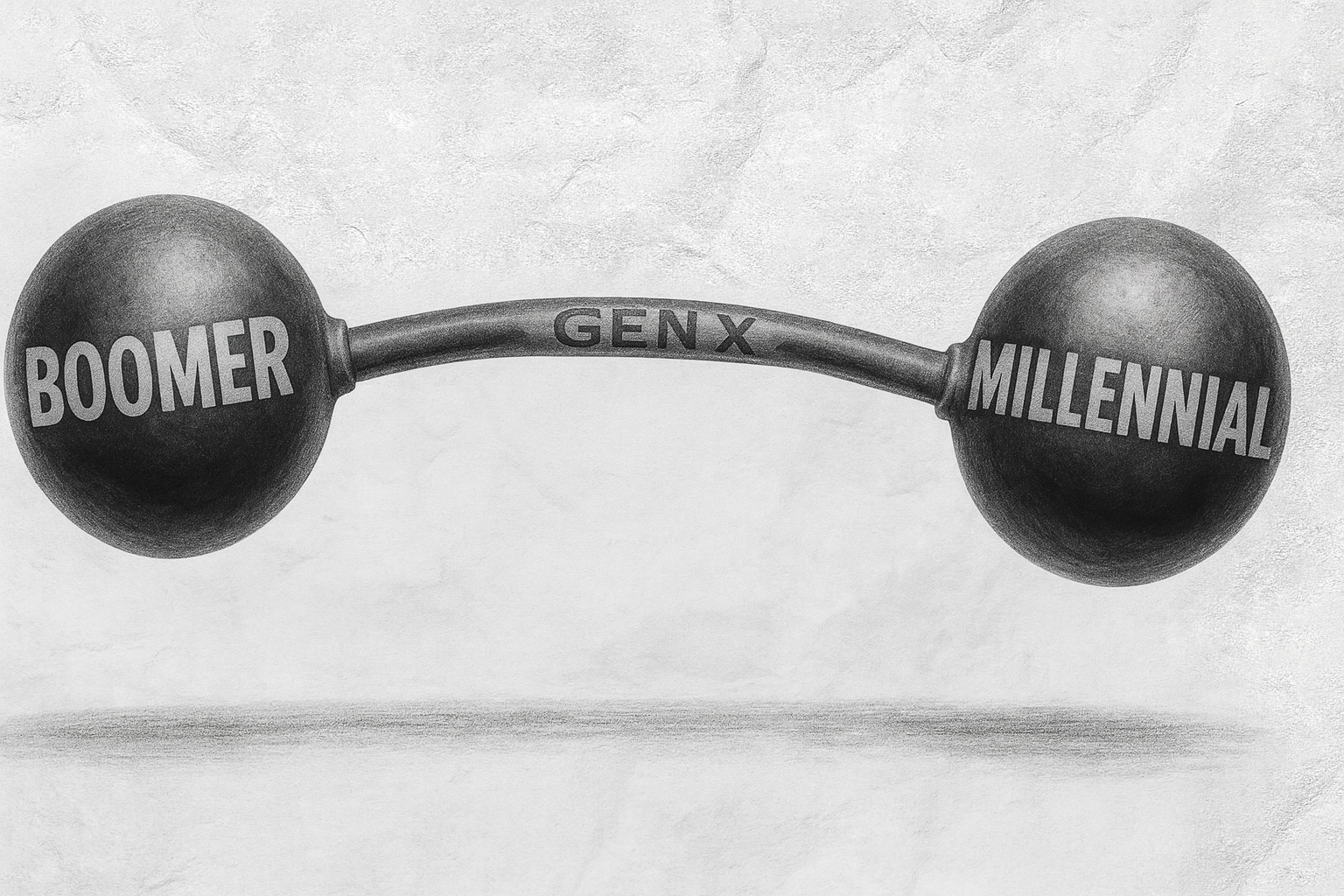
Economics and work. This is the heart of the Gen X story. The latchkey childhood produced a generation of self-starters who deliver consistently and quietly, and who make, by my read, some of the hardest-working and most dependable employees in any workplace. But their quiet competence has a cost in visibility. Gen X now holds more than half of all U.S. management roles yet is underrepresented at the very top, and the reason is what I call the Barbell Effect. They are squeezed between two heavier weights: Boomers holding onto executive seats longer than ever, and Millennials sprinting up the ladder behind them. Gen X holds roughly 43% of CEO roles today, still the largest single block, but that number is shrinking fast as Boomers delay their exits and Millennials climb (LinkedIn, 2024). When those Boomer tenures finally run out, the corner office is more likely to skip to a 40-something Millennial than to land on a 60-something Gen Xer. It is not that Gen X could not keep pace. Many of them chose a different pace.
The Barbell Effect (Ryan Vet)
The leadership squeeze on Gen X, compressed between two heavier weights on either end of the bar. On one end, Boomers are holding executive seats longer than ever. On the other, Millennials are climbing fast. Gen X, the smaller cohort in the middle, ends up holding most of the management jobs but a shrinking share of the very top ones. Not for lack of ability, but because the bar is loaded against them on both ends.
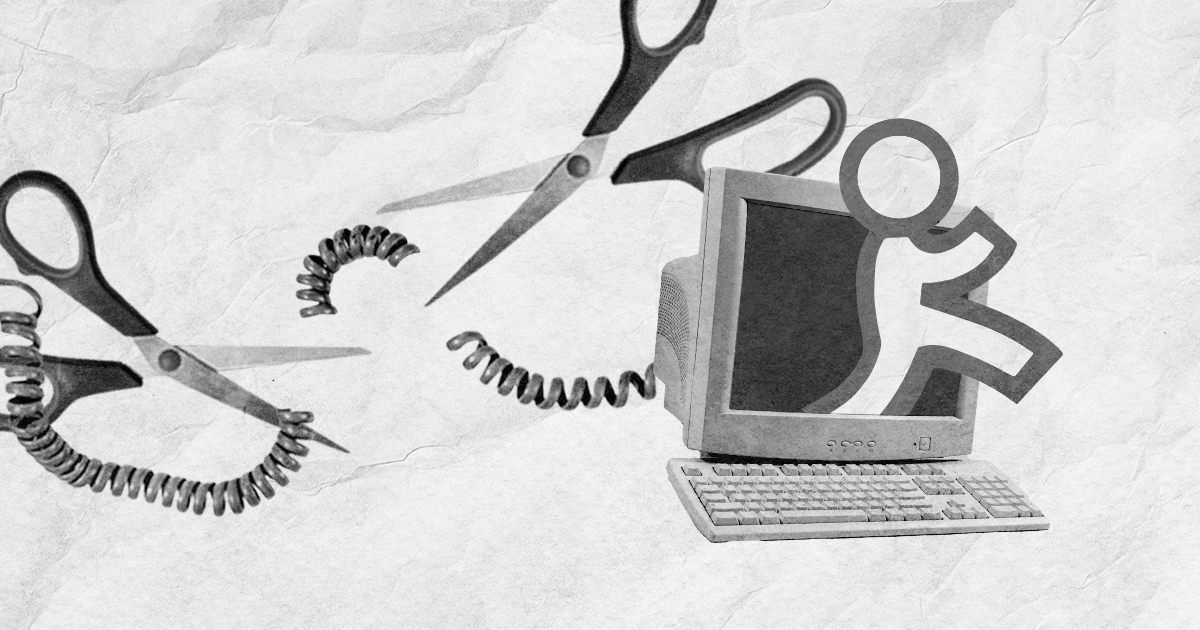
Technology. Gen X was the first generation to grow up with personal technology, and the frontline generation that carried the world across the analog-to-digital divide at work. They used the computer labs, logged into the first corporate email, and learned to translate between the fax machine and the inbox. Crucially, they did not experience the internet in their most formative teenage years, which is exactly why they can hold both worlds at once. They remember the analog era and they are fluent in the digital one, which makes them the rare cohort that can bridge the two, a skill that is quietly valuable in a volatile AI era.
Politics. If one thing hardened Gen X's worldview, it was watching institutions fail in real time. Their political formation ran from Watergate through the Clinton-Lewinsky scandal, a steady drumbeat of reasons to distrust the people in charge. It shows in the data. Only about 19% of Gen X adults say they trust the federal government most of the time (Pew Research Center, 2015). Their politics are less about party loyalty and more about a baseline skepticism of authority itself, the same "I will take care of myself" instinct applied to public life.
Communication. For Gen X, culture had a shared soundtrack, and it mostly came through MTV. When they came home to those empty houses, the television told a whole generation what to wear, what to say, and what to sing. That shared cultural feed is largely gone now, splintered by algorithms into millions of private playlists, which is part of why Gen X can feel like the last generation to have grown up inside a genuinely common culture.
Religion. Gen X sits at the hinge point where institutional religion's grip began to loosen. When they were around 21, in the late 1980s and early 1990s, only about 9% of young adults claimed no religious affiliation, and the vast majority still identified with a church even as its cultural authority quietly started to erode (NORC, 2014). Gen X did not break from institutional faith the way the generations after them would. They are simply where the long, slow drift began.
Sex and gender. Gen X grew up as the culture visibly began to open. Television diversified, with multiracial casts and storylines reaching the mainstream, and the language shifted with it: salesmen became salespeople, and identities that had been hidden or shunned in their parents' era slowly started to be spoken about openly. Gen X did not complete that shift, but they are the generation that watched it begin, which is part of why they tend to be more matter-of-fact about difference than the cohorts just before them.
Education. For Gen X, the four-year college degree moved from an advantage to an expectation. Where a diploma had once set you apart, by their turn it was simply the assumed next step, the default path to a stable career. That change, degree as baseline rather than degree as edge, helped set up the student-debt spiral that would land hardest on the Millennials they raised.
How to lead and work with them
Here is the thing leaders most often get wrong about Gen X: they mistake quiet for complacent. Gen X is now 46 to 61, holding the majority of management roles and a shrinking share of the top ones, and if you overlook them you lose exactly the kind of leadership that does not announce itself, the resilience, the steadiness, the person who keeps the organization upright when the storm hits.
So do not make them grandstand for it. Elevate the quiet leaders, and give them visibility without forcing self-promotion, because a generation raised to grind rather than grandstand will rarely campaign for its own recognition. Build succession pathways that reward the steadfast and not only the vocal. And lean on Gen X as bridge mentors, because they are the one cohort fluent in both the analog and the digital, and both trusted and grounded enough to translate across the generational divides above and below them.
Respect the boundary, too. Gen X will produce excellent work and then go home, and that is not disengagement, it is the balance they consciously chose after watching the alternative. Give them autonomy and skip the micromanaging. They were self-starters at nine years old. They do not need you standing over their shoulder now.
The irony of the middle child is that the overlooked one is often the most dependable one in the room. Gen X was never chasing the badge. They are just quietly still here, doing great work, steadily moving things forward.
Frequently asked questions about Gen X
What years is Gen X?
Gen X covers those born between 1965 and 1980, the range used by Pew Research Center. As of 2026 that makes them roughly 46 to 61 years old. They are also about 15% smaller in population than the Boomer and Millennial cohorts on either side of them.
Why is Gen X called the "forgotten" or "middle child" generation?
Because they sit between two much larger, louder cohorts. Boomers and Millennials command the cultural conversation and the leadership pipeline, while Gen X, smaller in number and quieter in temperament, tends to get skipped over. Pew has literally called them America's "neglected middle child."
What are Gen X's defining characteristics?
Self-reliance above all. As the latchkey generation, they learned independence early and grew into steady, dependable, hardworking adults who value work-life balance and are deeply skeptical of institutions. They deliver quietly rather than grandstand, and they would rather do meaningful work than chase a prestigious title.
What is the "Barbell Effect"?
It is my term for the squeeze Gen X faces in leadership. On one end, Boomers are holding executive seats longer than ever. On the other, Millennials are sprinting up the ladder. Gen X, the smaller cohort in the middle, gets compressed between the two, which is why they hold most management jobs but a shrinking share of the very top ones.
How is Gen X different from Boomers and Millennials?
Boomers defined themselves by their careers, titles, and the climb. Millennials want mentorship, feedback, and purpose in the work. Gen X wants to be left alone to do good work and then go home. They are the most self-reliant and the most institution-skeptical of the three, and the least interested in the applause.
Are Gen X good leaders?
Often the best, and the most underrated. Their leadership is not flashy, but it is foundational: steady, resilient, and quietly effective. They also make excellent bridge mentors, because they are fluent in both the analog and digital worlds and trusted across the generations on either side of them.