That word, inherited, is doing a lot of work, and we will come back to it. It matters more than the label, and how we use the label matters more than most people realize. So before we talk about who the Boomers are, we have to talk about how to think about them at all.
Labels are output, not input: the Generational Prism
I push back on generational labels often. Not because they are useless, but because they get treated like settled science when they are really shorthand, and shorthand that is easily misused. Start with the label, and you end with a caricature. Start with the moment, and you get a generation.
That is why I rely on a framework I call the Generational Prism: Age, Moment, Label. The label is the output, not the input. It is what happens when a person's life stage collides with the conditions of the world around them.
Lately the Boomer label has curdled into a punchline, "OK Boomer," shorthand for out of touch and holding on too long. Run it through the Prism and it softens into something more human. The drive that reads as materialism was planted by frugal, Depression-scarred parents who promised their children the Dream they never had. The self-focus that earned them the "Me generation" nickname was the flip side of being the first cohort told, from childhood, that they could be anyone and have anything. Judge the label and you get a caricature. Trace the moment and you get a generation doing exactly what it was raised to do.
When do the Baby Boomers start and end?
Baby Boomers cover those born between 1946 and 1964, the range most historians agree on and the one I use. As of 2026 that makes them roughly 62 to 80 years old, moving through retirement or already in it.
The name is literal. After World War II ended in 1945, the troops came home, and for nearly a decade the United States produced babies at a rate of about four million a year, roughly double the birth rates of the generations just before and after. It was the largest generational cohort the country had ever seen, and it stayed that way until the Millennials narrowly surpassed it decades later. That sheer size is part of why the Boomers have shaped every stage of American life they have passed through, simply by moving through it.
Who they are: the American Dream generation
To understand the Boomers, start with their parents. The Silent Generation had lived through the Depression and the war, and they raised their children to keep the peace and to want more than they had. Boomers grew up resenting the frugality of that upbringing and were promised, from childhood, a new and expanded American Dream: not the immigrant's dream of arrival, but the picture-perfect one of a single-family home, a white picket fence, 2.2 kids, and a good car in the garage. They were taught they could be whoever they wanted and have whatever they wanted, and they went to work to prove it.
That produced a generation whose identity became tightly wound around career and title. Ask a Boomer to tell you about themselves and many will lead with what they do and where they do it. They built the sixty-hour work week, and to this day they largely enforce it, having learned that being first in and last out was how you signaled loyalty and climbed the ladder. Their instinct with money followed the same logic: spend now, worry later, because money was proof that the Dream was working.
But there is a second Boomer, and it is easy to forget. Before they were corporate climbers, they were idealists and rebels. They came of age amid Vietnam, the Cold War, and the Civil Rights movement, and they were arguably the first modern generation to take a public stance, to question everything, and to believe they could change the world. Peace, love, and music were not marketing slogans to them. They were values, sung at Woodstock and carried into adulthood. The Boomer story is the tension between those two selves: the idealist who wanted to change the world and the climber who wanted to win in it.
What shaped them
When I trace what forms a generation, I use seven cultural levers, with a helpful acronym of R.E.S.P.E.C.T.: Religion, Education, Sex and Gender, Politics, Economics, Communication, and Technology. For the Boomers, nearly every lever is loud, because they lived through a period of extraordinary change.
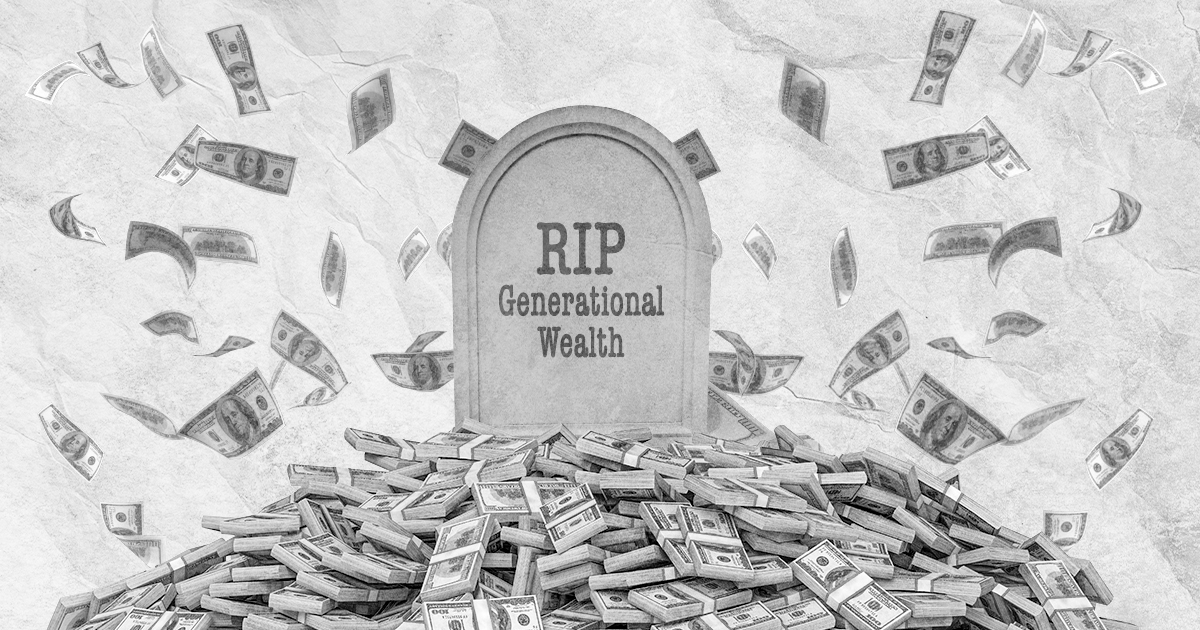
Economics. This is the center of the Boomer story. Postwar prosperity, rising wages, and, for the first time, two-income households gave American families more disposable income than ever before, and the Boomers spent it. Money became a status symbol, credit became a strategy rather than an emergency, and the bigger house and nicer car became the scoreboard of a life well climbed. Decades later, that accumulation has made them the wealthiest generation in history. Boomers hold more than half of all U.S. household wealth (Cerulli Associates, 2023), and they are now at the pivot from accumulation to legacy. An estimated $84.4 trillion will pass from Boomers and the Silent Generation to their heirs by 2045, with Boomers alone transferring roughly $53 trillion (Cerulli Associates, 2023). I call it the Great Wealth Transfer, and it is not merely a financial event. It is a cultural one, a generation moving from building empires to building legacies, and figuring out, sometimes late, that a true legacy is measured in purpose rather than in zeroes.
The Great Wealth Transfer (Ryan Vet)
The largest handoff of wealth in history: an estimated $84.4 trillion moving from Boomers and the Silent Generation to their heirs by 2045, with Boomers alone passing down roughly $53 trillion. It is not merely a financial event but a cultural one, a generation turning from building empires to building legacies, and learning, sometimes late, that legacy is measured in purpose rather than in zeroes.
Politics. The Boomers were shaped by a country in constant conflict: the Cold War, duck-and-cover drills, and above all Vietnam. A generation of eighteen-year-old men could be drafted to fight and die without the right to vote, a grievance that helped drive the 26th Amendment and lowered the voting age to eighteen in 1971. Vietnam and then Watergate seeded a deep and lasting distrust of government that never fully left them. It also made them activists. Unable to fix a war an ocean away, they turned inward to the causes they could touch, most powerfully the Civil Rights movement, and learned that a generation could raise its voice and move the country.
Sex and gender. The approval of the first oral contraceptive in 1960 helped open what became the Sexual Revolution, and the Boomers were the young adults living it. For the first time at scale, sexuality was framed as self-expression rather than taboo, and women began to be seen, and to see themselves, as more than mothers and homemakers. It was a decisive break from the moral framework of their parents, and its aftershocks reshaped the American family for decades.
Technology. The Boomers were the first television generation, raised in front of a screen that, by 1960, sat in the majority of American homes. They grew up in the Space Age, and nearly every Boomer can tell you where they were for the 1969 moon landing, the moment a generation decided the sky was no longer the limit. They also watched the personal computer arrive as they entered adulthood. Notably, they adopted the biggest technologies of their lives, the computer and later the internet, on the back end, in already-established adult lives rather than in childhood, which is a very different relationship to technology than the generations raised inside it.
Communication. Boomers were the first generation raised inside a thriving pop culture, the first to grow up with movie stars, television personalities, and musical acts as daily fixtures. That gave them an appetite to be seen and to make a name for themselves that earlier generations did not have. It also produced the most affectionately mocked Boomer habit of all, the tendency to begin a sentence with "when I was your age," which is less about the younger listener than about a generation that genuinely climbed from modest beginnings and wants you to know it.
Religion. The Boomers came of age at the high-water mark of institutional religion in America. When they were around 21, church membership held above 70% of Americans, and claiming no religious affiliation at all was a genuine rarity, under 5% (Gallup, 2023). Whatever has happened to faith in the generations since, the Boomers grew up when the church still held the cultural center, which is exactly why the long drift that followed them feels so stark by comparison.
Education. For the Boomers, education expanded dramatically. High school completion became nearly universal, and college shifted from a rare privilege to an encouraged and increasingly normal path, especially for men. It was the beginning of the credential era, the long climb toward a world in which a degree would eventually become an expectation rather than an advantage.
How to lead and work with them
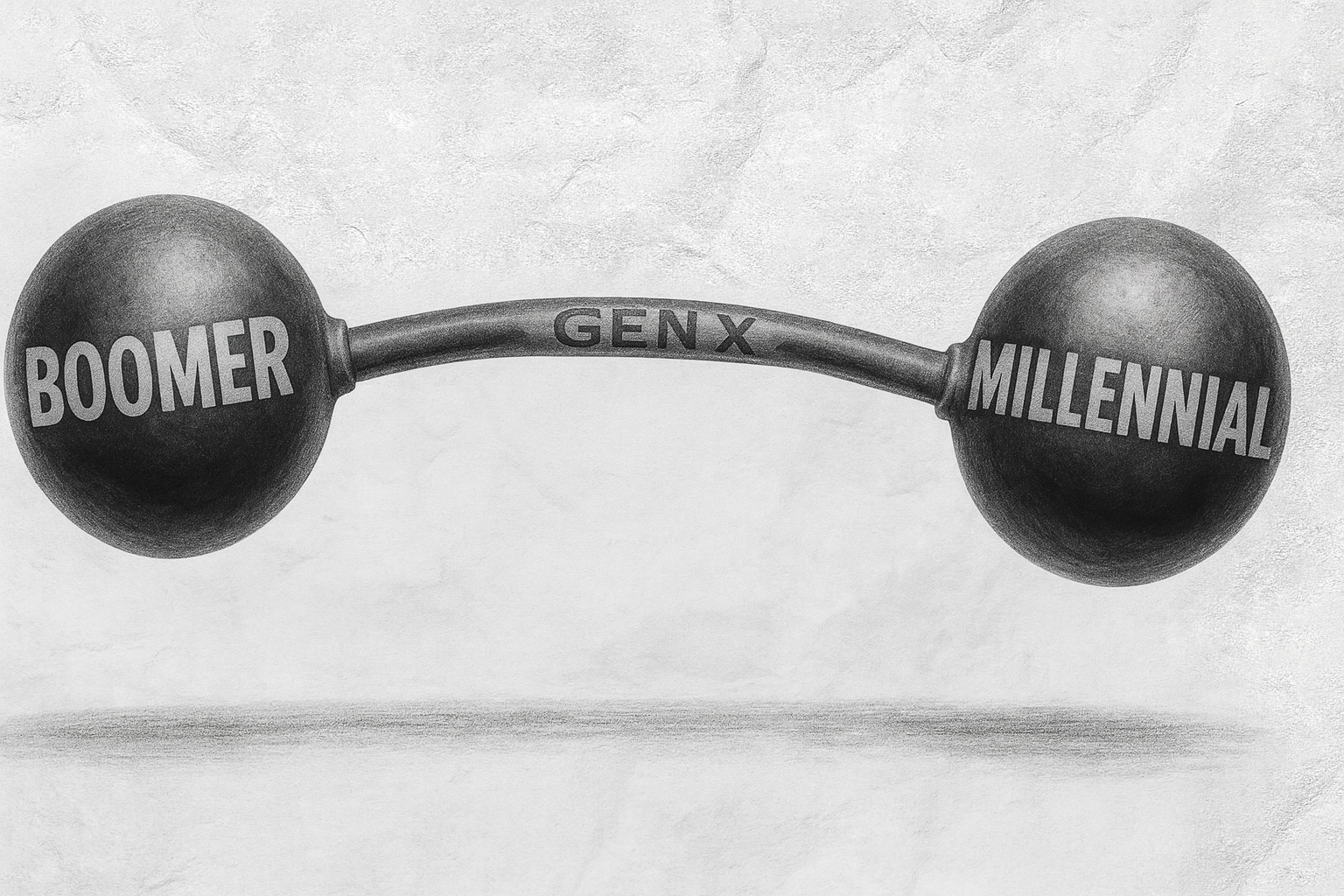
The Boomers are now the senior-most generation in the workforce, and the story with them is less about managing and more about transition. Some are holding onto executive seats longer than ever, extending careers and, in the process, forming one end of the squeeze I have called the Barbell Effect on the Gen X behind them. Others are moving toward the exit, taking decades of institutional knowledge with them if no one thinks to capture it.
So the first task is honor, not dismissal. "OK Boomer" is a cheap way to wave off the generation that holds most of the wealth, much of the leadership, and a working memory of how the present was actually built. They value respect, and they respond to being genuinely consulted rather than quietly sidelined. Ask for the story behind a decision, and you will usually get one worth hearing.
The second task is transfer, of two kinds at once. There is the wealth transfer, the largest in history, now moving to their children and grandchildren, and there is the knowledge transfer, the harder and less discussed one. Boomers tend to mentor naturally, more willing than most cohorts to bring someone along and watch them grow. The organizations that will weather the next decade are the ones that turn that instinct into a system before the corner office empties, pairing the generation that built the thing with the ones who will inherit it.
Because in the end, the Boomers have arrived at the same quiet realization many generations reach eventually. The ladder was never really the point. What you hand down is.
Frequently asked questions about Baby Boomers
What years are Baby Boomers?
Baby Boomers cover those born between 1946 and 1964, the range most historians agree on. As of 2026 that makes them roughly 62 to 80 years old, moving through retirement or already in it.
Why are they called Baby Boomers?
Because of a literal boom in births. After World War II ended in 1945, the United States produced babies at roughly four million a year for nearly a decade, about double the surrounding birth rates. It was the largest generational cohort in American history until the Millennials narrowly surpassed it.
What are Baby Boomers' defining characteristics?
They are the American Dream generation, defined by career, title, and the climb, and by an appetite for accumulation their frugal, Depression-shaped parents never had. But they were also idealists and activists in their youth, shaped by Vietnam, Civil Rights, and Woodstock. The whole generation lives in the tension between wanting to change the world and wanting to win in it.
What is the Great Wealth Transfer?
It is the movement of an estimated $84.4 trillion from Boomers and the Silent Generation to their heirs by 2045, with Boomers alone passing down roughly $53 trillion (Cerulli Associates, 2023). Boomers hold more than half of all U.S. household wealth, so as they retire and plan their legacies, that wealth is now shifting to younger generations, the single largest such transfer in history.
How are Boomers different from Gen X?
Boomers built their identity around career, title, and long hours, and largely created the corporate-ladder culture. Gen X, raised as self-reliant latchkey kids, wanted work-life balance and grew skeptical of the very institutions the Boomers climbed. Where a Boomer often leads with their title, a Gen Xer would rather do good work and get home for dinner.
Are Baby Boomers still working?
Many are. Even as roughly 10,000 Americans turn 65 every day (Pew Research Center, 2010), a notable share of Boomers are staying in the workforce, and some are holding executive seats longer than any generation before them, which is part of why the leadership pipeline behind them has slowed.