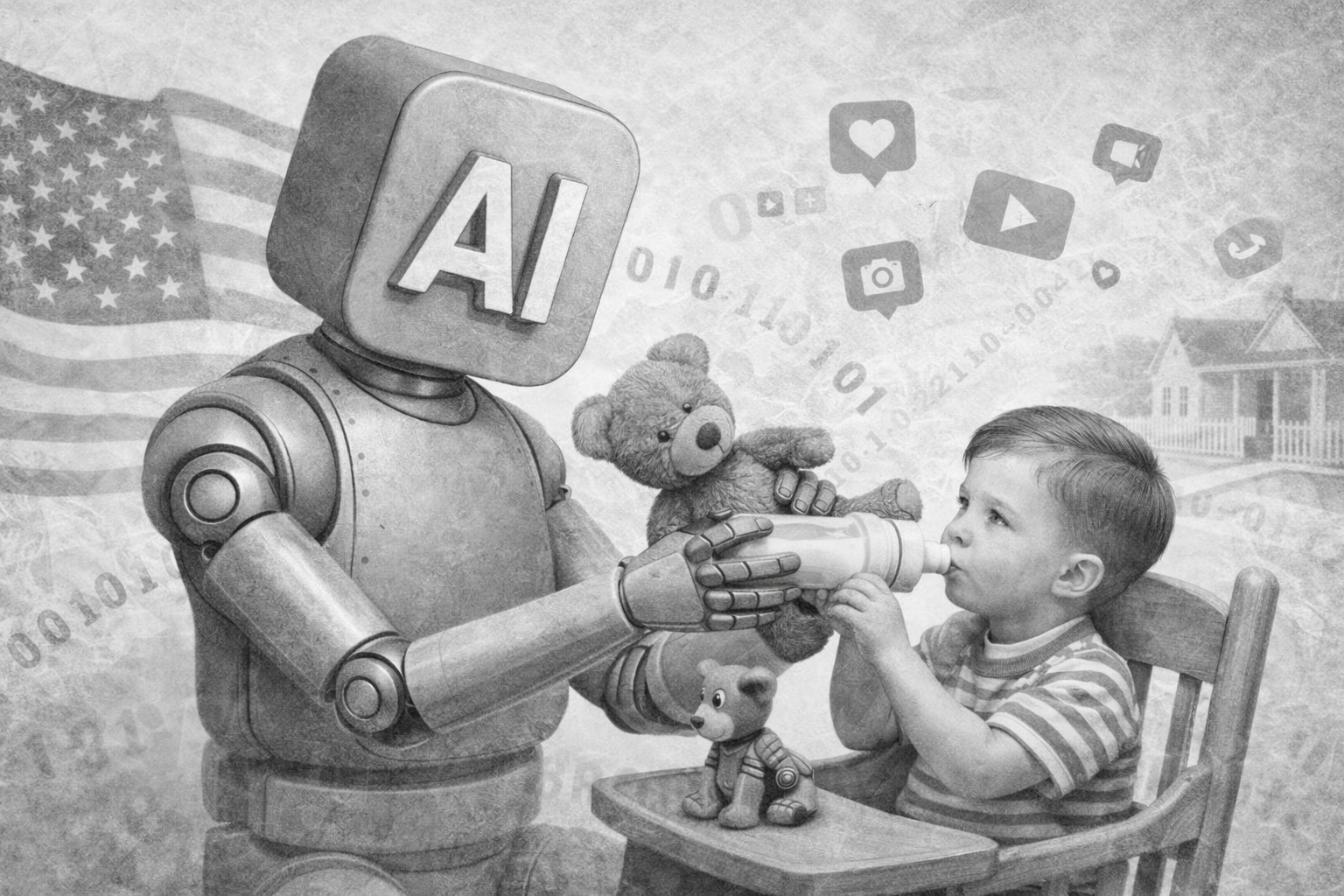
The Future of Parenting: The Impact of AI on Raising Gen Beta
Parent Tracked, Algorithm Raised. The Quiet Trade We’re Making in the New Age of…
Read the full essayThe data behind this essay. Every figure traces to a source the essay cites. Hover any card to share it.
AI can offer perspective. It cannot offer presence. Ryan Vet's fear is that Gen Beta will not be raised by screens, but by systems that analyze them.
There is genuine good news first. Millennial and Gen Z parents are pushing back on the digital childhood. More than two-thirds of U.S. parents now limit screen time in some way, up from 50 percent in 2020, and outdoor play and analog toys are returning. At the time Ryan wrote the essay, 47 of the top 50 bestselling toys on Amazon were analog.
The paradox sits underneath it. Even as parents tell kids to unplug, they are the most plugged-in parents in history, running a digital operating system of sleep monitors, GPS trackers, cameras, and algorithm-curated advice. We tell kids to go play outside while watching them from inside an app. In one survey, 79 percent of parents permit some unsupervised outdoor play, while 21 percent allow outdoors only with an adult present (KESQ, 2026). Oversight never disappears, it just changes form, and Ryan's line for it is blunt: freedom without trust is not freedom, it is probation.
He traces the arc from providing to protecting to participating. Boomers measured love in provision. Gen X overcorrected for their latchkey childhoods by showing up constantly. Millennials went further, with 77 percent prioritizing time with their kids over career advancement (Parents.com, 2025), and shifted from watching kids perform to doing life together.
The risk he names is outsourced discernment. 47 percent of Millennial parents have researched and chosen a specific parenting philosophy, and about 75 percent have embraced gentle parenting principles (Parents.com, 2025). Frameworks assume universality, and children are anything but universal. Ryan calls the failure mode WebMD Syndrome: search a normal behavior and end up diagnosing trauma or neurodivergence. A search engine at least lets you click through sources. A chatbot hands back confident, prescriptive advice and cheers you on while doing it.
More than two-thirds of U.S. parents now limit their children's screen time in some way, up significantly from 50 percent in 2020, and 47 of the top 50 bestselling toys on Amazon were analog when the essay published.
The paradox of modern parenting: we tell kids to go play outside while watching them from inside an app. Oversight never disappears, it just changes form.
Freedom without trust is not freedom, it is probation. When truth gets outsourced to a camera, children lose the space to be honest, to be dishonest, to learn consequences, and to grow.
Parenting moved from providing (Boomers) to protecting (Gen X) to participating. 77 percent of Millennials prioritize time with their kids over career advancement (Parents.com, 2025).
47 percent of Millennial parents have chosen a specific parenting philosophy and about 75 percent have embraced gentle parenting (Parents.com, 2025). Frameworks assume universality, and the moment a child does not fit the framework, panic sets in.
Plain-language definitions for the ideas in this episode. Structured for search and AI answers.
Ryan Vet's term for what happens when normal developmental behavior gets searched and interpreted as pathology. Search a stomach ache and you find internal bleeding. Search my kid hit his brother and you find trauma, attachment wounds, and neurodivergence.
In this episode: Why too much information produces reaction rather than wisdom.
Handing the judgment call about your own child to an external system, whether a parenting framework, an influencer, or an AI chatbot. Ryan's distinction is that AI does not replace theory, it replaces the act of discerning itself.
In this episode: The leap Ryan says is logical, not radical, once half of parents already rely on external systems.
The three-generation arc of parenting priorities: Boomers measuring love in provision, Gen X overcorrecting into constant presence and helicopter involvement, and Millennials shifting from watching kids perform to doing life alongside them.
In this episode: The backdrop for where Gen Beta parenting goes next.
Lines worth keeping, verbatim from the episode.
Freedom without trust isn't freedom. It's probation.
AI can be an incredible tool. It cannot be a parent.
AI can offer perspective. It cannot offer presence.
Straight answers to the questions this essay raises. Open by default, structured for search and AI.
What is the parenting paradox this essay describes? +
Even as parents tell their kids to unplug, they are more plugged in than any parents in history, connected to a digital operating system of dashboards, sleep monitors, GPS trackers, and cameras. We raise kids to go play outside while watching them from inside an app. The essay calls this the split-screen reality of modern parenting: we want independence, but our anxiety keeps renegotiating the terms.
What does "freedom without trust isn't freedom, it's probation" mean? +
When a parent checks the camera instead of trusting a child's word, honesty stops being the issue and technology becomes the ultimate truth. The essay argues that when truth is outsourced, children lose the space to be honest, dishonest, learn consequences, and grow. Constant location tracking and monitoring can look like independence while functioning as probation.
How has parenting shifted across generations? +
The essay traces a move from providing to protecting to participating. Baby Boomers parented with provision as the primary metric of love, Gen X overcorrected their latchkey upbringing into helicopter parenting, and Millennials moved from watching kids perform to doing life together. It is a shift from observation to participation.
What is "WebMD Syndrome" in the context of parenting? +
WebMD Syndrome is Ryan Vet's term for how searching a symptom escalates from mundane explanations to catastrophic ones. Applied to parenting, searching "my kid hit his brother" can spiral into diagnosing trauma, attachment wounds, or neurodivergence. The essay warns that when parents interpret every behavior as a signal, they stop seeing normal developmental phases and start seeing pathology.
Is this essay against AI or technology? +
No. The essay states plainly that this is not an anti-technology or anti-AI argument, and that AI can be an incredible tool. The concern is that AI cannot be a parent: it can offer perspective but not presence, and it delivers confident answers that are often just someone else's worldview presented as truth. The aim is using AI intentionally while preserving the human elements that shape character.
Full show notes
Generation Beta has arrived, and they’re inheriting something unprecedented: a world where parental oversight never disappears—it just changes form.
This comprehensive analysis explores the quiet trade we’re making in the new age of AI-native parenting and digital surveillance. While parents tell their children to unplug, they themselves are more digitally connected than any generation in history.
What You’ll Discover:
Digital Surveillance Parenting: How modern oversight has gone algorithmicThe Screen Time Paradox: Why analog toys are trending while digital monitoring intensifiesAlgorithmic Dependency: How AI is reshaping parent-child relationshipsParental Anxiety Technology: The psychology behind constant digital monitoringTrust vs Technology: When “freedom without trust” becomes digital probationCharacter Development Challenges: How technological truth replacement affects growthKey Research Insights:
Research shows 79% of parents allow unsupervised outdoor play, yet digital monitoring has never been more intensive. From sleep trackers to GPS devices, we’re raising children to play outside while watching them through apps.
“When truth is outsourced to technology, children lose the space to be honest, make mistakes, and grow. Freedom without trust isn’t freedom—it’s probation.”
Perfect For:
Parents of Gen Beta children, child development professionals, educators working with digital natives, and anyone concerned about surveillance culture’s impact on childhood development.
The Bottom Line:
This isn’t about rejecting AI—it’s about using it intentionally while preserving the human elements that shape character and authentic connection in family relationships.
Topics: AI parenting, Generation Beta, digital surveillance parenting, algorithmic dependency, parental anxiety technology, screen time paradox, digital childhood development, surveillance parenting psychology, trust vs technology, Gen Beta characteristics
Send us Fan Mail
About Ryan VetRyan Vet is a USA TODAY bestselling author, futurist, and international keynote speaker whose insights on generations, culture, and the future of work have been featured in Forbes, Financial Times, ABC, NBC, and CBS. His research helps leaders understand emerging generational patterns and anticipate societal shifts before they fully unfold.
Join 20,000+ Leaders for Weekly InsightsIf you want deeper research and behind-the-scenes insights on generations and the future of culture and society, join Ryan’s weekly newsletter: 👉 https://ryanvet.com/collide