
We've Never Been More Alone
The Surgeon General says loneliness now kills like smoking 15 cigarettes a day. The youngest generation is the most at risk.
Read the full essayThe data behind this essay. Every figure traces to a source the essay cites. Hover any card to share it.
The more we use technology to connect human beings, the further it seems to drive us apart. That is worth sitting with.
Ryan starts at a Walmart checkout line, buying the bright orange calling cards his family used to reach an aunt and uncle in Brazil. Then Skype arrived, grainy and garbled, and it felt revolutionary. Technology brought us together. Or so we thought. In May 2023 the U.S. Surgeon General declared loneliness a public health epidemic and compared its mortality impact to smoking up to 15 cigarettes a day.
The counterintuitive part is who is lonely. The CDC found loneliness highest among the youngest adults, with 43.3 percent of adults ages 18 to 34 reporting it against 23.8 percent of adults 65 and older (CDC, 2022). Nearly double. And it started before adulthood: 61 percent of Gen Z teens reported feeling lonely and isolated often during adolescence, twice the proportion of Baby Boomers at the same stage (Survey Center on American Life, 2023).
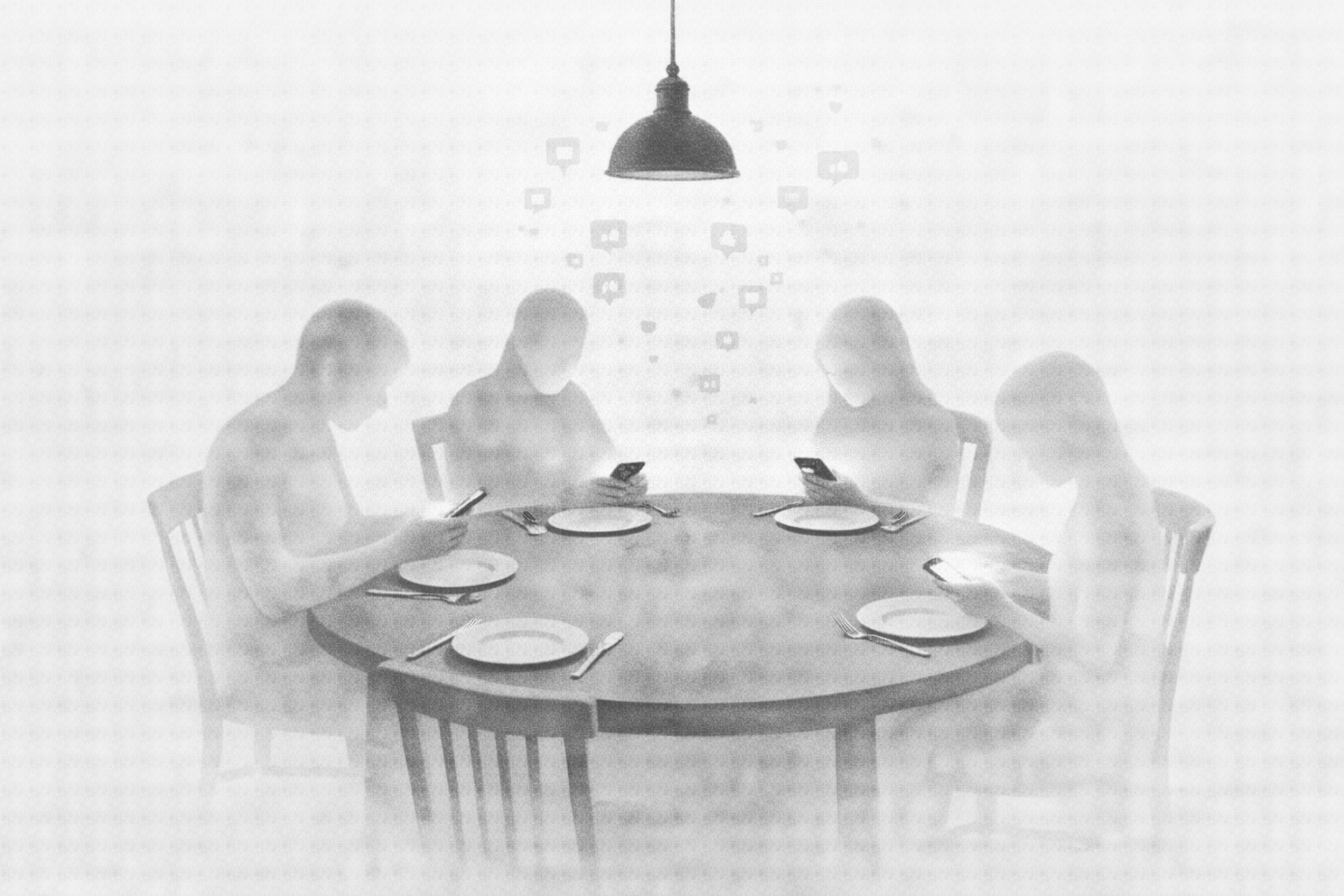
One of the clearest structural losses is the family table. Daily family meals fell from 84 percent among the Silent Generation to 76 percent for Boomers, 59 percent for Gen X, 46 percent for Millennials, and 38 percent for Gen Z (Institute for Family Studies, 2024). A 46 point collapse in four generations. The table was daily practice in being in community with people you did not choose but were committed to.
Meanwhile proximity went up and community went down. Time spent at home rose by 1 hour 39 minutes per day for U.S. adults between 2003 and 2022, and by an additional 124 minutes for those ages 15 to 24 (Sharkey, 2024), while social engagement with friends plummeted. When connection loses its cost, it also loses the relational growth that only comes through it. 72 percent of U.S. teens have tried an AI companion (NORC, 2025), and MIT and OpenAI research found heavy users were lonelier and more emotionally dependent, not less (Fang et al., 2025).
The U.S. Surgeon General declared loneliness a public health epidemic in May 2023, comparing its mortality impact to smoking up to 15 cigarettes a day.
Loneliness is highest among the youngest adults. 43.3 percent of adults ages 18 to 34 report it, against 23.8 percent of adults 65 and older (CDC, 2022).
Daily family meals collapsed 46 points across four generations, from 84 percent among the Silent Generation to 38 percent among Gen Z (Institute for Family Studies, 2024).
Time at home rose by 1 hour 39 minutes a day for U.S. adults from 2003 to 2022, and by an additional 124 minutes for young adults ages 15 to 24 (Sharkey, 2024), while social engagement with friends plummeted. Proximity is not community.
72 percent of U.S. teens have tried an AI companion (NORC, 2025), and MIT and OpenAI research found heavy AI companion users were lonelier, socialized less with real people, and showed more signs of emotional dependence (Fang et al., 2025).
Plain-language definitions for the ideas in this episode. Structured for search and AI answers.
The long-observed pattern of elevated loneliness in young adulthood, decline through midlife, and a rise again in oldest age (Luhmann and Hawkley, 2016). The shape still holds, but the depth of young adult loneliness today is what has changed.
In this episode: Why this is not simply what happens to people at that stage of life.
The image for the college-to-work transition. College controls the temperature, the light, and the people around you. Graduation drops you into an open field with no built-in community and no bridge between the two.
In this episode: Backed by a systematic review of 32 studies on educational transitions (Sundqvist et al., 2024).
Intimacy sought without the risk, friction, or obligation that used to accompany it. Ryan's argument is that removing the cost quietly removes the relational growth that only comes through paying it.
In this episode: The through line from dating app burnout to AI companions.
Lines worth keeping, verbatim from the episode.
The proximity is there. The community is not.
The more we use technology to try to connect human beings, the further it seems to be driving us apart.
A culture that removes the cost from connection will quietly remove the relational growth that only comes through it.
Straight answers to the questions this essay raises. Open by default, structured for search and AI.
Which generation is the loneliest, and why? +
Loneliness is highest among the youngest adults, not the oldest. The CDC's 2022 analysis found 43.3% of adults ages 18 to 34 reported loneliness, compared to 23.8% of adults 65 and older. Viewed through the Generational Prism, something specific is happening to this cohort rather than simply what happens to young adults at this stage of life.
Did Gen Z's loneliness begin in adulthood or earlier? +
It began earlier. The American Adolescence Survey found that 61% of Gen Z teens reported feeling lonely and isolated often during their adolescence, twice the proportion reported by Baby Boomers at the same stage. Two-thirds of Americans who felt lonely every day during childhood report feeling lonely or isolated most of the time today, suggesting the formation years set the trajectory.
How much have family dinners declined across generations? +
They have fallen steadily. Among the Silent Generation, 84% reported daily family meals growing up, dropping to 76% for Baby Boomers, 59% for Gen X, 46% for Millennials, and 38% for Gen Z. That is a 46-point collapse across four generations in one of the most basic daily rituals of family life.
Are AI companions helping solve the loneliness crisis? +
The research suggests they are deepening it. A NORC at the University of Chicago study found that 72% of U.S. teens have tried an AI companion. Research from MIT and OpenAI found that heavy AI companion users were lonelier, socialized less with real people, and showed more signs of emotional dependence, not less.
Why should leaders care about loneliness at work? +
Because it carries a measurable cost. The Cigna Group estimates that stress-related absence linked to social disconnection costs $154 billion annually in the United States. Every leader managing a team of Gen Z employees is managing people who, statistically, were lonelier as children than any previous generation.
Full show notes
We are the most digitally connected society in human history. We are also, by every measure, the loneliest.
The U.S. Surgeon General compared loneliness to smoking 15 cigarettes a day. The loneliest adults are not in nursing homes. They are in their twenties and thirties. Generational futurist Ryan Vet unpacks the research behind Gen Z’s loneliness epidemic, why it began in childhood and not in adulthood, and what leaders must understand about the first generation raised inside a connection paradox.
From the collapse of the family dinner to the rise of AI companions, Ryan applies the Generational Prism and the Friction Doctrine to explain why a culture that removes the cost of connection quietly removes the relational growth that only comes through it.
Topics Covered
Why the U.S. Surgeon General declared loneliness a public health epidemicHow Gen Z became the loneliest generation in American historyThe collapse of the family dinner across four generationsHow AI companions are deepening, not solving, the loneliness crisisWhat every leader managing Gen Z employees needs to understandKey Takeaways
The U.S. Surgeon General compared loneliness to smoking 15 cigarettes a day (2023).43.3% of adults ages 18 to 34 report loneliness, vs 23.8% of adults 65 and older (CDC, 2022).61% of Gen Z teens felt lonely often during adolescence, twice the Boomer rate (Survey Center on American Life, 2023).Family dinners fell from 84% (Silent Gen) to 38% (Gen Z), a 46-point collapse (Institute for Family Studies, 2024).72% of U.S. teens have tried an AI companion. Heavy users are lonelier and more emotionally dependent (Fang et al., MIT/OpenAI, 2025).Stress-related absence linked to social disconnection costs U.S. employers $154 billion annually (Cigna, 2025).Who Should Listen
Leaders managing multi-generational teams, parents raising Gen Alpha and Gen Beta children, HR executives, and anyone trying to understand why hyperconnected generations report record isolation.
Research Cited
U.S. Surgeon General (2023); CDC (2022); Cigna (2025).Institute for Family Studies (2024); Survey Center on American Life (2023).Fang et al., MIT/OpenAI (2025); NORC/TechCrunch (2025).Connect with Ryan Vet
Newsletter (COLLIDE): https://www.RyanVet.com/collideWebsite: https://www.ryanvet.comYouTube: https://www.youtube.com/@RyanVetLinkedIn: https://www.linkedin.com/in/ryanvet/Full essay: https://collide.ryanvet.com/p/we-ve-never-been-more-aloneSend us Fan Mail
About Ryan VetRyan Vet is a USA TODAY bestselling author, futurist, and international keynote speaker whose insights on generations, culture, and the future of work have been featured in Forbes, Financial Times, ABC, NBC, and CBS. His research helps leaders understand emerging generational patterns and anticipate societal shifts before they fully unfold.
Join 20,000+ Leaders for Weekly InsightsIf you want deeper research and behind-the-scenes insights on generations and the future of culture and society, join Ryan’s weekly newsletter: 👉 https://ryanvet.com/collide