The seven forces
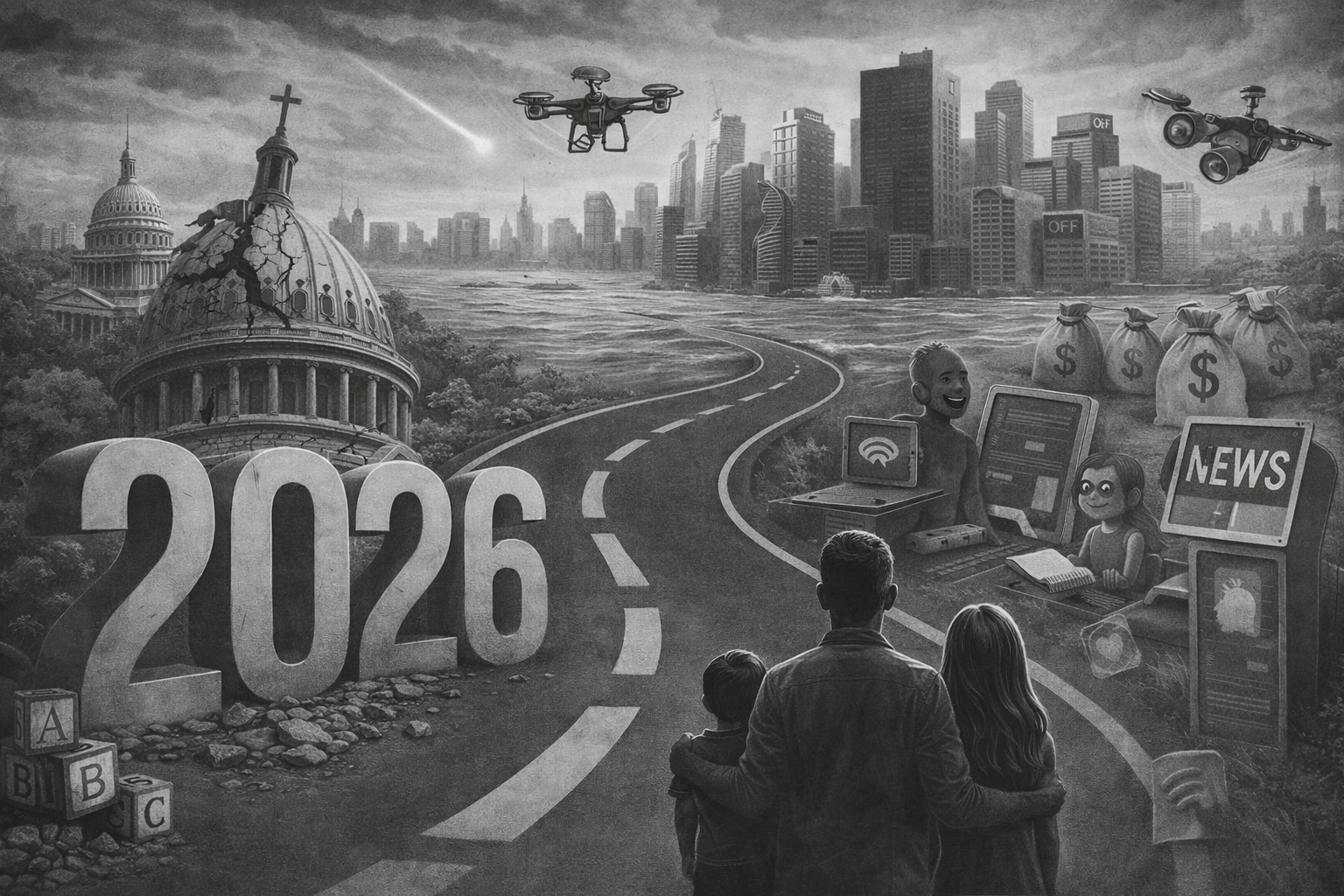
Each letter is a lever. Move one and a generation shifts. Move several at once and the culture does not drift, it lurches.
-
Religion
Shared belief, and the institutions built on it, set a culture's baseline for meaning, morality, and obligation. When religious participation shifts, so does everything downstream of it: family structure, community, and what a society treats as sacred.
Is Gen Z really going back to church? -
Education
What a society teaches, who gets taught, and how long they stay. Expanding access moves a generation's expectations, earnings, and timeline to adulthood. Fragmentation between public, private, homeschool, and hybrid models moves them again.
What the Class of 2026 is bringing to work -
Sex and Gender
Norms around relationships, family formation, and gender roles. This force moved further and faster in the second half of the twentieth century than almost any other, and it reshaped marriage, childbearing, and the workforce with it.
From Valentine's Day to "love is love" -
Politics
Not partisanship, but the distribution of trust and authority. When confidence in institutions rises or collapses, it changes who a generation believes, what it will submit to, and how it sorts itself socially.
Disagreement used to cost you something -
Economics
Scarcity and abundance are formative. A generation raised in a downturn relates to money differently from one raised in a boom, and that relationship follows it for life, into how it saves, spends, works, and defines success.
What the end of the penny says about money -
Communication
How information travels, and how fast. A single evening broadcast, a 24-hour news cycle, and an infinite personalized feed each produce a different society, because each one changes what people can know and who they trust to tell them.
The real barrier in cross-generational communication -
Technology
The tools that mediate daily life. Technology is the force currently moving fastest, and its distinctive property is that it does not move alone. It accelerates the other six.
The Velocity Gap
Why these seven
They are not an arbitrary list. They are the load-bearing institutions of any society, the ones that decide what people believe, what they are taught, how they form families, who holds authority, how they earn, how they hear about the world, and what tools they hold while doing all of it.
They are also, not coincidentally, the subjects most workplaces rule out of bounds. As Ryan put it on Shift Happens:
“I get to talk about the things you’re not supposed to talk about at work. I get to talk about religion, education, gender, politics, race — all the things that you’re not supposed to talk about.”
That is precisely why they matter. The forces a culture refuses to discuss openly are the ones moving underneath it unexamined.
The pattern is older than America
These seven are not a read on one country or one century. Asked on A Geek Leader how the pendulum picks up speed, Ryan traced the same factors back more than a thousand years:
“So I say there’s seven factors, and not just based on American history, but if you go all the way back to the Byzantine Empire, throughout all history there were seven main factors that you see help make this pendulum swing faster or slower. And they’re religion, education, sex and gender, politics, economics, communication, and technology.”
When several move at once, culture lurches
A single force moving produces a noticeable shift. Several moving together produce an era.
The clearest modern case is the postwar decades. Church membership held above 70 percent of American adults into the 1960s. College enrollment expanded rapidly. The first oral contraceptive was approved in 1960, separating sex from reproduction at scale for the first time in human history. Television went from roughly 9 percent of households in 1950 to about 85 to 90 percent by the end of that decade. Productivity and real family income climbed together. Religion, education, sex and gender, economics, communication, and technology all moved inside a single generation, which is why the culture that came out the other side was unrecognizable to the one that went in. That convergence is what built the American Dream as a statistically normal outcome rather than an aspiration.
The reverse is just as instructive. When friction shows up in only one pillar, the tension rarely stays put. It spills into the others, and the momentum compounds across the rest of the pendulum.
Right now, technology is the outlier
The seven forces do not move at equal speed, and the current imbalance is the whole story of this moment. Technology is not simply moving fastest; it is dragging the other six along with it.
“Right now technology is swinging so fast. We’re way on the upswing of that curve, but it’s impacting all other six elements. And I think one of the dangers of technology is some people aren’t seeing swings as much because they’re in an echo chamber of their own algorithms.”
That last clause is the part worth sitting with. A force can move the culture and simultaneously obscure the fact that it is moving, because the same systems accelerating the change are also curating what each person is allowed to notice. The distance this opens between capability and wisdom is its own framework: the Velocity Gap.
How to use it
R.E.S.P.E.C.T. is a diagnostic. When a generation behaves in a way that seems inexplicable, the question is not “what is wrong with them?” but “which of the seven moved while they were forming, and how far?” Run the list. The answer is usually sitting in two or three of them at once.
For leaders, it doubles as a forecasting tool. Watch which forces are currently under tension, and you get a reasonable read on where the pendulum swings next, before the behavior shows up in your hiring pool.
Hear Ryan work through it
The seven forces come up most often in conversation, where a host can push on them. Both episodes below are on this site in full, with the video and the complete transcript, and each links out to the show:
- A Geek Leader Where Ryan traces the seven factors back to the Byzantine Empire, and names technology as the force dragging the other six.
- Shift Happens Where he explains why the seven are the subjects most workplaces rule out of bounds.
For the written version, the framework runs underneath Collide, and shows up most directly in the essays gathered at the bottom of this page. If you want the parent idea first, start with the Generational Pendulum, then come back here for what sets its speed.
Frequently asked questions about R.E.S.P.E.C.T.
What is the R.E.S.P.E.C.T. framework?
R.E.S.P.E.C.T. is a framework from generational futurist Ryan Vet naming the seven forces that speed up or slow down generational change: Religion, Education, Sex and Gender, Politics, Economics, Communication, and Technology. It is the sub-framework beneath the Generational Pendulum. The Pendulum describes how generations swing; R.E.S.P.E.C.T. explains what sets the speed of the swing.
What do the letters in R.E.S.P.E.C.T. stand for?
Religion, Education, Sex and Gender, Politics, Economics, Communication, and Technology. The acronym is a mnemonic for the seven levers Ryan Vet examines when tracing why a generation changed when it did, and the order spells the name.
How does R.E.S.P.E.C.T. relate to the Generational Pendulum?
The Generational Pendulum describes the motion: each generation experiences the worldview of the one before it, challenges it, overcorrects, and eventually recalibrates. R.E.S.P.E.C.T. describes the drivers of that motion. The seven forces determine how fast the pendulum swings, and when several move at the same time, culture lurches rather than drifts.
Why these seven forces?
They are the load-bearing institutions of a society, and they are also, as Ryan puts it, the things you are not supposed to talk about at work. Ryan argues the pattern is not particular to modern America. Looking back as far as the Byzantine Empire, these same seven factors govern how quickly a culture moves.
Which force is moving fastest right now?
Technology, and it is not close. Ryan's concern is not the speed on its own but the spillover: technology is currently accelerating the other six forces at the same time, while personalized algorithms leave people in separate realities that no longer share the same headlines.