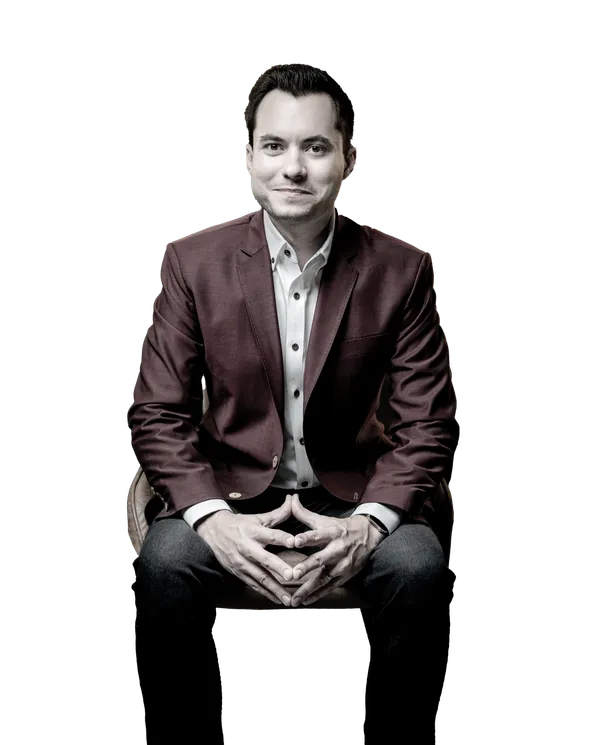
Everyone is asking whether AI will take their job. On the A Geek Leader Podcast, Ryan Vet flips the question. The more useful thing to ask, he tells host John Rouda, is what AI will not change, because that is where a leader's footing actually is.
From there the conversation turns to a quieter risk than unemployment: cognitive erosion, the slow outsourcing of thinking that started with spell check and GPS and is accelerating now that a six-year-old can build a toy just by speaking to it. It is a hopeful conversation, not a fearful one, but its argument is pointed. The tools will keep removing friction. Whether we add any back is up to us.
Ryan's Big Takeaways
- 01
Before you ask what AI will change, ask what it won't.
Ryan's starting point for any leader is the part of the business AI cannot touch. "Businesses are still built on human beings serving other human beings," he says, and he borrows Jeff Bezos to make it concrete: people will always want products faster, cheaper, and more convenient, whether a person or a robot packs the box. The headcount to deliver a service may shrink, but the human core does not move. For Ryan that is not a consolation prize. It is the strategy: build from what stays fixed.
The Velocity Gap - 02
The real danger isn't lost jobs. It's cognitive erosion.
Ryan's sharpest idea in this episode is a term he uses for a long, quiet trend: we have leaned on machine intelligence since the 1970s without naming it, from spell check to GPS to maps, and each handoff removed a little of our own capacity to think. His frame is friction. Humans have always tried to remove friction from life, from the Egyptians rolling bricks on logs to the Pascaline calculator of the 1600s, but friction is also what builds character, judgment, and a sense of right and wrong. "Knowledge is very different than wisdom and experience," he says, and the concern is that we are removing the friction and not adding it back anywhere else.
The Friction Doctrine → - 03
The generational pendulum is swinging back to the human, but seven forces set its speed.
Ryan sees real hope: later-born millennial and early Gen Z parents are pushing their Gen Alpha and Gen Beta kids back toward unstructured, outdoor, hands-on play, and courts and families are starting to hold tech companies accountable. But he warns the swing is uneven. Across history, going back to the Byzantine Empire, seven factors govern how fast the pendulum moves: religion, education, sex and gender, politics, economics, communication, and technology. Technology is racing ahead of the other six, and its echo-chamber effect, every teenager alone with a private algorithm, is pulling people into separate realities that do not even share the same headlines.
The Generational Pendulum →
The Story Ryan Told
Ryan is an adjunct professor, and he is not naive about AI in the classroom. One student turned in a paper that was not just obviously AI, it was copied and pasted so carelessly that it still contained the note "be sure to fill this in for your professor." Ryan invited him to office hours and said, warmly, that he found the piece interesting. When he asked if the student had used AI, the student said he did not even know what ChatGPT was, and kept denying it even after Ryan pasted the prompt and produced the paper almost verbatim. That student failed.
Another student had used AI but added her own thinking, fell a little short of the assignment, and, when asked, simply told the truth. She got a fair grade, docked only a couple of points. Ryan's point was not about the tool. It was about character, and about the whole reason he stands in front of a class. "My job as a professor is to get you to think. And if you're not thinking, then why would I give you the grade? You didn't earn it."
Standout Quotes
Businesses are still built on human beings serving other human beings.
Knowledge is very different than wisdom and experience.
Focus on being human. That's the one thing that's never going to change.
Every technological advancement in all of history has replaced jobs. And yet it's the productivity paradox. It creates new ones.
Gen Beta, born in 2026 and beyond, is the Romeo and Juliet generation. They're born into polarity.
Drag, swipe, or use the arrows to explore
Frameworks & Ideas Referenced
- Cognitive Erosion : Ryan's term in this episode for the gradual outsourcing of thinking to machines, from spell check and GPS to generative AI.
- The Friction Doctrine : Removing friction from life, and friction as the thing that forms character, judgment, and wisdom.
- The Generational Pendulum : Each generation overcorrects its parents, then recalibrates.
- The R.E.S.P.E.C.T. Framework : The seven forces that speed or slow the pendulum: religion, education, sex and gender, politics, economics, communication, and technology.
- The Velocity Gap implied : Technology outpacing human adaptation and wisdom.
Books, People & Sources Mentioned
- Jeff Bezos and Amazon : On what customers always want: faster, cheaper, and more convenient.
- Claude (Anthropic) : Ryan's six-year-old designed and 3D-printed a toy by describing it to Claude.
- Blaise Pascal and the Pascaline : The 1600s mechanical calculator, an early step in removing cognitive friction.
- Ryan's Collide essay: When Freedom Became Fear : How child-abduction fears outran the actual, very low rates.
Keep Exploring
-
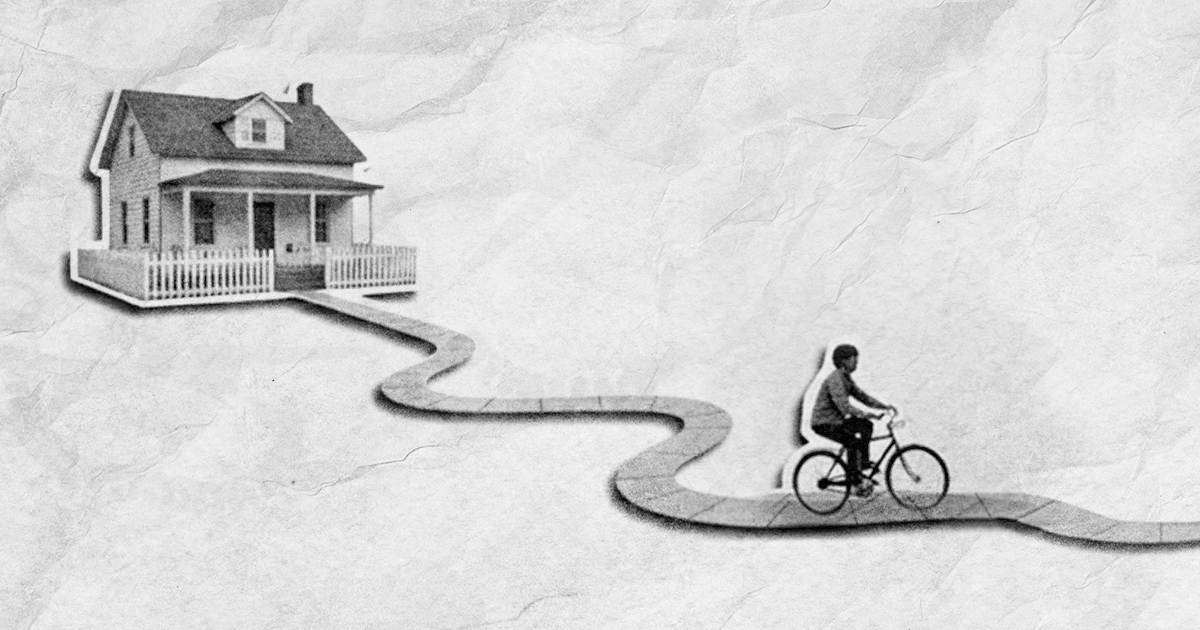 Collide essay When freedom became fear: how a generation lost its courage to let go Helicopter parenting didn’t appear overnight. It was built on headlines, moral panic, and a fear that safety could replace strength. Explore →
 -
 Appearance Ryan Vet on Sharpen the Spear: leading five generations without the labels Generational futurist Ryan Vet joins the Sharpen the Spear podcast to unpack leading five generations at work: labels versus lived experience, the job-hopping myth, and why fearful leaders quietly stopped leading. Explore →
 -
 Appearance Ryan Vet on Dents in the Darkness: the generations and the church Generational futurist Ryan Vet on the Dents in the Darkness podcast: leading five generations in the church, the velocity gap between technology and morality, and why Gen Z is unchurched but spiritually hungry. Explore →
 -
 Appearance Ryan Vet on The Human Factor: the generational fault lines of transformation Generational futurist Ryan Vet on The Human Factor Podcast: why the same change initiative lands as opportunity for one generation and threat for another, why removing friction backfires, and why leaders who stop apologizing lead better. Explore →
 -
 Appearance Ryan Vet on Workforce Alchemist: generational change, AI, and workplace friction Generational futurist Ryan Vet on the Workforce Alchemist show: the generational pendulum, why leaders fear the young workers who just want to be led, and why removing friction quietly erodes a team's ability to think. Explore →
 -
 Appearance Ryan Vet on Straight Up With Steph: generations and patient trust Generational futurist Ryan Vet on Straight Up With Steph: communicating across generations in healthcare, why patients trust you less than they used to, and how to get ahead of the second opinion. Explore →
 - Appearance Ryan Vet on S.M.A.R.T. Performance: lead through the prism, not the label Generational futurist Ryan Vet on the S.M.A.R.T. Performance podcast: the Generational Prism, why Gen X is missing from leadership, and why we forgot how to actually lead. Explore →
- Appearance Ryan Vet on Maximize Life with Mindset Pivots: the generational pendulum, decoded Generational futurist Ryan Vet on Maximize Life with Mindset Pivots: the four phases of the generational pendulum, its seven accelerators, and why the labels leaders reach for so often mislead them. Explore →
- Explore Ryan's generational frameworks Explore →
- speaking Keynote: AI and the future of work Explore →
Ryan writes one free essay a week. It's called Collide.
How generations are reshaping work and home. Practical, research-backed, and delivered weekly. Read it at RyanVet.com/collide.
Links from this conversation
Full Transcript
The complete conversation between John Rouda and Ryan Vet, transcribed in full. Key terms link to the ideas behind them.
Welcome to A Geek Leader podcast. I'm your host, John Rouda. All right, GeekLeaders. Today, I'm honored to have Ryan Vet on the show. He is a USA Today best-selling author, a generational futurist, speaker, entrepreneur, and has a lot of experience where things and technology and leadership kind of come together and merge, which is what we're talking about, which is what GeekLeader is all about. So, anyway, with all that being said, Ryan, welcome to the show.
Thanks so much for having me, John.
Yeah, if you don't mind, just tell the audience a little bit about your background, how you got into technology and leadership and speaking and all those things, and what is it that you do exactly today?
Yeah, great question, and I'll take you all the way back to growing up in Chicago with lemonade stands. I think a lot of entrepreneurs got their start trying to hustle lemonade in their neighborhood, and I was no different. But mine came up around the time of dial-up, and you could go to Walmart and get the AOL CDs and free juno.com email addresses. And that's really where I got my start, with an online marketing company behind an email address. No one knew that I was a preteen at the time. And so I started doing graphic design because I had access to the Adobe Creative Suite, which was not called that back in the day. But I had that early on and started doing graphic design. One thing led to the next, got a little bit involved in web. I'm not a developer, but ended up kind of launching a development firm, got into software, got into the venture capital world, all before stepping foot on a college campus, which was really a neat experience. Just blessed to have that experience early on, but then went down the venture capital path for many years in several different venture-backed startups, usually in big data or even one stint in medical device, which was interesting. And through all of that, it was great. Spent 20 years on kind of the entrepreneurial journey. All the while, people kept asking me about generations. I was a millennial. What made me different? It was when millennials was like the buzzword, but also a curse word. People don't want to be called a millennial. And one thing led to the next, and after an exit, I kind of sat back and reflected, and I've always loved researching and making complex things that are happening in our world as simple and approachable for the years as possible. So after 20 plus years of executive leadership roles, from $0 in revenue to $750 million in valuation leading a company that big, I said, in 2021, I'm going full-time writing, speaking, consulting, and helping other leaders look at the future. And so that's what I get to do every single day, is researching trends and understanding patterns and helping people make the most sense of how they stay relevant in an ever-changing world.
Yeah, so what do you see today that leaders need to be focused on? I mean, obviously AI is kind of one of the buzzwords that everybody's looking at, and what's it going to do? And there's been headlines with, you know, Jack Dorsey laying off 40% of his employees because of AI. What do you see happening? What do we need to be paying attention to?
Yeah, I think that's a really good question and one that a lot of people seem to be asking right now, which is, okay, am I going to lose my job? What does this mean for my career? What does this mean for our world? I think there's several things that are really important. I think the first thing is what's not going to change as a result of AI. At the end of the day, businesses are still built on human beings serving other human beings, providing a service, a product, whatever it is. Now, the number of people to deliver that service might change and be downsized because of AI, but the core of what your business is, that's not changing. I think that's a question we have to ask. Jeff Bezos, founder of Amazon, once answered that question and said, people still want products faster, cheaper, and more conveniently. And he's like, that's not going to change regardless of how many people are packing boxes or robots are packing boxes. And I think the same is true. So that's the one thing. Then I think the other thing is we need to really look at what I am referring to as cognitive erosion. For a long time, since the '70s, we've been relying on artificial intelligence, but we just haven't labeled it as such. You had spell check with the underlined red word at first. And it would only tell you if a word wasn't in the dictionary. It didn't give you other suggestions or anything like that. And then fast forward, we replaced our ability to navigate with GPS, then maps. So as you kind of go through this progression, we've already relied pretty significantly on AI. And part of that is now we're removing the ability to critically think, and I think that's another thing that leaders need to be very, very aware of.
Yeah, one of the things that I see with that, those are great examples because I can think back to when I was a kid, we had a phone, but it wasn't a cell phone, and you had to remember numbers and type in numbers. And then we had cell phones that could remember your numbers. And all of a sudden, everybody forgot every number that they, yeah, they didn't have to memorize numbers anymore. And the same thing with spell check, and then people forgot how to spell. Do you think people are going to forget how to write good sentences with grammar check and Grammarly and ChatGPT now writing things for them? Or is that like the decline that you're saying with cognitive erosion?
I think it's already happening. I think it's been happening for a long time, and it's not to be, I'm not trying to cause fear. I think it's just the reality of our nature as human beings. We have always tried to remove friction from life. You go back to the Egyptians building pyramids, and yes, while they used slave labor for a lot of it, you saw simple machines at its finest. You saw them building bricks and then rolling those bricks on logs, the earliest version of removing friction. And then we continue to build more machines and then got technology involved, and AI is just now where we're at with generative AI, because of the energy that we have access to and the computing power that we have access to. But this was dreamed about in the 1600s originally and conceptually. I mean, they didn't know what a computer was, but you could look at the Pascaline calculator, and you turn a dial and another dial, and it would spit out a complex mathematical equation, all the way to where we are today. And so I think as we rely more heavily on technology, we do remove some of that friction that's so important for us, that builds character and our morality and our sense of right and wrong, because you're not experiencing the things anymore, and knowledge is very different than wisdom and experience.
Yeah, no, I think you're absolutely right. But do you think we're going to add that in somewhere else? Because it seems like a lot of times we take away from one area and we add it in somewhere else. Like we take away one hardship and add it in, you know, we took away physical labor and put it in mental labor. What do you think it's going to go with AI?
And that's what's really interesting with AI. If you look at it, we've removed so much friction that we're not seeing that friction being added in anywhere else. And I think that is the significant risk that you have. I mean, think about it this way. You've got someone that's four or five years old can pick up their parents' device and speak to it, and now it can generate something. I mean, even just imagine, and I don't think we slow down to think about this enough, but I have a 3D printer, and it's hooked up to Claude. And my six-year-old can come say, I want to create a toy that does X, Y, and Z. Claude can build a 3D file and print it out. You're giving a six-year-old, and I don't allow my child to do that. He doesn't know he can do that, but I have that technology in my house. And now you're giving them the ability to create by speaking. When you think about it that way, we remove friction from quite a bit, and now parents have done it, too. Parents aren't asking their kids how they slept because they've got the sleep monitor and the pulse ox to know exactly how restless they were. It's changing the whole way we interact.
Yeah, it is for sure. Do you think it's a good thing for society, or is it still up in the air?
You know, I am a living paradox, right? I've got an Apple Watch on. I've got all sorts of technology and cameras, and yet I speak against it and write against it quite a bit because of how it can impede. A perfect example, and then I'll answer your question more directly. The other day, one of my kids was like, you didn't ask me if I wanted more food and I wasn't done eating. And my wife's like, play it back on the cameras. I said, no, that's not reality. That's not discussing what actually happened. I know I was right, he was just being emotional at the time. And the cameras did verify it later, for the record. But that's not how parenting needs to be. It's like, no, when you and your sibling fight and the parents hear it and come running, you're going to have to tell them both sides of the truth. And so I think what we've done and where we are in society, if we're not intentional, I think this is where people raising the next generation, whether that's policy makers, whether that's teachers, whether that's parents, whether that's clergy, whatever it is, I think they need to be really proactive on how we're getting people to critically think beyond technology. Otherwise, our dependence is going to be so heavily on a technological world that I do see great risks for the future.
Yeah, no, I think you're absolutely right. And even using AI tools for different things, I think the people that think critically and use their own knowledge, their own experience of how to do certain things, and have Claude build things for them, but they spec it out really well because they've had experience building it, they know the best ways to do it, have the best results. Do you think that path is going to continue, or do you think it's going to get to the point where you don't even need to know the best way to prompt?
Yeah, I think our human nature has always been to find information. And you can trace it back to very different myths and religious practices and everything, but humans have always either tried to become deity or replace deity or find information and knowledge. And that's cross-cultural, from Eastern religions to Western religions, modern and ancient alike. And I think that is the human pursuit. So I do think there is a natural curiosity that human beings have. And I think a strong element of hope is you're seeing later-born millennial parents and early-born Gen Z parents of kids now that are Gen Alpha and Gen Beta being born this year. I think what you're starting to see is a pushback to traditional play. And they're calling it risky play and dirty play. I don't love those terms, but I didn't come up with them. So it's this idea of getting back into nature, getting more curious. And I think there is hope because these generations that were raised in technology with a screen in front of them, we didn't know the implications. Even as recently as this past week, we saw court cases in California where YouTube and Meta, the parent company of Facebook and Instagram, were held liable for creating addiction with a young girl when she was six. And she just got awarded, I believe it was $6, I'd have to double check. But there's almost 2,000 other cases in the United States right now on those topics. So I think we are starting to see, and I'm not saying government control is the right way to fix that, but I think we're starting to see some movements in the right direction. So companies are being held accountable, and parents are starting to be aware because they saw what it did to their childhood.
Yeah, I think you're absolutely right. And I don't know the details of that case. I have heard about it just this morning. People were talking about it on the podcast I was listening to. But how does that differ, the addiction of social media and apps like that that do have parental guidance, differ from soda or coffee or sugar, other things that are addictive that are designed to be addictive? I mean, even potato chips used to have an ad, I bet you can't just have one, because it was designed to be addictive. But we don't see those going to court.
Yeah, I mean, sometimes you do a little bit. You saw Coca-Cola. This was maybe a decade and a half ago or longer. Time warps so badly. But they have definitely had their moment in court. And I think you look at parents today and they're moving their kids away from sugary drinks. So I think a lot of it, you know, we've moved from a collectivist society, meaning it takes a village to raise a kid, to an individualistic society. And in an individualistic society, you naturally blame everybody else. And so it's the company's fault. It's the government's fault. It's whatever's fault. And I do think, I wouldn't say we're moving back to a collectivist society, but I do think parents of young kids today are more open-minded to the fact that they have a responsibility to put up guardrails. You know, the Gen Z favorite word, put up boundaries, to help their kids have a better life, which is what every parent has always done. I talk about the generational pendulum, and you see it swing back and forth. Every parent tries to overcorrect what their parents did wrong, and in so doing, eventually we find recalibration, but it's always a big swing back and forth.
Yeah, it usually is a big swing. And I found the same thing. I see that my parents had, a lot of it was more like you go outside and play until it gets dark, and don't come home until it's dark kind of thing.
Exactly.
And then you saw the generation that was like, everything is monitored and watched. And I have friends that have kids. I have young kids, and I have friends that have kids that are older than mine, and they monitor everything their kid does. And they have kids that are in their 20s and they're still following them around. And I get that, because it was that swinging. And now it's like my generation, where I kind of want to watch some of it, but I also want to give them freedom. I want my son to get on his bike and go to his friend's house, and I don't want to know where he's at. I want him to have that freedom to say I can just go, I don't have to have a device tracking me, and just know that, you know, be home by dinner time.
Yeah, well, I think we're so much more aware, especially for millennials. They were born into a time of fear. Everything was scary for their parents. Their parents bubble-wrapped them, and so when they became parents, they were fearful for their kids, and that's when the monitoring and all that came in, and technology advancements obviously helped that. I was driving the other day in Cary, North Carolina, one of the safest, allegedly the safest, cities in the country for being over 100,000 people or whatever it is. And I saw two boys, middle elementary school, so probably second, third grade, walking alone. No parents anywhere around, and it was like a jarring sight. And then I thought back when I was a kid, and I was like, I was totally allowed to do that. I rode on my own bike miles and miles and miles away from home with my friends, and as long as we were home by dinner, my parents didn't care. And I think it is that freedom and that responsibility has been hampered so dramatically because we're more aware and we're more fear-based.
Yeah, I think you're absolutely right, because I remember growing up, we were all out doing whatever we want, and then there was some news story about kidnappings happening. And then it was like every mom in the world all became fearful that their kid's going to be kidnapped. There's this rampage of kidnapping, and it was like almost not happening at all, but there were stories about it on the news, so all of a sudden it was like, oh, you can't leave here. You can't go there, and stay away from ice cream trucks or whatever else.
Yeah. And now I think people are realizing the percentage of actual kidnappings happening is very low. It is depending on where you're at, obviously. I actually wrote a big essay about that. It's called When Freedom Became Fear, and it talks exactly about that, when the kidnapping news cycle started coming up, how parents did get more afraid, and how that changed everything. And the actual reality of child abductions is so low. And if they are abducted, it's usually from a family member. And then stranger abductions, I forget what the statistics are, but the essay is called When Freedom Became Fear, and it goes into exactly what you just said.
Yeah, I think when I saw something about it, it was like you're more likely to get struck by lightning than getting kidnapped, or eaten by a shark than getting kidnapped.
Yeah, exactly. Exactly.
Or by a non-family member. Let's put that out there, yeah.
Correct. Yes, exactly.
Yeah, so that led to a lot of parents wanting to know where their kid is and monitoring them and not letting them out of the neighborhood and things like that. And then you see this thing where people are starting to realize, oh, that's not really the case. It's not really that dangerous. Now let's go and let them back out again. And you're right, the pendulum's swinging, but I feel like it's swinging less extreme. Am I wrong in that or right in that?
Yeah, so I say there's seven factors, and not just based on American history, but if you go all the way back to the Byzantine Empire, throughout all history there were seven main factors that you see help make this pendulum swing faster or slower. And they're religion, education, sex and gender, politics, economics, communication, and technology. And if you look at those swings in society, right now technology is swinging so fast. We're way on the upswing of that curve, but it's impacting all other six elements. And I think one of the dangers of technology is some people aren't seeing swings as much because they're in an echo chamber of their own algorithms.
Yes.
And social media was supposed to be this unifying thing, open community. And it does provide, I mean, you can communicate without a calling card to anywhere around the world. You don't have to go to the grocery store to buy that calling card anymore, but at the same time, it is more isolating. And I think what so many people, especially parents, aren't always considering is their teenager, that 13 or 14-year-old, is in their room alone with an algorithm unique to them. They're not connecting with their friends. Their friends don't even have the same algorithm. So they're getting their own news feed, their own source. And as part of my studies, I always have an extremely left-leaning and extremely right-leaning feed on different devices, and I continually like and comment on those things so that I get fed that. And there are two totally different worlds out there. And they don't even talk about the same news headlines. And to think that that's happening at a kid, in a kid's mind who's not able to synthesize things and think objectively, it can be pretty concerning.
Yeah, I think you're absolutely right. And I think you have to be very intentional to focus on both sides of issues, because there's always two sides, or sometimes more than two sides, of every issue. But to try to be focusing on them, like I subscribe to podcasts that, some of them are very liberal and some of them very conservative, just to kind of get that balance. And I'll listen, like, oh, I never thought of it that way. Try to change my perspective of things, because you're right, the algorithm has created all these echo chambers. And my son is at the age now where he's getting into, we have screen time, but he's getting into YouTube and things like that. And he's like, oh, all the videos are about e-bikes. And I'm like, no, your videos are about e-bikes. He's like, I never see a video about e-bikes.
Yeah. Exactly. And it's getting more and more localized, too. I remember, even a couple years ago, if someone in the house looked up something, everyone was getting it. But now they know who's logged into the device and they're able to surface things. Before, I knew what clothes my wife was looking at. Now I have no idea, because it's so custom-tailored to exactly what I've searched and looked at.
So how do we, as leaders of an organization and as parents, kind of protect our families and employees from things like this?
Yeah, I think we talked a lot about the scary thing, so let's talk about the benefits, right? There's so much good, and I think an awareness to some level is so important for people to know and set guardrails. Just like anything we do in life. If you're to be healthy, you know that you either have to work out this much or not eat these foods or not eat them in excess, or if you're at a bar, before you leave, if you had this much, you should not drive. There are certain boundaries that we've already put in place in society, so we need to do the same thing with technology. It doesn't seem as harmful because it's convenient. And when things are convenient and there's not immediate risk or repercussions with it, you keep doing it until it's too late. And so I think with technology, absolutely leverage it. Make sure your team's aware of it. Allow them to experiment and explore what generative AI things can help impact their jobs positively. And don't let it be a scary thing. It's absolutely going to replace jobs. Every technological advancement in all of history has replaced jobs, and yet it's the productivity paradox. It creates new ones. Everyone was terrified the computer was going to replace jobs, but look at all the jobs computers created. The same thing's going to be true here. And I think because of the breadth of AI, it's going to be very different than computers. But you're going to need people to still do the blue-collar work. You're going to need people to be in service industries because people are going to have more time. You're going to need people to manage server farms, even though most of that will be remotely monitored. You're going to need construction. And there's just things that, it's going to create new jobs that we don't yet even know exist. I'm sure there's going to be ethics and compliance roles that don't currently exist today.
Yes.
That are going to exist. So don't be afraid of it. Change is hard, right? Nobody likes change. Change causes us to go into fight or flight mode in our brains. That's what begins to happen. But how can you embrace these things? How can you set guardrails that are healthy around these things? And just have open dialogue. And then I think one of those things, whether you're a parent, a policymaker, an executive, a leader, if you have any responsibility over anyone beyond yourself, which is most people, figure out ways that you can go back to the basics, too. What are those things that you continually do every single day or week that just kind of force you to reset and unplug from technology? Again, I'm not saying you've got to bury your phone and go back to the dumb phones, because I would be a hypocrite if so. I'm always having the latest gadgets. It's just what I like to do, but I also have boundaries. There are certain days and times I don't use the devices. There are certain things I won't do on a device. And I've even, like, I will never calculate a tip on a device. It's really stupid. It's really simple, but calculating tips is so simple. And yet so many people go to the app for that. Not condemning it, but it's like, I had to do that math in second grade or third grade. Why can't I do it when I'm an adult? And so what are those things that you won't compromise on? And just always have your own code of ethics, if you will. And then explore technology. It's fun. The 3D printers are fun. Having Claude come up with something to put on your 3D printer is fun. But just know where that lives and how to use it responsibly.
Yeah, no, I think that's fantastic. And you're absolutely right. I gave a talk not too long ago to some high school and college kids, and their biggest fear is like, will I have a job? And I ended with just saying, you know, we've been here before. This has happened before. We had the steam revolution, the electricity revolution, the computing revolution, and now we're having the intelligence one. And it's all happened before. And every time we were fearful, and people were saying, oh, I'm going to lose my job. And yes, maybe some people did, but at the end we created a lot more jobs than we had before that. And they're just different jobs. We don't know what they're going to be yet. So focus on how you can learn, how you can engage, and come up with things to make yourself better so that you're prepared whenever these new jobs arrive.
Yeah, absolutely. Focus on being human. That's the one thing that's never going to change. Human beings interacting with other human beings. And we've tried to use all this technology to better the human experience. And in so doing, it's a physics saying, but for every action there's an equal and opposite reaction. And the same's true in generations, in technology, in whatever it is. Just focus on being human. That's not going to change, and we're going to crave it more than we ever have as we move to, it's not even a digital world anymore. We've been in the digital world. This is next level. But that human element's not going to change.
Yeah, so I love what you're saying about the tips. Do you have any other things that you do manually or mentally without technology that you would like to share that people can kind of steal?
You know, one of the things that I've been really forcing myself to do, and this is hard, because I literally flunked handwriting in fourth grade. I'll never forget that. Straight A's until handwriting. But I've been trying to write more and more by hand, because I write every week between 1,500 and 2,000 words plus, have another book coming out in 2027. And I'm not writing at all by hand, that would be a complete lie. But I'm writing a lot of it by hand and then putting it back into my computer, and not using AI for that. Grammarly's off. Spell check's off. I'll let the editor deal with that. And before I was embarrassed, now it's like, no, this is, I wrote it, you know? I'm okay with your red pen correction. So that's one thing I'm trying to do. I'm not great at it, but just some disciplined time to write by hand. And then I'm just trying to do more and more projects. Even little, I'm not handy, necessarily. I'm not unhandy. But I used to, like, oh, what are the plans that I could go build this new raised garden bed, for example? It's like, no, I'm going to go get the sheet metal and the wood and get my own tape measure out and get a piece of paper and write it down by hand. I'm not going to go to the computer for that. So there are definitely things that I am working on that are very manual and totally trying to remove as much technology as possible from it. Cooking conversions is another one. Like, how many ounces in a, like, you can ask any second grader and they know how many ounces in a quart, how many pints, pi-, see, I can't even do it. That's terrible.
Pints in a quart, quarts in a gallon. Yeah, yeah.
And I forgot cup in there. See, this is how bad it is. We could have passed that in second grade, and now, a couple decades later, we can't. So those things I'm recently working on trying to just be able to do all those conversions in my mind, because it's important.
Yeah, I think that's fantastic. And I think there's something that comes from doing things manually in the old way of doing them that makes you more rewarded. I had A.J. Jacobs on the show when he was writing The Year of Living Constitutionally. And he told me that he wrote that entire book on a typewriter, because he wanted to live like you did back in the Constitution time. There was no computer, so he had to type it all out manually. He said it was very difficult, but there was something satisfying and rewarding about actually pushing the key and watching the lever strike the paper. But it also made him think about everything he's typing, because you can't just go back and delete it. You have to start that page over. So you had to be very intentional about everything you're writing. And that was one of the things that came from that that he didn't expect. And I imagine doing things by hand, you're thinking about how to be economical with your words if you're writing by hand.
Yeah, you think about it a lot more. And it's healthy. It's a great exercise. And then when you take that text and transpose it into the computer and you're typing, you're like, I say that word so much. There are certain words I didn't realize were in my lexicon that I just repeated, and it helps you and trains you better. And my kids are in a classical education school where they are forcing some of those more traditional, you know, learning cursive and handwriting and all that. And for me to go back and watch them do that is like, man, those are the building blocks of our mind. Not that that's the only way for education or anything like that. I think there are many great ways to learn, but it just kind of forces my mind back, and it's like, wow, think about everything I've lost because I haven't had to remember it. And that's just really been a sobering thought.
Yeah, yeah, it absolutely is. And my kid will be like, why am I learning this? I can just ask ChatGPT. And I'm like, you know, I have to come up with that idea of why. I'm like, well, because it's important to understand the process. You can't just get the answer. You have to know how the answer came about. And until you learn the process, there's no sense in asking ChatGPT. If you don't know the why behind it, then there's no point of getting the what, you know?
Yeah, exactly. I'm an adjunct professor at a university, teaching a class this semester, and I had a student, people are using AI, and I'm not dumb when I read that. But I had a student turn in a paper that was not only blatantly AI, but it was copied and pasted, like not a single thing changed, and it even had notes in there, like, hey, be sure to fill this in for your professor. Like, it was brutal. And so all I said was, hey, I would love for you to come to office hours and let's chat about it. And I said that I found your piece really interesting, is what I said. So he shows up, and I said, so, did you use AI at all? He said, what's AI? So I said, like, ChatGPT or something. And he's like, no, I don't even know what that is. I said, interesting. Let me show you something. So I copy and paste the prompt, put it in, and almost verbatim, he still denied it. And so I said, you know what? I'm going to flunk you. You absolutely clearly did. There are notes to your professor in here. And then I had another student who had used it, but also put in her own thoughts, and it was a fine paper, but it didn't completely meet the whole assignment, and I asked her, and she's like, yeah, I did. I was in a hurry and all of that. I would always rather the person who uses it and is honest, and so I gave her a grade that was reflective of, you know, as if it were her work, and a couple points off because it wasn't totally, but I think that's the big thing that we've got to teach is character. Like, hey, these tools are great, and you can use them, and you can use them when you're in a hurry, but you've got to be able to think. Otherwise, my job as a professor is to get you to think, and if you're not thinking, then why would I give you the grade? You didn't earn it.
Yeah, I teach also at a university part-time, and when I'm teaching my computer science class, I make them do the first three assignments of a project written by hand, hand-coded, with no technology at all. Like, not even using an IDE, just use a notepad, and straight out hand-code it. And then we will take what you wrote in those first three and then use AI to enhance it and make it actually usable, and then they can kind of see. So they have to learn how to use functions, learn how to write, well, what is a variable, how to do all that stuff manually, so they get the concepts behind it, and then use AI to kind of flesh it out to something fantastic.
Yeah, I love that. I had a conversation with a headmaster over a high school the other day. And he was talking about how AI was writing all the reports, so they went back to handwritten book reports up through 12th grade. And then how AI was writing those. And so we got into this conversation. I basically said, you know, while I think I would rather have the kid not use ChatGPT or whatever they're using, flavor of the day, there's something beneficial to them actually hand-taking that information, handwriting. They're still at least internalizing it a little bit more than copying and pasting it. But it's a fascinating, I mean, it's going to be an uphill battle, and I think that's where, when I was talking about those who influence the next generation, whether that's leaders of businesses, policy makers, parents, whatever it is, they really need to focus on how do you keep us rooted in the humanness of our existence.
Yeah, I think you're absolutely right. And I think there's a benefit for both. Obviously, as a technology leader, I don't want to hire someone that doesn't know anything about AI, doesn't work with it, but I also want someone that also knows the core fundamentals of what they're doing and has experience in that as well. So it's a very challenging, and teaching right now is so hard because of all these tools, and coming up with ways that can kind of incorporate learning things but also learning how to use the tools, too. It's a very challenging time, but I think that we will benefit the most from going through that challenging time.
Absolutely. I think it's going to create a big dichotomy. All of these things have tried to create, call it a more fair world, increase middle class, whatever you want to call it, but I do think you're actually going to see a greater divide of the people who become so reliant on the tools that they can't think for themselves, and the true thinkers. And I think that is a really big risk. We're trying to become less polar as a society because we're living in such polarized times, but I don't think AI is that tool. I think it's going to make it worse. And I think it's going to be a while till we see that great divide. But I often say Gen Beta, born in 2026 this year and beyond, is the Romeo and Juliet generation. They're born into polarity, and I think that polarity is only going to get more significant because of technology. And I think it will be, if we don't start acting now, I think we're going to see those repercussions a couple decades from now.
Yeah, no, I think you're probably onto something there. And it's unfortunate, but I do think there's also an opportunity for us to do good with it. And we have to kind of focus on what is coming and how we can mitigate that, at least especially on an individual level with our own children and our own families, and hopefully that everybody does that and then we have a nice society.
Exactly. Exactly. That's what we can hope for.
Yeah. Ryan, this has been a great conversation. I really appreciate it. I love to talk about all these conceptual things of what's going to happen in the future and how it's always tied back to the past, because when you look at where we were, you're talking about how these things have happened before. We've had similar things like this before, and I think that's fantastic. Being a history minor, it's really exciting for me to kind of see history playing out in my own lifetime. So how can people, oh, go ahead. Sorry about that.
I was just going to say there's nothing new under the sun. I mean, it always repeats itself. Just new tools and new manifestations, but it's the same thing over and over and over again. Same trends.
Yeah. Yeah. Ryan, this has been a fantastic conversation. I really enjoyed it. How can people learn more about the work you're doing and connect with you online?
Yeah, I appreciate that, John. Well, I've got a weekly newsletter that goes out completely free. It's called Collide. You can learn more at ryanvet.com slash collide and get all of that. I also have the audio version of those newsletters available on YouTube or wherever you listen to your podcasts. And so those are read out every week as well. And just stay in touch there. New books and new things are coming out. My speaking schedule's posted there. So chances are I'll be in a city near you. I speak about 70 times a year. So if you're interested in exploring these topics more in depth, happy to do that, and always love fun conversations like this, John.
Awesome. Thanks so much. I really appreciate having you on the show.
Yep, absolutely.
Lightly edited from the podcast's automated captions for readability.