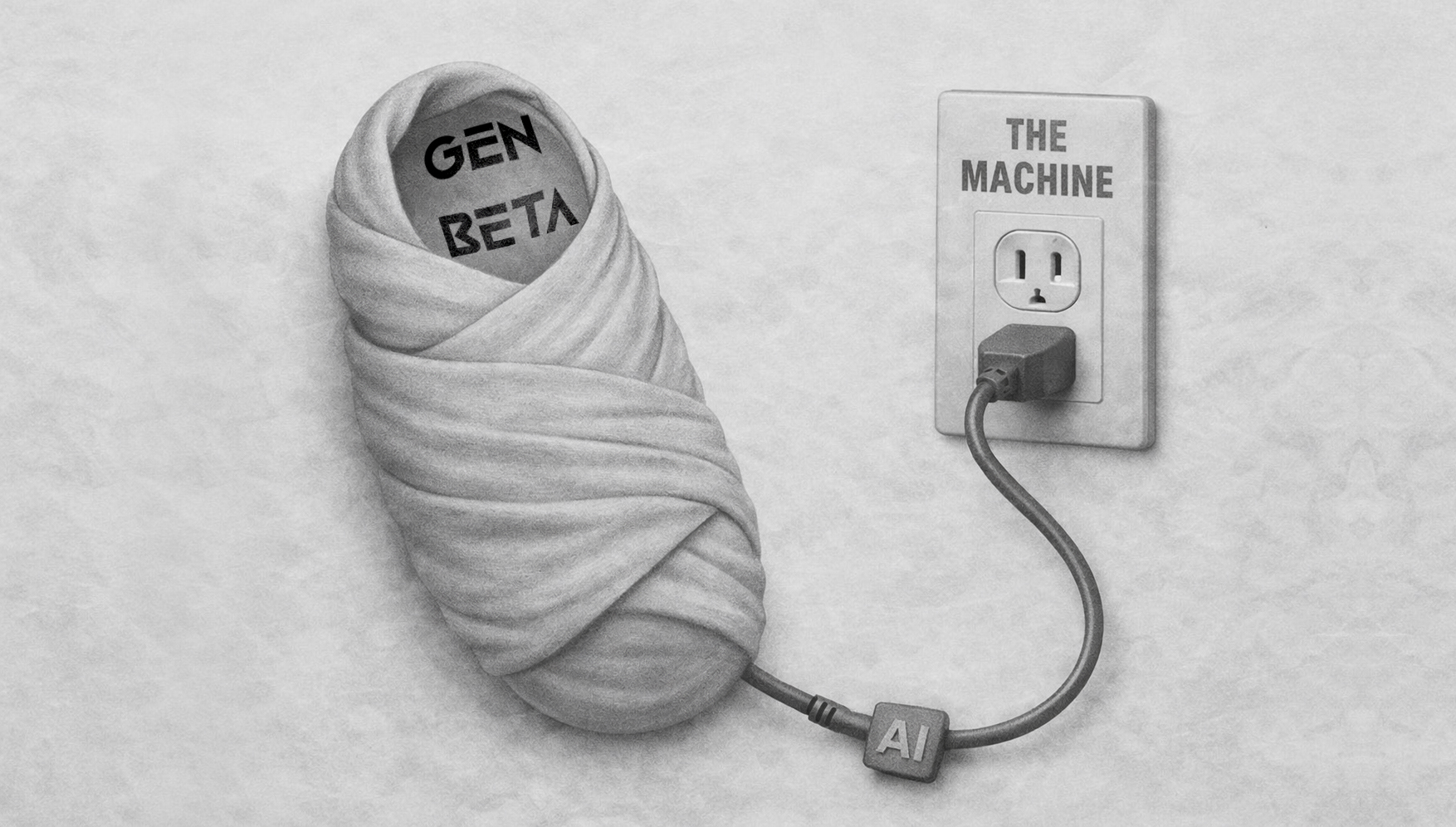
The Future is Born: Gen Beta has Arrived
The latest generational cohort, Gen Beta, was officially born on January 1, 2026, marking a new era and a new generation.
Read the full essayThe data behind this essay. Every figure traces to a source the essay cites. Hover any card to share it.
Generational shifts follow cultural tipping points, not calendar pages. Ryan Vet argues 2026 is the year AI stopped being something you use and became something you grow up inside of.
Henry Schamp was born at exactly midnight on New Year's Day in a suburban Philadelphia hospital, arguably the first official member of Gen Beta in the United States. Ryan is upfront that the label does not change a child's trajectory. A baby born at 11:59pm on December 31 inherits the same world.
He is wary of generational labels in general, not because they are useless but because they get treated like settled science. His Generational Prism framework runs Age, Moment, Label, in that order. The label is the output of a life stage colliding with the conditions of the moment, never the starting point. Start with the label and you end with stereotypes, as with the claim that Millennials were uniquely prone to job-hopping, when longitudinal data shows that by age 25, and even by 30, they had held only about 0.3 more jobs than late Boomers or Gen X.
So why 2026? Because generative AI crossed its tipping point. ChatGPT reached 100 million users roughly two months after its November 2022 launch, and by mid-2025 Pew found 58 percent of U.S. adults under 30 had tried it, with 38 percent of all U.S. adults using generative AI for work. More decisive for Ryan, the parents, educators, and institutional decision-makers shaping early Gen Beta are disproportionately Millennials, who are not merely trying AI but integrating it.
He grants the edges are fuzzy. Jean Twenge extends Gen Alpha closer to 2029, Mark McCrindle starts Gen Beta in 2025, and both positions are defensible. Ryan calls that overlap the Generational Blur, and says landing on 2026 is about shared language rather than being right.
Henry Schamp, born at exactly midnight on New Year's Day in suburban Philadelphia, is arguably the first official member of Gen Beta in the United States.
The Generational Prism runs Age, Moment, Label. The label is what happens when a life stage collides with the conditions of the world, not the starting point for analysis.
The job-hopping Millennial narrative does not survive the data. By age 25, and even by age 30, Millennials had held only about 0.3 more jobs than late Baby Boomers or Gen X.
ChatGPT reached 100 million users roughly two months after its November 2022 launch. By mid-2025, 58 percent of U.S. adults under 30 had tried it and 38 percent of all U.S. adults used generative AI for work.
2026 is the line because AI stops being something you occasionally use and becomes invisible infrastructure, something a child grows up inside of and increasingly dependent on.
Plain-language definitions for the ideas in this episode. Structured for search and AI answers.
Ryan Vet's framework for reading generations in the order Age, Moment, Label. A generation's label is the extrapolation of what happens when a person's life stage collides with the conditions of the moment, never the starting point.
In this episode: The frame Ryan sets before the Gen Beta mini-series begins.
The overlapping edge between two generational cohorts, where normalization happens unevenly across systems, families, and institutions instead of on a clean break.
In this episode: Why reasonable scholars put the Gen Alpha to Gen Beta line anywhere from 2025 to 2029.
The moment a technology's adoption moves from novelty to inevitability, past what Malcolm Gladwell called the magic third. Home internet crossed it around 1998 and smartphones around 2012.
In this episode: The standard Ryan applies to generative AI to land on 2026.
Lines worth keeping, verbatim from the episode.
Generational shifts tend to follow cultural tipping points, not calendar pages.
childhood is shaped by what the adult world normalizes
When we start with the label, we usually end with stereotypes, unhelpful generalizations, and false narratives.
Straight answers to the questions this essay raises. Open by default, structured for search and AI.
Why does Ryan Vet say Gen Beta begins in 2026? +
Ryan places the start of Gen Beta in 2026 because generational shifts follow cultural tipping points, not calendar pages. He argues that by the start of 2026, AI stopped being something you occasionally use and started becoming invisible infrastructure, while the Millennial and Gen Z parents shaping early Gen Beta are integrating AI rather than just trying it. He is clear the date is less about being right and more about shared language, even when the edges are fuzzy.
What is the Generational Prism framework? +
The Generational Prism is Ryan's framework built on a simple idea: Age - Moment - Label. It treats the label, like Baby Boomer or Gen Beta, as the output rather than the starting point, produced when a person's life stage collides with the conditions of the current moment. Ryan argues that when we start with the label instead, we usually end with stereotypes, unhelpful generalizations, and false narratives.
What does Ryan mean by the Generational Blur? +
The Generational Blur is Ryan's term for the messy, overlapping reality of how generations actually form. He explains that normalization does not happen overnight but unevenly across systems, families, and institutions, so one cohort shifts into the next rather than breaking cleanly. He points to Jonathan Haidt's range of 2010 to 2013 for the Gen Z to Gen Alpha turn as an example of a shift, not a sudden pivot.
What makes Gen Beta different from earlier generations? +
According to the essay, a generational label does not suddenly alter a child's trajectory, and a baby born January 1, 2026 does not face a fundamentally different future than one born minutes earlier. The real difference is the world Gen Beta is born into, where AI becomes invisible infrastructure you grow up inside of, attached to, and increasingly dependent on. Ryan warns that convenience has quietly replaced competence, reducing the friction and hands-on learning that are fundamental to growth.
Does Ryan Vet think generational labels are useful? +
Ryan often pushes back on generational labels, not because they are useless but because they are treated like settled science when they are really shorthand and often misused. His posture is that if we are going to use them, we should use them intelligently. He points to the decade-old claim that Millennials were uniquely prone to job-hopping, noting that by age 25 and even age 30 they had held only about 0.3 more jobs than late Baby Boomers or Gen X.

Full show notes
Gen Beta has arrived. At midnight on January 1, 2026, the world quietly crossed a generational threshold, and almost no one noticed.
In this episode, Ryan Vet breaks down why Gen Beta begins in 2026, what makes this generation fundamentally different from Gen Alpha and Gen Z, and why generational shifts don’t follow calendar pages; they follow cultural tipping points.
This isn’t speculation or trend-chasing. It’s a grounded, research-backed look at how artificial intelligence moved from novelty to invisible infrastructure, reshaping childhood, parenting, education, and leadership in ways we’re only beginning to understand.
You’ll learn:
Why Gen Beta is more than just a new generational labelHow AI adoption crossed a cultural tipping point—and why that matters for kids born in 2026What it means to grow up AI-native, not by choiceWhy convenience may be replacing competence—and the long-term implicationsHow Millennials and Gen Z parents are shaping a new era of childhoodWhy debates about when Gen Beta starts miss the bigger pointRyan also introduces the concept of Generational Blur—the messy, overlapping reality of how generations actually form—and explains why shared language matters, even when the edges are fuzzy.
If you’re a parent, educator, leader, futurist, or simply trying to understand what’s changing in the world, this episode sets the foundation for a deeper exploration of Gen Beta and the cultural forces shaping their future.
Gen Beta isn’t coming. They’re already here.
Send us Fan Mail
About Ryan VetRyan Vet is a USA TODAY bestselling author, futurist, and international keynote speaker whose insights on generations, culture, and the future of work have been featured in Forbes, Financial Times, ABC, NBC, and CBS. His research helps leaders understand emerging generational patterns and anticipate societal shifts before they fully unfold.
Join 20,000+ Leaders for Weekly InsightsIf you want deeper research and behind-the-scenes insights on generations and the future of culture and society, join Ryan’s weekly newsletter: 👉 https://ryanvet.com/collide